Rivian Spinout Also Abandons Kenya E-Moto Project to Focus on Autonomous Driving

Rivian spinout Also drops its Kenya e-moto project to prioritize autonomous driving.
Rivian spinout Also had quietly been advancing an electric motorcycle project in Kenya but ultimately shelved it. Co-founder and president Chris Yu said the company decided to prioritize autonomous driving technology rather than spread resources thin. The pivot reflects real trade-offs micromobility startups face in technology roadmaps and resource allocation: autonomous driving is seen as a foundational capability with a higher ceiling, while the Kenya e-moto project involves cross-border operations, local supply chains, and regulatory compliance, with low relevance to the core strategy. Also's exit adds uncertainty to Kenya's e-moto market and reminds entrepreneurs that emerging-market projects need a stronger independent business logic to survive.
Rivian's micromobility spinout Also had quietly been advancing an electric motorcycle project in Kenya, but the project was ultimately shelved. According to TechCrunch, Also co-founder and president Chris Yu said the company decided to prioritize autonomous driving technology. This strategic pivot reveals the real-world trade-offs micromobility startups face in technology roadmaps and resource allocation.
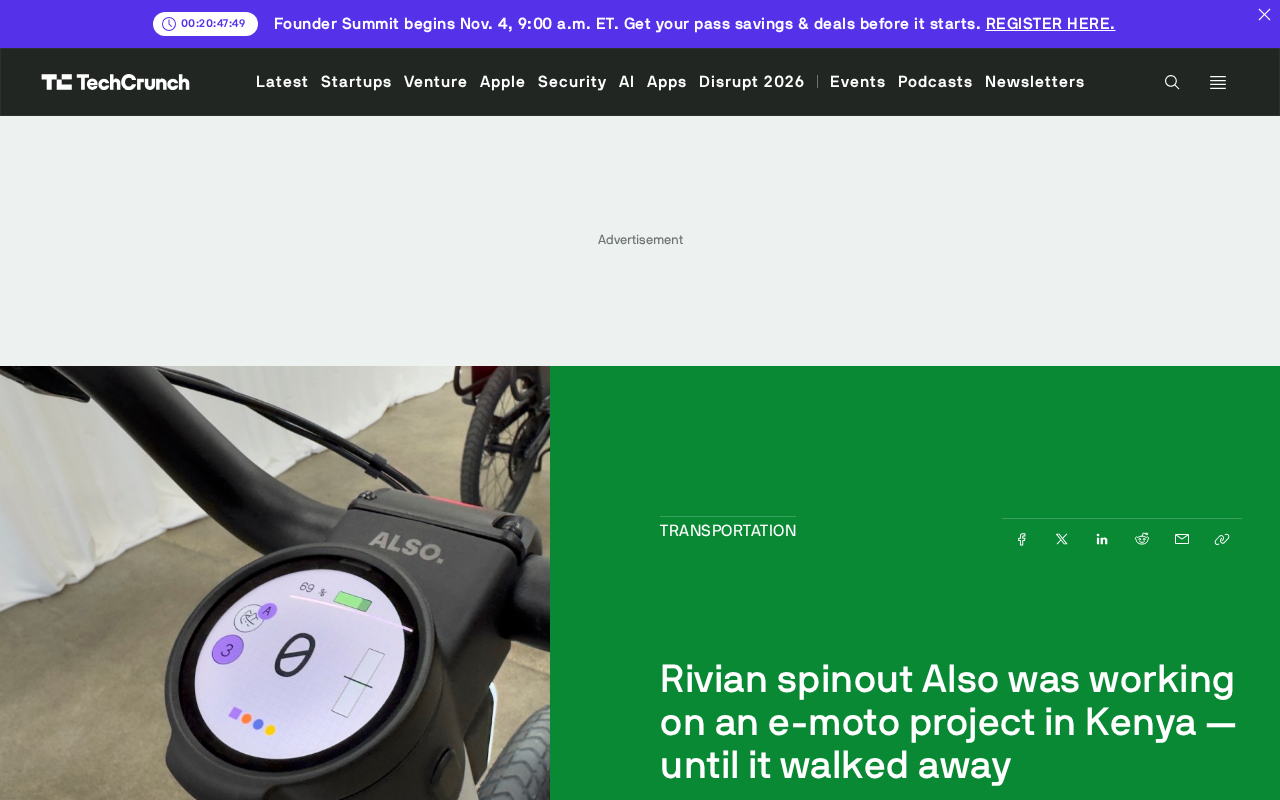
The Kenya E-Moto Project: Background and Context
Also was spun out of Rivian and focuses on micromobility solutions. The electric motorcycle project in Kenya was originally an attempt by the company to explore emerging markets. Electric motorcycles have potential demand in East Africa, where traffic congestion is severe and fuel costs are high, and electrification is seen as one path to improving travel efficiency. However, Also did not publicly disclose the specific progress or scale of the project. In explaining why it was abandoned, Chris Yu emphasized that the company wants to concentrate its efforts on autonomous driving technology rather than spread resources thin.
This decision means Also will narrow its front and channel limited engineering and funding into the autonomous driving space, which is more competitive but has a higher ceiling. For a company spun out of Rivian, combining autonomous driving with micromobility may be more imaginative, but it also faces challenges related to technology maturity and the regulatory environment.
Rivian is an American electric vehicle manufacturer known for electric pickups and SUVs, and it listed on Nasdaq in 2021. A "spinout" refers to a parent company carving out an internal business unit or project into an independent company, usually accompanied by independent financing and an operating team. Also's spinout from Rivian means it inherited Rivian's technical accumulation and brand endorsement in electric mobility, but it also needs to make strategic decisions independently and cannot fully rely on the parent company's resources. This spinout model is common in the tech industry; the goal is to give peripheral innovation projects more flexible mechanisms while allowing the parent company to focus on its core business.
The Strategic Logic of Prioritizing Autonomous Driving
Chris Yu's statement directly reflects Also's strategic priorities: autonomous driving is the core, and other exploratory projects can make way for it. Micromobility companies typically face long profitability cycles and high market education costs, while autonomous driving is regarded as a foundational capability for future transportation. Also's trade-off is not an isolated case—in recent years, many mobility startups have been adjusting their business boundaries, cutting peripheral projects to maintain cash flow and team focus.
From a technical synergy perspective, if Also can apply autonomous driving capabilities to micromobility vehicles, it may create differentiation. But the Kenya e-moto project has low relevance to autonomous driving and involves complex factors such as cross-border operations, local supply chains, and regulatory compliance. Abandoning it helps Also reduce management complexity.
Micromobility generally refers to travel modes using light vehicles (such as electric scooters, e-bikes, and electric motorcycles) for trips of less than 5 kilometers. The concept became popular around 2018 with the shared scooter boom and was seen as a solution to the urban "last mile" problem. However, micromobility companies generally face challenges such as unit economics that are difficult to make work, high vehicle wear and tear, and regulatory uncertainty, resulting in long profitability cycles. By contrast, autonomous driving is seen as a more platform-like foundational technology that, once mature, can be applied to multiple scenarios, making it more attractive to capital and entrepreneurs. Also's shift of resources from micromobility projects to autonomous driving is precisely based on the differences between the two in scale effects and technical barriers.
Impact on the Micromobility Industry
Also's exit leaves a question mark over Kenya's e-moto market. The adoption of electric motorcycles in Africa is still at an early stage and requires companies to invest in infrastructure and after-sales service. The fact that a company with Rivian backing once entered this space shows that capital has had interest in African micromobility, but changes in strategic priorities may make such explorations more cautious.
For entrepreneurs and investors focused on micromobility, Also's case is a reminder: the business boundaries of technology companies often shift with core goals, and projects in emerging markets need a stronger independent business logic to survive. The abandonment of the Kenya e-moto project does not mean local demand has disappeared; rather, it shows that in the face of hot tracks such as autonomous driving, peripheral innovation can easily become a casualty.
Background
The electric motorcycle market in Kenya and East Africa has a unique context. The locally common boda boda (motorcycle taxi) is an important source of employment and mobility, but fuel costs are high and pollution is serious. In recent years, several startups (such as Roam and Spiro) have tried to promote electric motorcycles and have adopted battery-swapping models to lower the purchase threshold. However, the market still faces obstacles such as insufficient charging infrastructure, supply chains dependent on imports, and financing/leasing models that remain to be validated. Also's exit does not mean demand has disappeared; instead, it reflects that multinational companies need to weigh strategic priorities against local operational complexity when evaluating emerging markets. For the local market, the entry and exit of external companies will directly affect the competitive landscape and capital confidence.
One-line Summary
Rivian spinout Also abandons its Kenya e-moto project to prioritize autonomous driving.
Related articles

9 AI Subscription Plans Compared: The Real Cost Per 100M Tokens Revealed
Bilibili creator tests 9 AI subscription plans from Volcano, Alibaba, Tencent, Baidu, Zhipu, Xiaomi, MiniMax and more, converting them all to real cost per 100M tokens, breaking down fixed-quota vs. three-tier coefficient billing and how caching, time-of-day discounts, and window limits affect actual quota.

Vibe Coding for Beginners: Expressing Intent Instead of Handwriting Code
What is Vibe Coding? A 137-episode Bilibili course defines it: the core is expressing intent, not writing code. This article analyzes Vibe Coding's productivity logic, target audience, and entry expectations to help beginners decide if it's worth learning.

LangChain Beginner's Guide: An Agent Development Roadmap from LangGraph to Deep Agents
Clarify the encapsulation relationship among LangChain, LangGraph, and Deep Agents, and master the learning path and selection logic for agent development frameworks—suitable for beginners in large model development.