RoboKit: GPU-Parallel Differentiable Optimization Accelerates Robot Learning
RoboKit connects optimization and learning with a parallel differentiable optimization toolkit, achieving 2-60x speedups and 9-240x faster policy inference.
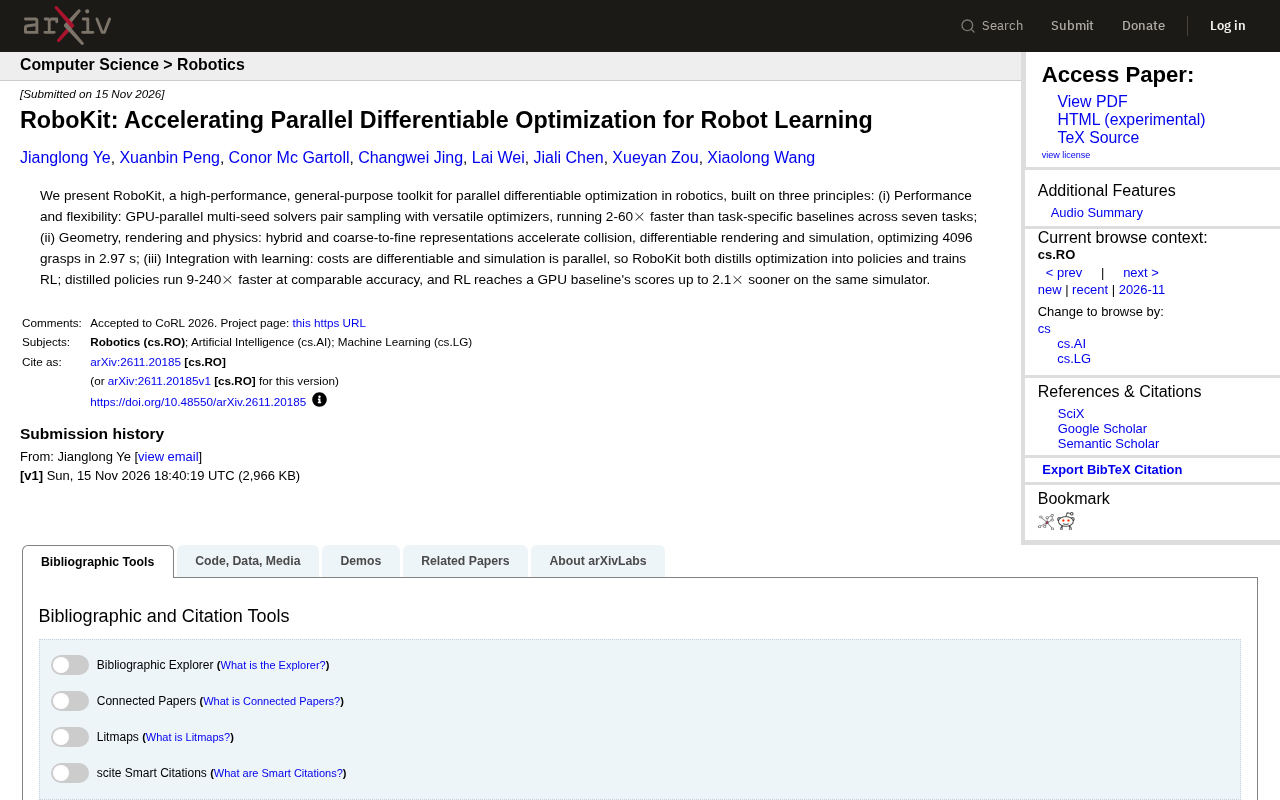
RoboKit is a high-performance parallel differentiable optimization toolkit for robot learning, addressing the tension between accurate-but-slow optimization and fast-but-sample-inefficient RL. Built on three pillars—GPU-parallel multi-seed solvers 2-60x faster than specialized baselines on seven tasks; hybrid and coarse-to-fine representations that optimize 4096 grasp poses in 2.97s; and deep learning integration that distills optimization into policies with 9-240x faster inference—it serves as a general-purpose acceleration substrate for researchers and a deployment-efficiency tool for engineering teams.
Robot learning has long faced a tension: optimization methods are accurate but slow, while reinforcement learning is fast but sample-inefficient. RoboKit aims to break this deadlock with a high-performance, general-purpose parallel differentiable optimization toolkit. It is built around three core ideas: performance and flexibility, geometry rendering and physics, and deep integration with learning algorithms. According to its paper, the toolkit achieves 2-60x speedups over specialized baselines on multiple tasks, and distills the optimization process into policies, boosting policy inference speed by 9-240x.

Performance and Flexibility: GPU-Parallel Multi-Seed Solvers
RoboKit's first pillar is performance and flexibility. It pairs sampling with a variety of optimizers and runs multi-seed solving in parallel on the GPU. This design lets a single toolkit adapt to different tasks without hand-writing a specialized solver for each one. Across tests on seven tasks, RoboKit ran 2-60x faster than task-specific baselines.
The significance of multi-seed parallelism is that robot optimization problems often have local optima, and a single seed easily gets trapped in suboptimal solutions. GPU parallelism lets a large number of seeds explore simultaneously, improving solution quality while amortizing the cost of each solve through batching. At the same time, the toolkit preserves optimizer replaceability, so users can choose different sampling and optimization combinations based on problem characteristics, balancing out-of-the-box usability with deep customization.
Differentiable Optimization refers to designing the solving process of an optimization problem (such as trajectory optimization or grasp pose solving) itself as a differentiable computation graph. In this way, the gradients of the optimization layer's output with respect to input parameters (such as cost function weights or initial states) can be backpropagated, seamlessly connecting with neural network training. Traditional optimization solvers (such as sampling-based or gradient-descent black-box methods) are often non-differentiable and hard to embed in end-to-end learning pipelines. RoboKit implements optimizers as differentiable modules, making it possible to "supervise policies with optimization results" or "backpropagate gradients through the optimization layer in RL." This is the technical foundation of its policy distillation and integrated learning.
Geometry, Rendering, and Physics: Hybrid Representations Accelerate Simulation
The second pillar focuses on geometry, rendering, and physics computation in robot simulation. RoboKit adopts hybrid representations and coarse-to-fine representations to accelerate collision detection, differentiable rendering, and physics simulation. One intuitive example: it can optimize 4096 grasp poses in 2.97 seconds.
Grasp optimization is a classic problem in robot manipulation, involving a large amount of collision detection and rendering computation. In traditional pipelines, each candidate pose must be evaluated separately, and time grows linearly with the number. Through coarse-to-fine representations, RoboKit first quickly screens at low resolution, then finely evaluates promising candidates, and with GPU parallelism compresses this process to seconds. This acceleration comes not only from hardware but also from algorithm-level representation design.
Coarse-to-fine representation is a multi-resolution computation strategy: first use a low-precision, low-cost representation to quickly screen candidate solutions, then use a high-precision representation to finely evaluate the small number of candidates that pass. In robot simulation, this typically manifests as hierarchical geometric representations (such as bounding boxes, voxels, and meshes) or progressive rendering resolution. Its advantage is concentrating computation on promising candidates and avoiding expensive computation on large numbers of clearly poor candidates. Combined with GPU parallelism, the coarse stage can process thousands of candidates in batch, while the fine stage handles only the few winners, greatly reducing average computation while maintaining accuracy. RoboKit uses exactly this idea in grasp optimization, evaluating 4096 poses in 2.97 seconds.
Integration with Learning: Distilling Optimization into Policies and Training RL
The third pillar is integrated learning. Because the cost functions in RoboKit are differentiable and the simulation itself is parallel, it can both distill the optimization process into policies and be used directly for reinforcement learning training. The distilled policies, while maintaining similar accuracy, run 9-240x faster than the original optimization process. And on the same simulator, training RL with RoboKit can reduce the time needed to reach the GPU baseline score by up to 2.1x.
The value here lies in closing the loop between optimization and learning. Optimizers can produce high-quality solutions but are often too slow at inference time; policy networks infer quickly but require large amounts of data for training. RoboKit connects the two with differentiable simulation and parallel optimization: first use optimization to generate high-quality demonstrations, then distill them into policy networks, or directly use parallel simulation to accelerate RL sampling. For robot applications requiring real-time response, this "slow optimization, fast policy" path is especially practical.
Policy Distillation is a technique for compressing a complex, slow solving process (such as online optimization) into a fast neural network policy. Specifically: first use an optimizer to generate high-quality solutions across many scenarios as "teacher signals," then train a policy network (student) to imitate these solutions. The distilled policy requires only a single forward pass at inference time, avoiding the latency of iterative optimization, so speed can improve by tens to hundreds of times. The cost is possible loss of some accuracy, but in practice performance often remains within an acceptable range. RoboKit leverages its differentiable simulation and parallel optimization to efficiently generate demonstration data, making the distillation pipeline itself fast, thereby enabling a "slow optimization, fast policy" deployment path.
Multi-Source Perspectives and Positioning
From public information, RoboKit is positioned as a general-purpose toolkit rather than a single-task solution. It covers grasping, rendering, simulation, and RL training simultaneously, emphasizing differentiability and parallelism as unifying abstractions. Compared with many works that solve only a single component, this full-stack approach lowers the cost of switching between different tools. However, generality also means it may not match highly specialized solutions on specific tasks, and the 2-60x speedup range in the paper suggests that gains vary considerably across tasks.
For robot learning researchers, RoboKit provides a reusable acceleration substrate; for engineering teams, distilled policies and accelerated RL training directly affect deployment efficiency. Its future development is worth watching, especially scalability in more complex scenarios and transfer performance on real robots.
One-line Summary
RoboKit connects optimization and learning with a parallel differentiable optimization toolkit, achieving 2-60x speedups and 9-240x faster policy inference.
Paragraph Summary
RoboKit is a high-performance parallel differentiable optimization toolkit for robot learning, aimed at resolving the tension between accurate-but-slow optimization and fast-but-sample-inefficient reinforcement learning. It is built around three pillars: GPU-parallel multi-seed solvers that are 2-60x faster than specialized baselines on seven tasks; hybrid and coarse-to-fine representations that accelerate collision detection, differentiable rendering, and physics simulation, optimizing 4096 grasp poses in 2.97 seconds; and deep integration with learning, distilling the optimization process into policies with 9-240x faster inference at similar accuracy, while parallel simulation reduces the time for RL training to reach baseline scores by up to 2.1x. Positioned as a general-purpose toolkit, it emphasizes differentiability and parallelism as unifying abstractions, providing researchers with a reusable acceleration substrate and engineering teams with deployment efficiency.
Related articles

David Fincher's New Film Accused of Being AI-Generated? The Truth Behind the Controversy
David Fincher's new film *The Further Misadventures of Cliff Booth* is accused of using AI, with a carriage shot in the trailer sparking controversy. Netflix's acquisition of Ben Affleck's AI company and Fincher's own openness to AI keep suspicions alive. This article sorts out the controversy and the views of all sides.

FCC Clears SpaceX's Space-Based AI Data Centers: A Debate Over Regulatory Boundaries
The FCC approved SpaceX's plan to deploy AI data centers in space but dismissed opponents' key concerns about scientific research impacts as beyond its regulatory authority. This article analyzes the regulatory boundary issues behind the decision, the deeper tensions of space-based AI infrastructure, and its implications for the industry.

Why Are Latinos Nearly Half of the U.S. Border Patrol?
Latinos hold nearly half of the U.S. Border Patrol and about 30% of ICE. Vox's Khalil Green explores their motivations, identity tensions, and why enforcement work ≠ MAGA.