Robotics & RL Control Code Verification: Decision-Making Methods from Simulation to Deployment

A comprehensive look at how robotics engineers verify control code from simulation to real-world deployment.
This article explores how robotics and RL engineers make critical go/no-go decisions when deploying new control code. It covers statistical aggregation of simulation results, layered verification pipelines from unit tests to hardware-in-the-loop testing, strategies for bridging the Sim-to-Real gap, and the growing need for standardized verification methodologies as learning-based control policies become widespread in industry.
Control Code Verification: A Critical Yet Overlooked Step
In the field of robotics and reinforcement learning (RL), engineers iterate daily on various control algorithms—balancing algorithms, steering laws, gain parameters, and even end-to-end learned policy networks. As an important branch of machine learning, reinforcement learning's core idea is to let an agent learn optimal behavioral strategies through interaction with the environment, guided by reward or penalty signals. Unlike supervised learning, RL doesn't rely on labeled data but instead explores autonomously through trial and error. In robotics control, "end-to-end learned policy networks" refer to deep neural networks that map directly from sensor inputs (such as vision and torque information) to actuator outputs (such as joint angles and motor torques), bypassing the traditional steps of manually designing state machines and control laws. This approach has shown enormous potential in tasks like dexterous manipulation and complex terrain locomotion, but it also introduces verification challenges such as poor interpretability and unpredictable behavior.
However, once a new version of control code is completed, a seemingly simple yet critically important question emerges: How do we confirm that this new version is truly better than the old one and worthy of deployment?
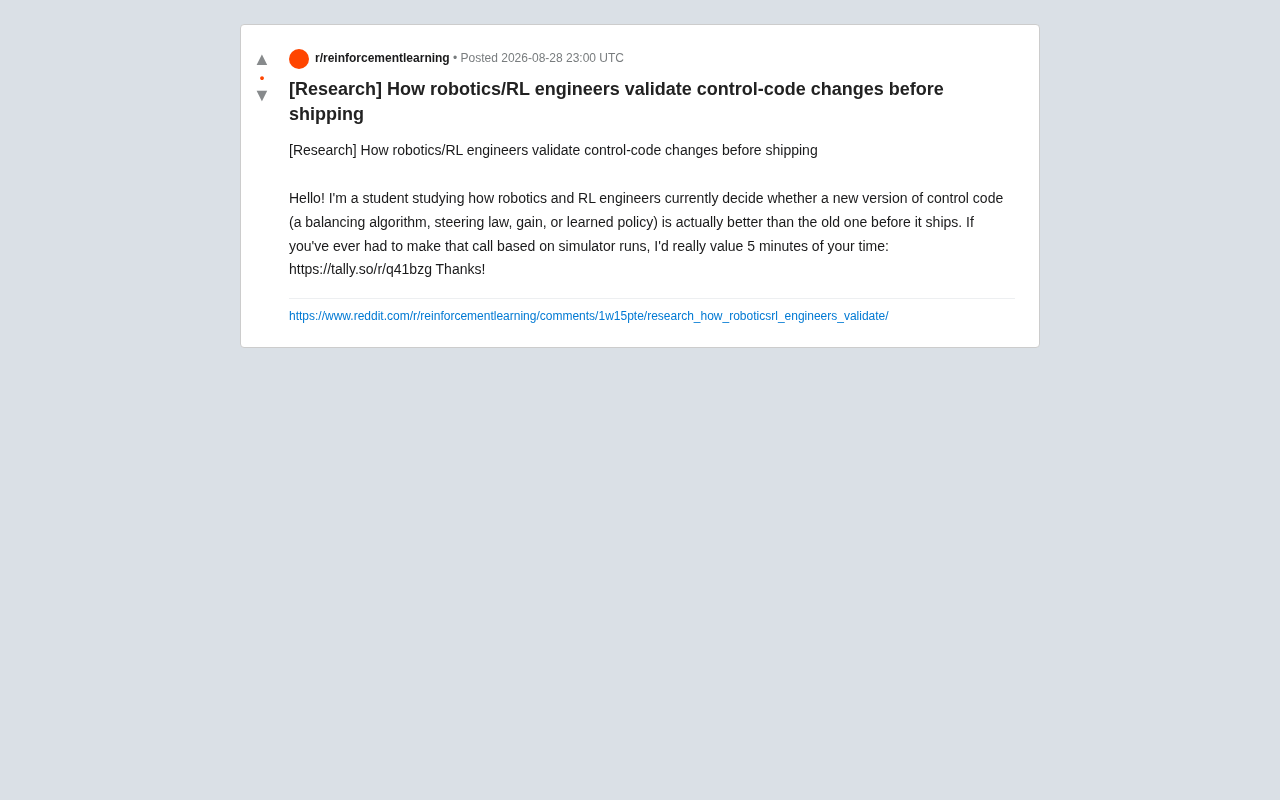
Recently, a researcher focused on this problem launched a survey on Reddit, aiming to clarify how robotics and RL engineers actually make the "go/no-go" release decision in practice. This research focuses on a long-standing pain point that has rarely been discussed systematically: version comparison and release judgment based on simulation run results.
Why Is Judging "Better" So Difficult?
For traditional software, we have mature verification systems including unit tests, integration tests, and regression tests. After code changes, you run the test suite, and if all lights turn green, you can merge and release. But the verification logic for control code and learned policies is fundamentally different.
Uncertainty in Simulation Results
Robot control policies often need to be evaluated through repeated runs in simulation environments. However, simulation has inherent randomness—initial state perturbations, sensor noise, environmental parameter variations, and other factors cause the same code to produce varying results across different runs. This means a single simulation score can hardly serve as a reliable basis for judgment.
From a technical perspective, the "random seed" in simulation controls the initial state of the pseudo-random number generator, and different seeds produce different sequences of environmental perturbations and sensor noise samples. This is essentially an application of the Monte Carlo method—estimating the statistical distribution of policy performance through large-scale random sampling. Common industry practice is to run hundreds or even thousands of simulations, then use statistical tools like Bootstrap methods or Welch's t-test to determine whether performance differences between two policy versions are statistically significant. However, there's a practical trade-off between simulation computational cost and statistical precision: more runs yield more precise estimates but also consume more computational resources and time.
Engineers must answer the following questions:
- How many simulation runs are needed to reach statistically meaningful conclusions?
- What metrics define "better"? Mean reward, success rate, stability margin, or worst-case performance?
- Is the performance difference between old and new versions a real improvement or an illusion created by random noise?
Sim-to-Real Gap: The Chasm Between Simulation and Reality
Even more challenging is the fact that policies performing excellently in simulation may not replicate on real hardware. Simulation environments cannot perfectly model real-world friction, latency, material deformation, and sensor defects.
The technical root of the Sim-to-Real Gap lies in the limited modeling accuracy of physics simulation engines (such as MuJoCo, Isaac Sim, PyBullet, etc.). Rigid body contact models struggle to precisely simulate flexible material deformation, friction coefficients are highly nonlinear and state-dependent in real environments, and sensor quantization errors, latency, and drift are difficult to fully model. To address this, researchers have developed multiple techniques: Domain Randomization enhances policy robustness by widely randomizing physical parameters in simulation; Domain Adaptation attempts to learn the mapping between simulation and reality; System Identification calibrates simulation parameters using real data to narrow the gap. OpenAI's Rubik's Cube solving robot and Boston Dynamics' Atlas humanoid robot have both confronted and attempted to solve this problem to varying degrees.
Therefore, even when a new version "looks better" in simulation, engineers must carefully assess whether this advantage can transfer to physical systems.
Commonly Used Control Code Verification Methods in Practice
From an industry practice perspective, engineers typically combine multiple approaches to reduce release risk.
Statistical Aggregation Across Multiple Simulations
To combat randomness, mature teams typically run batch simulations across multiple random seeds and initial conditions, then compute statistics on key metrics including mean, variance, and confidence intervals. Some teams adopt an A/B comparison approach, having old and new policies compete on identical test sets to eliminate interference from environmental differences.
Layered Verification Pipeline
A typical verification chain follows a pyramid-style progression:
- Unit-level verification: Validating the mathematical correctness of control laws, such as stability analysis and boundary condition testing;
- Simulation-level verification: Evaluating policy robustness across large-scale randomized scenarios;
- Hardware-in-the-Loop (HIL) testing: Connecting control code to partial loops of real sensors and actuators;
- Constrained real-world testing: Limited-scope trial runs in safe, controlled physical environments;
- Full deployment: Pushing to production only after passing all preceding gates.
Among these, Hardware-in-the-Loop (HIL) testing is a critical verification step between pure software simulation and full real-hardware testing, widely used in aerospace, automotive electronics, and robotics. In HIL testing, the control algorithm runs on the target hardware (or equivalent processor) while interacting with simulated sensor signals and actuator models through interfaces. This approach can expose issues undiscoverable in pure simulation, such as insufficient control frequency due to computational latency, precision loss from fixed-point arithmetic, and timing issues with communication buses (such as CAN, EtherCAT). Companies like dSPACE and National Instruments offer mature HIL testing platforms, while ROS 2's real-time capabilities and hardware abstraction layer are also driving the standardization of HIL testing in robotics.
Focusing on Worst-Case Rather Than Average Performance
For safety-critical robotic systems, engineers are often more concerned with a policy's floor performance. A policy with high average scores but occasional catastrophic failures may be far less desirable than a stable but mediocre one. Therefore, tail risk assessment carries extremely high weight in release decisions.
The concept of tail risk originates from financial risk management theory, referring to risks arising from the tails of probability distributions (i.e., extreme events). In robotics control, this corresponds to policy performance under rare scenarios such as sudden external force impacts, complete sensor failure, or extreme environmental conditions. Common metrics for evaluating tail risk include: Conditional Value at Risk (CVaR), which represents the average performance of the worst certain percentage of runs; worst-case analysis; and Adversarial Testing, which actively searches for scenarios that cause policy failure to assess vulnerability. In safety-critical systems, international standards such as IEC 61508 (functional safety) and ISO 13482 (personal care robot safety) impose explicit requirements on system failure probabilities and risk mitigation measures, and these standards are gradually extending to learning-based control systems.
The Value of This Survey: Filling the Methodology Gap
The researcher's motivation for launching this survey is precisely to systematically capture engineers' real decision-making psychology and workflows. Currently, the field lacks a standardized "control code verification" methodology, and many decisions rely on personal experience and team conventions.
By collecting frontline engineers' practical feedback, this type of research has the potential to answer several core questions:
- To what extent do engineers trust simulation results?
- What quantitative metrics do they use for release decisions?
- What iterations and compromises exist between simulation and real-hardware deployment?
- What gaps exist in current toolchains for the verification process?
Implications for the Robotics & RL Industry
As RL and learning-based control policies are increasingly applied in robotics, autonomous driving, and industrial automation, the standardization of policy verification is becoming an urgent engineering gap to fill.
Traditional MLOps (Machine Learning Operations) focuses on pipeline automation for model training and deployment, covering data version management, training automation, continuous integration/continuous deployment (CI/CD), model monitoring, and more, with common tools including MLflow, Kubeflow, Weights & Biases, etc. However, lifecycle management for robotics control policies faces unique challenges: policy "testing" isn't simple input-output validation but requires long-duration runs in complex dynamic environments; "deployment" means code will directly control physical hardware, where errors can cause equipment damage or personal injury; "monitoring" requires real-time analysis of high-frequency control data streams rather than offline metrics. Consequently, the industry is exploring specialized frameworks like "RobotOps" or "ControlOps" that incorporate simulation evaluation, safety constraint verification, and progressive deployment (such as canary releases to partial robot fleets) into automated pipelines. NVIDIA's Isaac platform and Google DeepMind's robotics research infrastructure are both evolving in this direction.
It's foreseeable that more tools and standards for control policy verification will emerge in the future—ones that combine statistical rigor with alignment to engineers' actual work rhythms. This seemingly niche survey actually touches on a critical piece of robotics engineering's journey toward maturity and scale.
If you're an engineer working in robotics or RL, participating in this type of research not only contributes your experience but also helps drive the entire field toward more reliable verification consensus.
Related articles

Chain of Thought Isn't Just for AI: How Humans Can Use CoT to Improve Thinking Quality
Chain of Thought isn't just a prompt trick for large models. Starting from a Hacker News discussion, this article analyzes why CoT works for human thinking too, breaks down actionable ways to transfer it, and highlights the key differences between human CoT and machine CoT.
Cloudflare Teams Up with OpenAI: Closi…
Cloudflare Teams Up with OpenAI: Closing the Loop from Vulnerability Discovery to Defense with AI
Cloudflare uses OpenAI Daybreak to investigate security vulnerabilities and generate reviewable remediation plans, while developers use Codex to boost coding efficiency and quality.

Orca Multi-Agent Orchestration in Practice: A Guide to Parallel Collaboration with Claude and Codex
Orca is Stable AI's free open-source agent workbench supporting 34 agents like Claude Code and Codex in parallel. Learn its Git worktree isolation, multi-model orchestration, and mobile management.