Rodeo: A Free AI Meeting Notes Alternative to Notion
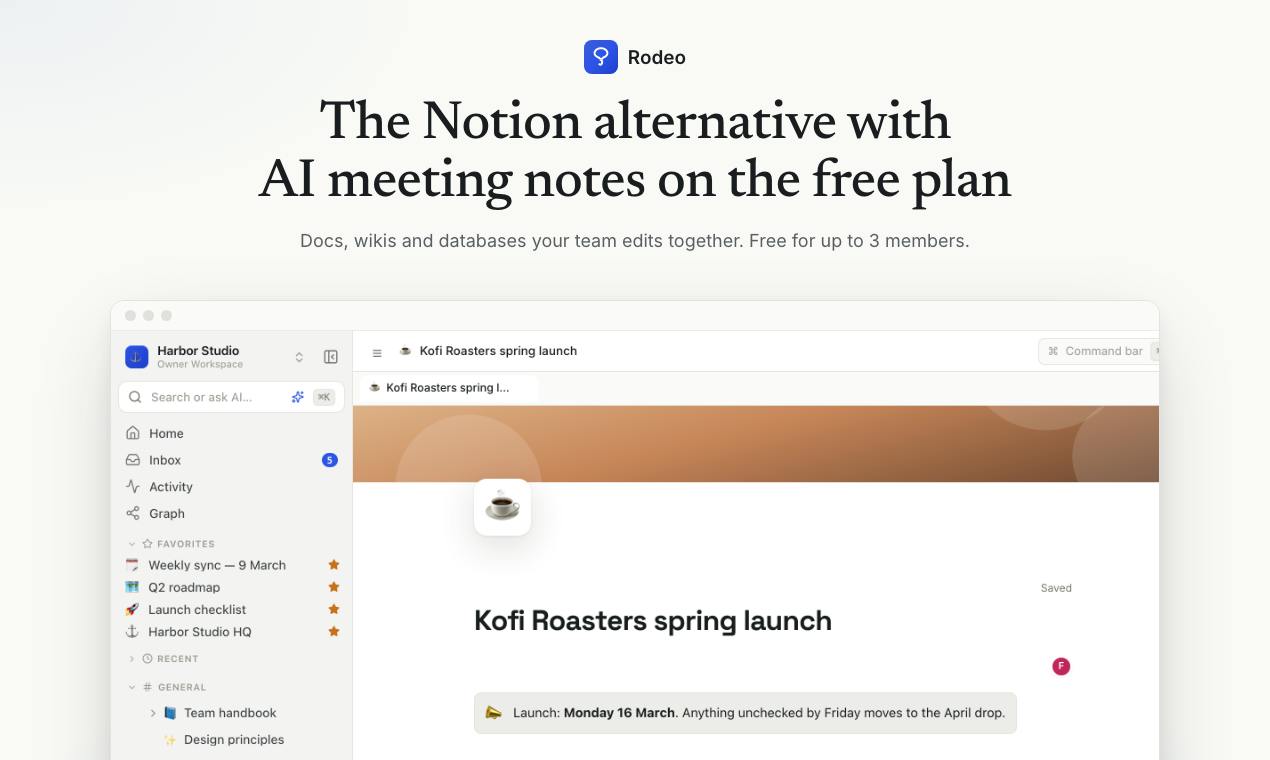
Rodeo challenges Notion with free AI meeting notes and a built-in MCP server.
Rodeo is a real-time collaborative team workspace positioned as a Notion alternative, combining docs, wikis, and databases. Its key selling point is making AI meeting notes (transcription, summaries, decisions, task extraction) standard across all plans, including the free tier—rare in a market where AI is usually a paid add-on. It also offers Ask AI, an AI canvas, a built-in MCP server for external AI toolchains, and Notion import to lower migration costs. It suits budget-conscious small teams wanting AI meeting features, but ecosystem maturity and third-party integrations still need time to develop.
A New Choice for Collaborative Workspaces
Rodeo is a team workspace built around real-time collaboration, positioned as a Notion alternative, and it received 70 upvotes on Product Hunt. It integrates documents, wikis, and databases, allowing team members to edit content simultaneously. Unlike many products that put AI features behind a paywall, Rodeo makes AI meeting notes a standard feature across all plans, including the free tier.
AI Meeting Notes: The Core Selling Point of the Free Plan
Rodeo's AI meeting notes provide transcription, summaries, decision records, and action item extraction. For small teams on a tight budget, this means getting a meeting productivity tool without an additional subscription.
According to the official description, AI meeting notes are available on every plan tier, and the free version includes the full feature set. This is relatively rare in the current collaboration tool market—most competitors treat AI capabilities as a paid upgrade.
AI meeting notes generally refer to a category of automated meeting recording tools: they use speech recognition to transcribe meeting audio into text (transcription), then use large language models to generate structured summaries, and extract key decisions and action items from them. The value of these tools lies in turning unstructured conversation into searchable, trackable team assets, reducing the cost of manual post-meeting organization. Common standalone products on the market include Otter.ai, Fireflies.ai, Granola, and others, most of which charge by seat or by duration. By building this capability into the workspace and making it available on the free plan, Rodeo essentially turns meeting notes from a "standalone subscription tool" into a "basic feature of the workspace," which is also the core of its differentiated positioning.
More Than Meetings: Ask AI and AI Canvas
In addition to meeting notes, Rodeo also offers an Ask AI feature that lets users ask the AI questions directly within the workspace. The AI canvas provides teams with a visual collaboration space, suitable for brainstorming and organizing ideas.
Together, these features make Rodeo more than a document tool—it is closer to a lightweight collaboration hub with integrated AI assistance.
Built-in MCP Server: A Bonus for Developers
Rodeo has a built-in MCP (Model Context Protocol) server, which means it can integrate with AI toolchains that support MCP. For technical teams, this opens a door: data within the workspace can be securely accessed and used by external AI agents.
This design approach follows the current trend of interconnection in the AI tool ecosystem, and it also gives Rodeo a degree of technical differentiation among similar products.
MCP (Model Context Protocol) is an open protocol proposed by Anthropic at the end of 2024, aimed at establishing a standardized way to connect AI models with external data sources and tools. You can think of it as the "USB-C interface of the AI world": previously, every AI application that wanted to connect to a database or service needed to write separate integration code; with MCP, as long as the server implements the protocol, any MCP-compatible client (such as Claude Desktop, various AI IDEs, or agent frameworks) can access it in a plug-and-play manner. The protocol uses a client-server architecture, where servers expose resources, tools, and prompt templates, and include built-in permission and user confirmation mechanisms to prevent AI from reading or writing data without authorization. For Rodeo, a built-in MCP server means that documents and databases within its workspace can become "context sources" callable by AI agents—this is a key architectural difference between it and traditional collaboration tools.
Migrating from Notion
Rodeo supports importing content from Notion. For teams considering a migration, this lowers the switching cost. Combined with the AI meeting notes available on the free plan, Rodeo has a certain appeal for price-sensitive small teams that want to adopt AI features quickly.
However, as a new product, Rodeo still needs time to build up ecosystem maturity and the richness of third-party integrations. Whether its actual experience can match Notion's smoothness also remains to be verified by more users.
Who Should Try Rodeo
If your team is looking for a collaboration space with AI meeting notes and does not want to pay extra for AI features, Rodeo is worth adding to your shortlist. This is especially true for teams that are already hesitant about Notion's pricing strategy and also need basic meeting recording capabilities.
However, for users who rely heavily on the Notion ecosystem (such as complex database relationships and a large number of third-party integrations), feature coverage should be carefully evaluated before migrating.
One-line Summary
With free AI meeting notes and a built-in MCP server, Rodeo challenges Notion's position in collaborative workspaces.
Paragraph Summary
Rodeo is a team workspace focused on real-time collaboration, positioned as a Notion alternative that combines documents, wikis, and databases. Its biggest selling point is making AI meeting notes (transcription, summaries, decision records, task extraction) a standard feature across all plans, with the free version fully usable as well—something relatively rare in a collaboration tool market where AI capabilities are commonly treated as paid add-ons. The product also offers Ask AI, an AI canvas, and a built-in MCP server for connecting to external AI toolchains, while supporting Notion imports to reduce migration costs. The article argues that Rodeo is suitable for small teams with limited budgets that want to quickly adopt AI meeting features, but it still needs time to build ecosystem maturity and third-party integrations, and users who rely heavily on the Notion ecosystem should carefully evaluate before migrating.
Related articles
The Other Side of Anthropic's IPO: The Trillion-Dollar Loss Illusion and the 2008 Specter Hiding in AI Debt
Anthropic's IPO sparks fierce debate: headlines show a $104B loss over nine months, yet adjusted operating profit hit $4.1B. This article unpacks the accounting magic in the S-1, the $900B compute commitment, four future scenarios, and why AI data center debt is being compared to the 2008 subprime crisis.

Anthropic's $1.4 Trillion IPO Bid: Explosive Revenue Growth and a Massive Compute Bet
Anthropic races toward an IPO at up to a $1.4 trillion valuation, with revenue surging from $41M to $17B a quarter—but $895B in compute commitments and unproven margins pose huge risks. This analysis breaks down its business, finances, and IPO pricing logic.

Anthropic's $1.4 Trillion IPO: The $400 Billion Compute Bill Hiding a Two-Way Trap
Anthropic races toward a $1.4 trillion IPO, but its prospectus reveals over $400 billion in fixed compute commitments against usage-based revenue that customers can cut at any time.