Roland Launches Melody Flip: How a Generative AI Music Plugin Empowers Professional Creators
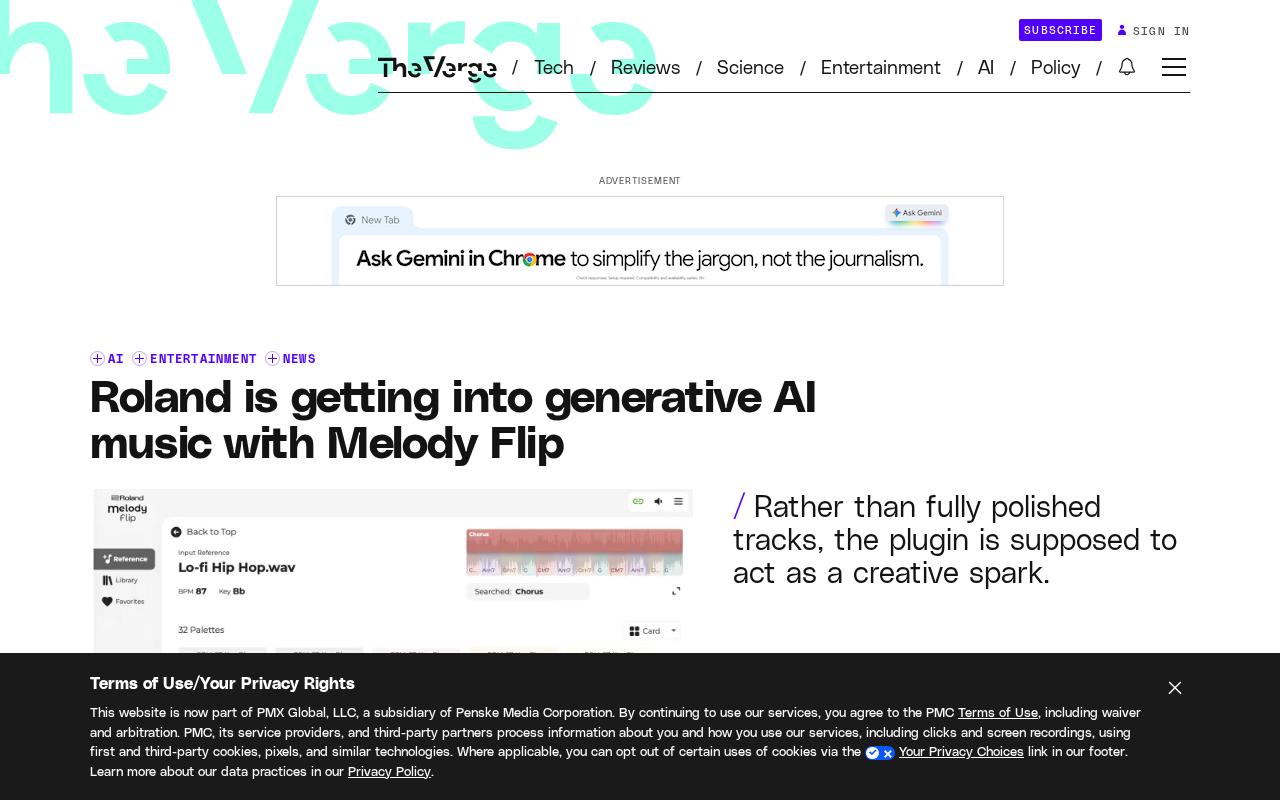
Roland launches Melody Flip, a generative AI DAW plugin designed to assist — not replace — professional music creators.
Roland has entered the generative AI music space with Melody Flip, a DAW plugin offering 250 genre-based "palettes" to inspire professional creators. Unlike Suno's one-click song generation, Melody Flip provides editable musical material within existing workflows, keeping creative control with the musician. The move signals that legacy music tech companies are seriously embracing AI, while Roland's assistive approach also helps navigate ongoing copyright and ethical challenges in AI-generated music.
Roland Officially Enters the Generative AI Music Arena
As a longstanding giant in the electronic instrument space, Roland has officially entered the generative AI music arena. The company's recently launched Melody Flip tool marks a pivotal moment for a brand renowned for its synthesizers, drum machines, and digital pianos, as it embraces today's hottest AI-powered creative technology.
Roland Corporation was founded in 1972 by Ikutaro Kakehashi in Osaka, Japan, and boasts multiple milestone contributions to electronic instrument history. Its TR-808 drum machine profoundly shaped the rhythmic aesthetics of hip-hop and electronic music. The TB-303 bass synthesizer unexpectedly gave birth to the Acid House genre. The Jupiter-8 and Juno-106 synthesizers defined the iconic sounds of 1980s pop music. Perhaps most importantly, Roland was one of the core drivers behind the MIDI (Musical Instrument Digital Interface) communication protocol standard, which has served as the foundation for electronic instrument interoperability since its introduction in 1983. In recent years, Roland has been actively pursuing digital transformation through its Roland Cloud platform, and the launch of Melody Flip can be seen as a natural extension of its cloud strategy into the AI domain.
That said, Melody Flip is not a "push a button, get a full song" tool like Suno. It's more of an assistive engine designed for professional creators, running as a plug-in within the user's digital audio workstation (DAW). This distinction in positioning reveals Roland's unique take on AI music: AI should not replace creators — it should serve as a partner that sparks inspiration.
From a technical standpoint, the underlying technologies behind current generative AI music follow several main approaches: Transformer-based sequence generation models (such as Google's MusicLM and Meta's MusicGen), diffusion models (such as Stability AI's Stable Audio), and hybrid architectures. Products like Suno use end-to-end generation, directly outputting complete audio waveforms from text prompts. Melody Flip, on the other hand, most likely operates at the symbolic music level (MIDI/note level), generating editable musical data rather than final audio renders. This allows creators to maintain fine-grained control over every note, velocity, and duration — a technical choice that aligns perfectly with Roland's professional positioning.
Melody Flip: Core Features Breakdown
250 Musical "Palettes" to Drive Inspiration
Melody Flip's most central design feature is its approximately 250 "Palettes." These palettes are essentially thematic collections of musical ideas organized by genre. Each palette is a pre-built library of musical material from which users can select a creative starting point that matches their project's style.
The "palette" metaphor is quite clever — it draws an analogy between the abstract process of music creation and the intuitive act of a painter selecting colors from a palette. For musicians stuck in a creative rut or lacking melodic inspiration, these genre-organized libraries offer quick entry points, transforming the creative process from staring at a "blank canvas" to building upon an existing foundation.
The Strategic Significance of Being a DAW Plugin
Designing Melody Flip as a DAW plugin rather than a standalone application was a deliberate strategic choice by Roland. DAWs (such as Ableton Live, Logic Pro, FL Studio, etc.) are the core platforms for modern music production, and virtually all professional and semi-professional musicians' workflows revolve around them.
To appreciate the weight of this decision, it helps to understand how the DAW ecosystem works. Digital audio workstations serve as the central nervous system of modern music production, with each major platform having its own strengths: Ableton Live excels in electronic music and live performance, Apple Logic Pro is the go-to choice within the Mac ecosystem, FL Studio is known for its intuitive step sequencer, and Avid Pro Tools is the recording studio industry standard. The DAW plugin ecosystem primarily follows three technical standards: VST (Virtual Studio Technology, established by Steinberg), AU (Audio Units, Apple's standard), and AAX (Avid's proprietary format). Plugins fall into two broad categories: virtual instruments and effects processors. As a DAW plugin, Melody Flip must conform to these technical standards while being able to interact directly with the DAW's MIDI tracks, audio tracks, and automation systems.
By integrating as a plugin, Melody Flip seamlessly fits into users' existing creative environments. Generated melodies and ideas can be directly edited, mixed, and layered on the timeline — no need to export and import between different applications. This "frictionless" workflow experience is the key dividing line between professional-grade AI music tools and consumer-level AI products.
Melody Flip vs. Suno: A Battle of Approaches
Two Fundamentally Different AI Music Product Philosophies
Melody Flip and Suno represent two vastly different paths in generative AI music.
Suno's approach pursues ultimate ease of use — type in a text description and get a complete song with vocals, requiring virtually zero musical knowledge. This path targets the mass market of everyday users and content creators. Founded in 2023 by former Kensho Technologies team members, Suno quickly became a breakout product in the consumer AI music generation space, having raised $125 million by 2024 at a $500 million valuation. Competitors in this space include Udio (founded by former Google DeepMind researchers), Stability AI's Stable Audio, Google's MusicFX, and others.
Roland Melody Flip's approach holds firm to the professional creation camp. Rather than generating finished works, it provides editable, controllable musical material, keeping the final creative decisions firmly in the hands of the musician. This "human-AI collaboration" rather than "full replacement" mindset more closely aligns with professional musicians' core desire to maintain creative control. In the professional creative assistance space, similar competitors include AIVA (focused on classical and film scoring) and Amper Music (acquired by Shutterstock), but the entry of a legacy manufacturer with Roland's deep industry roots will undoubtedly reshape the competitive landscape.
A Legacy Manufacturer's Differentiation Strategy
For a traditional hardware and software company like Roland, competing head-to-head with pure-play AI startups like Suno on "one-click generation" would not be wise. Roland's true competitive moat lies in its decades of music production expertise, its massive existing user base, and its deep roots in the DAW ecosystem.
By grafting AI capabilities onto professional creative workflows, Roland responds to the industry's AI wave while avoiding a direct confrontation with new entrants on unfamiliar ground. This is a textbook differentiation strategy: leveraging deep expertise in professional music production to build product barriers that AI startups cannot easily replicate in the short term.
Industry Implications of Generative AI Music
AI Accelerates Its Penetration Across the Music Value Chain
Roland's entry sends a clear signal: generative AI is no longer the exclusive domain of startups — traditional music technology giants are also making serious investments in this technology. When industry-benchmark companies start making moves, it typically means the technology is transitioning from the proof-of-concept stage to becoming a practical productivity tool.
We can expect more music software and hardware manufacturers to roll out similar AI-assisted features in the future. AI generation capabilities may well become a standard feature of music production tools, much like reverb and EQ are today.
Copyright and Creative Ethics Remain Core Challenges
Generative AI music still faces significant controversy, particularly around thorny issues such as the copyright status of training data and the ownership of generated content. These debates have moved beyond theoretical discussion into legal battlegrounds: in 2024, the Recording Industry Association of America (RIAA), on behalf of Universal, Sony, and Warner, filed copyright lawsuits against both Suno and Udio, alleging unauthorized use of copyrighted music for model training. The outcome of these lawsuits will have profound implications for the entire industry.
On the legal framework front, countries are gradually clarifying the rules. The U.S. Copyright Office (USCO) stated in 2023 that purely AI-generated content does not qualify for copyright protection, but works where humans have made substantial creative edits and selections to AI output may qualify. The EU's AI Act and Copyright Directive require AI developers to disclose training data sources.
Roland's choice of "assisted creation" over "full generation" also sidesteps some ethical risks — since the final work is still primarily driven by human creators, the human contribution is proportionally greater, making it easier to satisfy copyright law's requirements for "originality." This approach of seeking balance between technological exploration and ethical prudence may well become the prevailing stance among legacy manufacturers as they embrace AI.
Conclusion: The Pragmatic Path May Prove More Durable
Melody Flip may not be as flashy as Suno, but it represents a more pragmatic — and potentially more sustainable — development path for generative AI music. Rather than trying to replace musicians, it has chosen to become a new tool in their arsenal.
For Roland, Melody Flip is just the first step on its AI journey. And for the music industry as a whole, finding the optimal balance between AI efficiency and human creativity will remain the central challenge to explore in the years ahead.
Related articles

GPT-Next Leak, Gemini 4 Argon Imminent: AI News Roundup
GPT-Next leak suggests extreme efficiency; OpenAI's 28-day shipping pledge boosts speed 50%; Gemini 4 Argon nears release; Anthropic subscription value report sparks debate.

GPT-Next Leaked, Gemini 4 Argon Speeds Up, Fable 5.5 May Launch Today
OpenAI's GPT-Next model leaks, expected to be extremely low-cost and possibly part of the 28-day release plan; Gemini 4 Argon internal testing accelerates, NanoBanana 2.1 is live; Semi Analysis tests show Claude Max's equivalent API value is about 5 times that of ChatGPT Pro; Fable 5.5 may launch today.

Gemini 4 Argon Launches Globally: Key Highlights from the AI Daily Brief
Google opens Gemini 4 Argon globally across Pro and Ultra subscriptions and the API, and demonstrates robot control. This article rounds up open-source models, Agent infrastructure, cost transparency, and safety governance updates.