Rool: A Privacy-First Private AI Workspace with Data Protected Under EU Law

Rool is a private AI workspace with data stored in Finland, protected by EU law, and built around true data ownership.
Rool is a private AI workspace that unifies files, ideas, and AI capabilities in one environment. Its core differentiator is a privacy-first approach: it commits to never selling user data, showing no ads, and never using content to train AI models. Data is stored in Finland under EU GDPR jurisdiction. Unlike mainstream SaaS AI tools running on shared infrastructure, Rool gives each user a dedicated instance for true data sovereignty. Targeting privacy-conscious individuals, teams, and creators, it launched on Product Hunt to 90 upvotes and 37 comments, reaching #9 for the day.
At a time when mainstream AI tools broadly rely on cloud-based data collection, a product called Rool has chosen a different path — placing privacy and data sovereignty at the core of its product design. After launching on Product Hunt, it garnered 90 upvotes and 37 comments, briefly reaching #9 on the daily leaderboard, signaling genuine user demand for privacy-first AI tools.
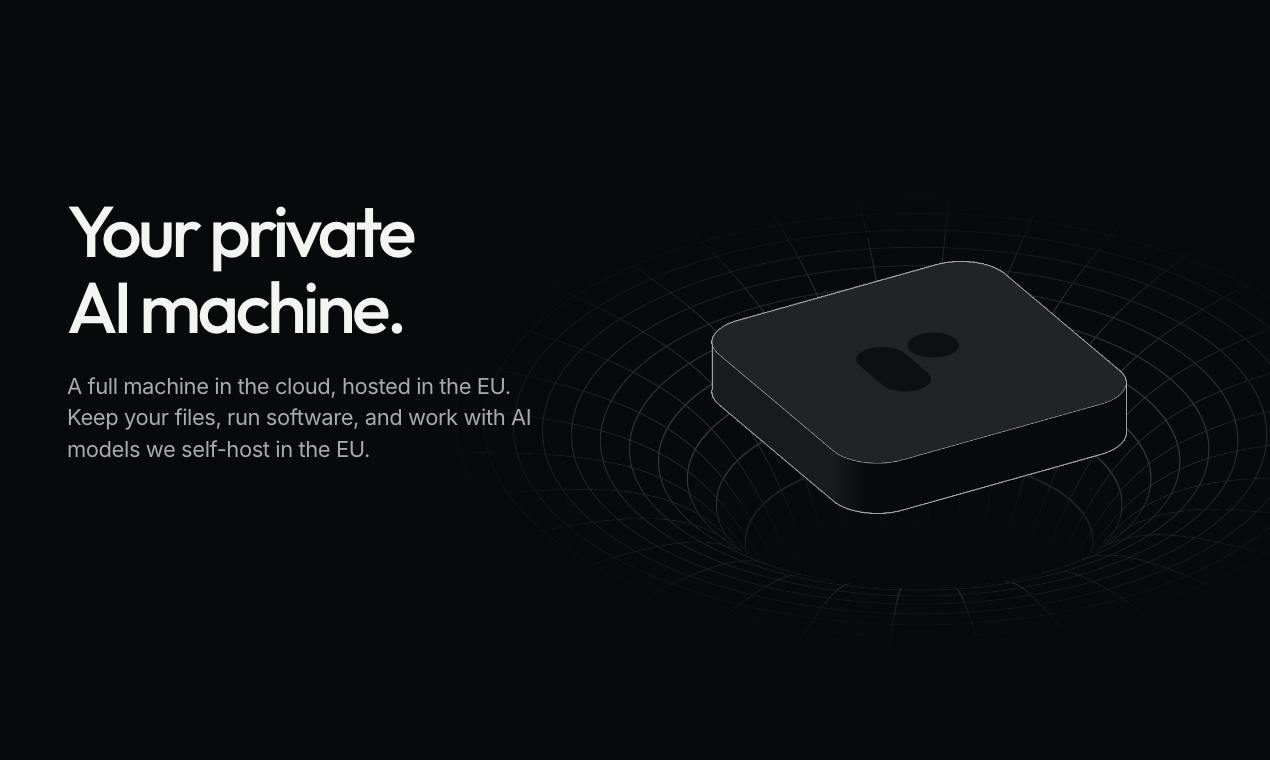
A Private Workspace That Brings Together Files, Ideas, and AI
Rool positions itself as "Your private AI machine" — a workspace that brings three things into a single environment: your files, your ideas, and AI capabilities. Unlike most SaaS-style AI assistants, Rool emphasizes that this environment runs on a cloud machine that belongs to you, rather than on shared infrastructure managed by a vendor.
This design philosophy addresses a long-standing pain point: when users hand documents, notes, and creative materials over to an AI for processing, they often can't be sure where that content ends up or whether it's being repurposed. Rool aims to return AI workflows to users' hands through a model of dedicated instances and localized control.
Privacy Commitments: No Data Selling, No Ads, No Training on Your Content
Rool's three stated commitments are straightforward: never sell user data, show no ads, and never use user content to train AI. These three points map directly onto the most controversial business practices of mainstream AI products — data monetization, ad-driven models, and opaque sourcing of model training data.
The more critical differentiator is where data is stored. Rool explicitly states that data is stored in Finland, governed by EU law. For European users and teams with GDPR compliance requirements, this is a concrete and verifiable selling point — not a vague "we care about privacy" statement. Specifying the data residency location and applicable legal framework often resonates more with privacy-sensitive users than product features alone.
GDPR (General Data Protection Regulation) is the EU data privacy regulation that came into full effect in 2018, widely regarded as one of the strictest data protection frameworks in the world. It grants users rights to access, correct, delete (the "right to be forgotten"), and port their personal data, while requiring data processors to clearly communicate data usage purposes and obtain user consent. Non-compliant organizations can face fines of up to 4% of global annual revenue or €20 million, whichever is higher. Companies operating outside the EU are also subject to GDPR if they process data belonging to EU residents — which is precisely why "data stored in Finland, governed by EU law" carries real compliance significance for European enterprise customers. As an EU member state, Finland's data centers fall naturally within GDPR enforcement jurisdiction, avoiding the compliance complexities associated with cross-border data transfers.
Target Users: Privacy-Conscious Individuals, Teams, and Creators
Based on official descriptions, Rool is aimed at three groups: privacy-minded individuals, teams, and content creators. What these users share is that they frequently handle sensitive or original content — contracts, research materials, unpublished creative work — and are particularly wary of whether AI tools might be quietly reading or retaining their data.
Rool summarizes this experience as "AI that runs on your terms, with full control and privacy." It offers a free trial and uses "own your AI" as its rallying call. The word "own" here is both an emphasis on data sovereignty and a deliberate contrast with mainstream platforms where users are effectively renting access while the platform keeps the data.
Industry Perspective: Privacy Is Becoming a Key Battleground for AI Products
Rool is not an isolated case. As generative AI becomes mainstream, a growing number of users and enterprises are paying closer attention to data flows, compliance risks, and vendor lock-in. In an AI tools market where feature differentiation is increasingly difficult, "privacy" and "data sovereignty" are gradually shifting from niche concerns to core selling points.
That said, products in this space face real challenges. Private, localized control often implies higher operational costs and greater complexity for end users. How Rool balances its privacy commitments with ease of use and compute costs will directly determine whether it can grow from a well-received Product Hunt launch into a sustainable product. Additionally, specific technical details about how "running on your own cloud machine" is implemented, which AI models are supported, and actual performance benchmarks remain limited in public information — all worth watching going forward.
"Vendor lock-in" refers to a situation where users become so dependent on a platform's proprietary formats, APIs, or infrastructure that switching to another provider becomes prohibitively costly. In the AI tools space, lock-in is particularly subtle: documents uploaded over time, accumulated conversation history, and customized workflows often only function within the original platform. Private or locally deployed solutions can theoretically mitigate this, since data and workflows remain in the user's hands rather than being locked away in a proprietary format. This is also why "data sovereignty" has grown in weight as a factor in enterprise procurement decisions in recent years — especially in heavily regulated industries like legal, healthcare, and finance, where strict rules apply to data transfers and third-party access.
Summary
Rool offers a clear value proposition: a unified workspace for files, ideas, and AI, with privacy-first principles and EU legal protection as its core selling points. For users who want to benefit from AI without handing over their data, it represents an appealing alternative. Whether it can truly deliver on the promise of "owning your AI" will ultimately be tested by real-world product execution, cost management, and user experience.
Related articles

Free Unlimited Claude Code Solution: Agnes AI + CC Switch Setup Guide
No paid subscription needed — pair the free AI platform Agnes AI with the open-source tool CC Switch to provide a backend for Claude Code, enabling unlimited free calls to text, image, and video models. This guide covers the full setup, test results, and usage boundaries.

A Complete Zero-Cost Guide to Getting Started with Claude Code for Beginners in China
A beginner's guide to Claude Code for users in China: two installation methods (command line and IDE plugin), full configuration steps for replacing the official API with the free domestic LongCat model, and a hands-on demo of building a small tool with natural language, plus tips.

When the NSA Gets Involved: The AI Supply Chain Crisis Behind Open-Source CVEs and API Key Hijacking
Multiple open-source projects disclosed severe CVEs in one day, PHP flaws alarmed the FBI, and Railway and OpenCode were breached with API keys stolen. This article breaks down the vulnerability window, AI-accelerated exploitation, and the AI supply chain crisis behind the API key black market, with a developer defense checklist.