Room AI: Redesign Your Room Through Conversation, One Change at a Time

Room AI uses conversational single-step iteration to redesign room photos, turning AI image generation into step-by-step decisions.
Room AI is a lightweight interior design tool on Product Hunt. Users upload a room photo, describe changes in natural language, and the product modifies only one thing at a time while keeping the rest unchanged. This "one change at a time" design mirrors the iterative process between designers and clients, making causality clear and reducing cognitive load. All versions are preserved for comparison, and "no credits, no card" lowers the trial barrier. The article notes generation precision, version management, and business model as key open questions.
From "Upload a Photo" to "Conversational Redesign": The Product Logic Behind Room AI
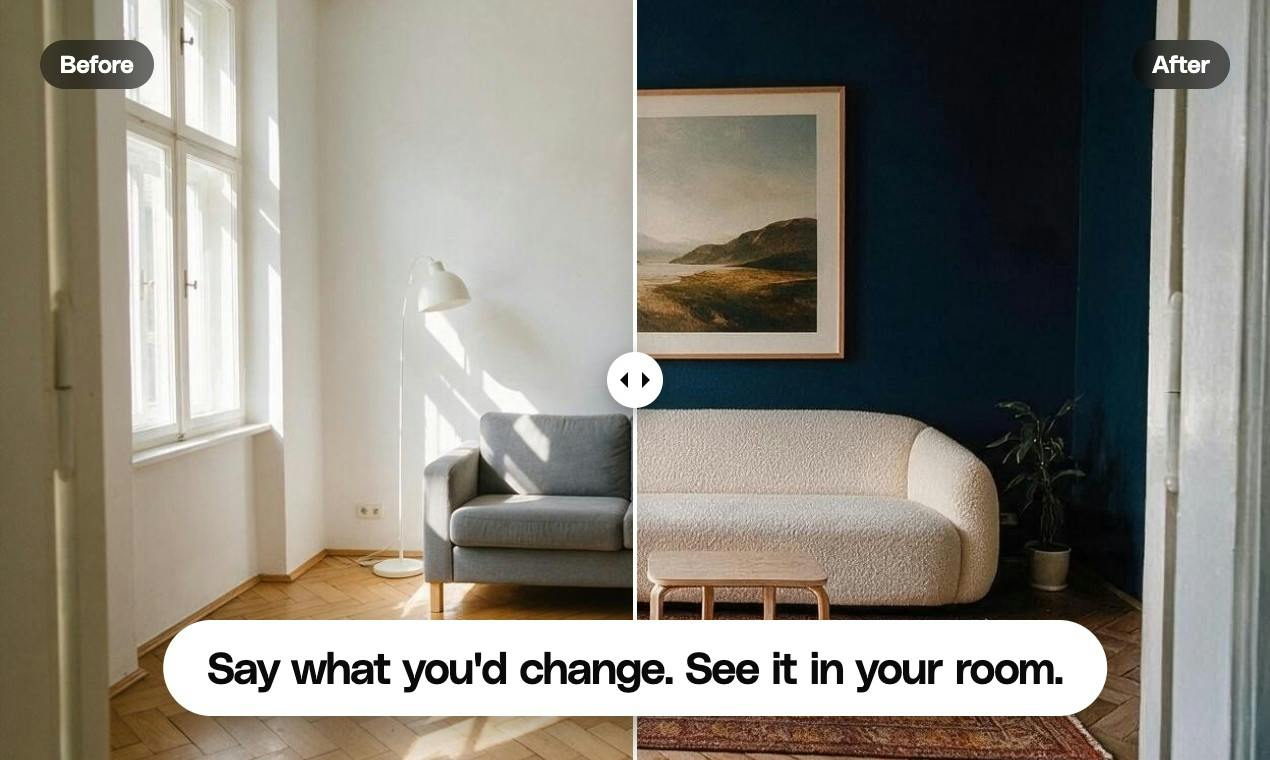
On Product Hunt, a product called Room AI proposes a simple interaction paradigm: upload a photo of your room, then describe what you want to change as if chatting with a designer. Its response isn't textual advice—it's a new photo: your room, but with only the one change you requested, everything else left untouched.
Behind this design is a clear trade-off: change only one thing at a time. Most AI image tools tend to generate a "brand new" image, while Room AI constrains changes to a single dimension, allowing users to clearly perceive the effect of each decision. Every version is preserved, and users can compare any two versions.
According to the Product Hunt page, the product was developed by Marc Köhlbrugge, with categories spanning artificial intelligence, home improvement, and interior design. It ranked 15th among products of the day with 79 votes. These figures reflect the starting state of an early-stage product—moderate attention, but a direction worth noting.
How Product Hunt Works: Product Hunt is a platform for launching and discovering new products. Products are ranked by user upvotes on the day of launch, typically presented as a "daily leaderboard." Many products go live each day competing for limited exposure, so ranking and vote count are intuitive signals of early attention. For indie developers, reaching the top of the daily leaderboard can bring considerable initial traffic and feedback; ranking mid-tier with fewer than a hundred votes often means the product is still in a validation phase and hasn't yet built momentum. Understanding this context helps interpret what "15th place, 79 votes" really means in this article—it's not a failure, but a typical cold-start beginning.
Why "One Change at a Time" Beats "One-Click Makeover"
Interior design is essentially an iterative decision-making process. Between professional designers and clients, multiple rounds of communication are often needed: first adjust the wall color, then see whether the flooring material matches, then judge whether the furniture layout makes sense. Each step builds on the confirmation of the previous one.
Room AI's interaction logic simulates exactly this process. The user says "paint the walls light green" and gets a new image; then says "swap the sofa for a beige fabric one" and gets another new image. Every intermediate state is preserved and can be revisited or compared at any time.
The benefit of this design is that it reduces cognitive load. When all elements change simultaneously, it's hard for users to tell which change had an effect and which caused disharmony. Single-variable iteration makes causality clearly visible and gives users a stronger sense of control over the final result.
Another notable detail is "no credits to count" and "no card" required to try. In a landscape where AI image generation products commonly adopt credit systems or subscriptions, this lowers the barrier to first-time experience.
Single-Variable Iteration and Controlled Comparison: In scientific and engineering methods, the single-variable principle means changing only one factor at a time while keeping all other conditions constant, so that the effect of a particular change can be clearly attributed. This idea carries over to design decisions: when multiple elements change at once, users can't tell which adjustment caused the difference in effect, easily leading to the confusion of "something's off but I can't say what." By limiting each modification to a single dimension, Room AI effectively lets users run a series of controllable small-scale comparative experiments, making causality explicit and making revisiting and selecting the best option well-grounded.
Product Positioning and Potential Use Cases
Judging from the category tags, Room AI covers three domains at once: AI, home improvement, and interior design. This means its target users may include: ordinary residents preparing to renovate but unsure of how a plan will look, designers who need to quickly show clients multiple options, and renters—who may simply want to see how a room looks after changing curtains or rearranging furniture.
The interface shown in the screenshot currently only presents the product's basic form, but the core message is clear enough: this is a lightweight tool with conversation as input, images as output, and version comparison as support.
For an indie developer like Marc Köhlbrugge, Room AI's positioning also fits the "small but polished" route common on Product Hunt—not pursuing a large, all-encompassing feature matrix, but doing one specific interaction well.
Credits in AI Image Generation: Credits are a common billing method for AI image generation products—users purchase a certain number of generations, and each image consumes some credits. Behind this is the reality that GPU inference costs are priced per call: generating an image requires real compute, and free unlimited use is hard to sustain. Most products therefore set free quotas, subscription plans, or top-up packs. Room AI's claim of "no credits to count" and "no card required to try" means it is initially absorbing the cost of experience itself to lower the psychological and operational barrier to first use—a common customer-acquisition strategy among small tool products.
Issues to Watch
As an early-stage product, Room AI faces several practical challenges. First is generation precision: when the user says only "paint the walls light green," can the AI accurately understand boundaries, preserve lighting relationships, and avoid damaging adjacent areas? This directly determines whether the promise of "change only one thing" can be kept.
Second is version management usability: once the number of changes accumulates to a dozen or more versions, how does the user quickly find the desired version? Can the comparison feature support effective decision-making? The screenshots don't yet reveal the answers.
Finally, the business model: the current "no credits" approach lowers the barrier, but how it will sustain itself long-term—subscription, pay-per-use, or something else—has not yet been disclosed.
Overall, the interaction concept Room AI proposes—single-step iterative spatial modification using natural language—is a direction with real product sense. It pulls AI image generation away from "one-shot gacha pulls" back onto the track of "step-by-step decision-making," which is something worth watching for anyone interested in interior design tools and AI applications.
One-line Summary
Room AI uses conversational single-step iteration to redesign room photos, turning AI image generation into step-by-step decision-making.
Paragraph Summary
Room AI is a lightweight interior design tool launched on Product Hunt. After users upload a room photo, they describe in natural language what they want to change; the product modifies only one thing at a time and generates a new image while keeping the rest unchanged. This "one change at a time" design simulates the multi-round iteration between professional designers and clients, making causality clearly visible and reducing users' cognitive load. All versions are preserved and any two can be compared. The product also lowers the barrier to trying it with "no credits, no credit card." While affirming its product approach, the article points out that generation precision, version management usability, and business model are the key questions to be validated.
Related articles

@ai-sdk/sandbox-vercel 1.0.196 Patch Release: Dependency Update
Interpretation of the @ai-sdk/sandbox-vercel 1.0.196 patch release: @ai-sdk/harness dependency upgraded in sync, analyzing the AI SDK sandbox component's versioning strategy and practical impact on developers.

AI SDK Svelte 4.0.339 Released: The Ecosystem Coordination Behind a Minor Version Update
The AI SDK Svelte adapter releases patch 4.0.339, with core package ai updated to 6.0.339. We explain this coordinated release, Svelte's role in AI development, and upgrade advice.

@ai-sdk/tool-bash 1.0.38 Released: Analyzing a Patch in the AI SDK Toolchain
@ai-sdk/tool-bash 1.0.38 patch released via GitHub Actions, pointing to ai@7.0.184. An analysis of version alignment, automated release pipelines, and practical tips for handling patch updates.