@ai-sdk/sandbox-vercel 1.0.196 Patch Release: Dependency Update

AI SDK sandbox package releases 1.0.196 patch, only synchronizing the harness dependency upgrade—a low-risk maintenance update.
Vercel's @ai-sdk/sandbox-vercel releases patch version 1.0.196, with the only change being upgrading the dependency @ai-sdk/harness to the same version. The article notes that such synchronized version releases typically reflect monorepo version alignment, indicating the sandbox layer and toolchain layer are managed by the same pipeline and must maintain a compatible baseline. Since this component provides AI applications with a secure isolated environment for executing model-generated code, its stability is especially important for developers building code interpreters and Agents. This update contains no feature or behavioral changes and carries low upgrade risk, but it is advised to confirm harness is not referenced by other dependencies at different versions. The article also cautions that public information is limited, interpretation should be cautious, and follow-up attention should go to the harness changelog and sandbox documentation improvements.
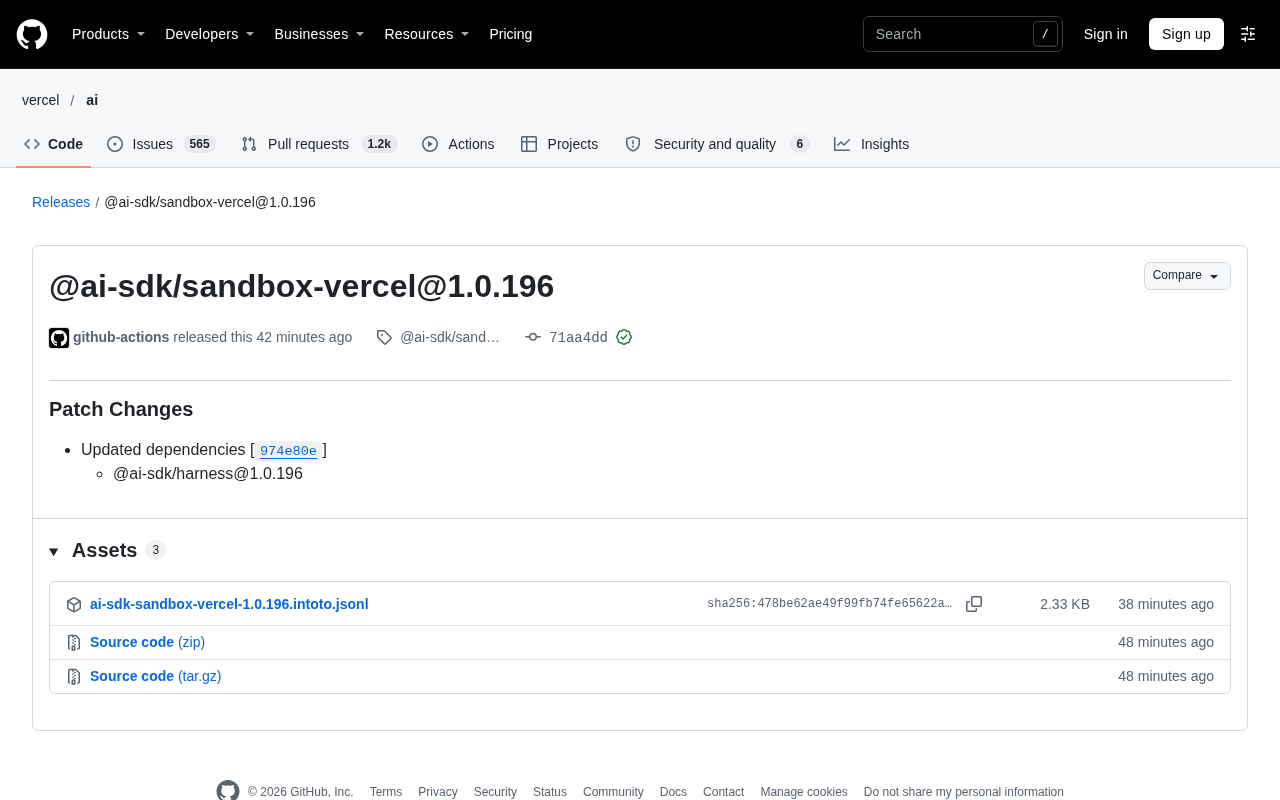
The sandbox component @ai-sdk/sandbox-vercel in Vercel's AI SDK ecosystem has released version 1.0.196. According to the GitHub release notes, this is a patch-level update, with the core change being an upgrade of the dependency @ai-sdk/harness to version 1.0.196. Based on the limited information available on the release page and the context of the AI SDK ecosystem, this article interprets the signals this update may send.
What the Patch Update Contains
The release notes are very brief: the change type for @ai-sdk/sandbox-vercel@1.0.196 is Patch Changes, and the only listed change is "Updated dependencies," pointing to commit 974e80e, with the updated dependency being @ai-sdk/harness@1.0.196. The version was published by github-actions on November 27 at 23:26, and commit 71aa4dd carries a GitHub-verified signature (GPG key ID: B5690EEEBB952194).
From an engineering perspective, this kind of patch release with synchronized version numbers typically indicates version alignment between packages within a monorepo. sandbox-vercel and harness share the same version number (both 1.0.196), suggesting the two packages are likely managed in the same release pipeline, and the purpose of the dependency upgrade is to ensure the sandbox layer and the runtime tooling layer use compatible code baselines.
Monorepo and Synchronized Version Releases
A monorepo (single code repository) is an engineering practice of placing multiple interrelated software packages in the same code repository for unified management. In the JavaScript/TypeScript ecosystem, tools like pnpm workspace, Lerna, Nx, and Turborepo are commonly used to support this structure. Its core advantages include: cross-package refactoring can be done in one pass, dependencies are explicitly controllable, and CI pipelines can be shared.
In a monorepo, release tools (such as changesets) typically automatically determine which packages need to be released and how version numbers should be incremented based on the submitted changesets. When one package depends on another, if the depended-upon package is upgraded, the dependent package is often automatically bumped by a patch version, generating a mechanical record like "Updated dependencies" in the CHANGELOG. This is exactly the form of the only entry that appears in this release note.
Therefore, sandbox-vercel and harness both being at 1.0.196 does not necessarily mean there is any functional synergy between them; it is more likely just changesets automatically synchronizing the dependency graph during a batch release. Understanding this helps developers avoid over-inferring conclusions like "tight coupling" or "deep integration" from synchronized version numbers—the actual degree of coupling depends on import relationships and API contracts in the source code.
Why the Sandbox Component Deserves Attention
The positioning of @ai-sdk/sandbox-vercel is evident from its name: it provides sandbox capabilities running in the Vercel environment for the AI SDK. In AI application development, sandboxes are commonly used to safely execute model-generated code, isolate untrusted operations, or provide Agents with a controlled environment for tool calls. The stability of such foundational components directly affects the reliability of upper-layer applications.
@ai-sdk/harness, on the other hand, is more like a supporting test or runtime layer. The synchronized upgrade of the two suggests a tight coupling between the sandbox's execution environment and the accompanying toolchain. For developers building code interpreters, automated Agents, or online evaluation systems with the AI SDK, keeping these two packages at consistent versions is a basic prerequisite for avoiding runtime exceptions.
Technical Background on AI Code Execution Sandboxes
Code generated by large models cannot be executed directly on production hosts: it may contain risks such as infinite loops, filesystem damage, network exfiltration, or resource exhaustion. Sandbox technology limits the resources and side effects visible to code through process isolation (e.g., subprocess + seccomp), container isolation (Docker/Firecracker microVM), or runtime-level isolation (WebAssembly, Deno's permission model).
In scenarios like the AI SDK, sandboxes are typically the foundation for "code interpreters" or "Agent tool calls": the model outputs a piece of Python/JS, and the sandbox executes it under constrained time, memory, and network policies and returns stdout, errors, or generated files. Mainstream implementations include E2B, Modal Sandboxes, Cloudflare Workers' isolated runtime, and Vercel's own execution environment based on Fluid Compute or Firecracker.
The term harness in engineering contexts usually refers to a "test fixture/runtime support framework"—scaffolding that provides inputs to the object under test, drives execution, and collects results. If @ai-sdk/harness plays this role, then releasing it in sync with the sandbox package makes logical sense: the sandbox needs the harness to define execution contracts, run integration tests, or provide a local simulation environment. Once developers understand this relationship, they can see why the versions of the two should be kept aligned.
Practical Impact on Developers
This update contains no new features or behavioral changes and is a low-risk upgrade. Projects depending on @ai-sdk/sandbox-vercel are not expected to encounter API-level breaking changes after upgrading to 1.0.196. However, since the release notes do not provide a more detailed changelog, it is advisable to confirm before upgrading whether @ai-sdk/harness@1.0.196 is also referenced by other dependencies, to avoid version conflicts.
Judging from the release cadence, AI SDK-related packages adopt a high-frequency, small-step patch release strategy, with version numbers already advanced to 1.0.196, indicating that the maintenance team is continuously performing dependency maintenance and issue fixes. This cadence is friendly to downstream users: small patches reduce the cost of upgrade decisions, but they also require developers to establish automated dependency update and regression testing processes to keep up with the iteration speed.
Information Limitations and Follow-up Observations
It should be noted that the public information for this release is extremely limited, with only a single line recording the dependency update and no accompanying performance improvements, security fixes, or feature descriptions. Therefore, interpretation of this update should remain cautious and not be over-extrapolated. What is worth watching going forward is the changelog of @ai-sdk/harness itself, and whether the AI SDK's sandbox capabilities will introduce clearer API or documentation support in future versions.
For developers following the AI programming toolchain, such patch releases can be seen as a signal of ecosystem activity, but real technical judgment still requires waiting for more complete release notes or documentation updates.
One-line Summary
AI SDK sandbox package releases 1.0.196 patch, only synchronizing the harness dependency upgrade, a low-risk maintenance update.
Paragraph Summary
Vercel's @ai-sdk/sandbox-vercel releases patch version 1.0.196, with the only change being upgrading the dependency @ai-sdk/harness to the same version number. The article notes that such synchronized version releases typically reflect version alignment mechanisms within a monorepo, indicating that the sandbox layer and toolchain layer are managed by the same pipeline and need to maintain a compatible baseline. Since this component provides AI applications with an isolated environment for safely executing model-generated code, its stability is particularly important for developers building code interpreters and Agents. This update contains no functional or behavioral changes and carries low upgrade risk, but it is recommended to confirm that harness is not referenced by other dependencies at different versions to prevent conflicts. The article also reminds that public information is limited and interpretation should be cautious, with follow-up attention worth paying to the harness changelog and improvements to sandbox documentation.
Related articles

Pure-Code Video Generation Tested: Which AI Model Actually Follows Instructions?
A Bilibili creator tested three AI models' pure-code video generation with unified prompts and three revisions each: Xiaonaomao has a high ceiling but lacks stability, GPT 6.2 Extra models well but only follows half the instructions, and OPAS 5.5 remains the benchmark.

GPT-6 Six-Tier Hands-On Test: Astra Ultra Dominates but Bills Double
GPT-6 six-tier test: Astra Ultra sweeps 3:0 in 3D tasks thanks to sub-agents and runs 14% faster, but hidden backend bills make its real cost 2.6x single-threaded.

GPT-6.2 Astra vs Fable 5.2: Huge Cost-Efficiency Gap Across 12 Real-World Tests
Bilibili creator tests GPT-6.2 Astra vs Fable 5.2 across 12 real tasks: Fable wins 7-5 but costs 7.2x more and takes nearly 5x longer. Token efficiency emerges as the key selection metric.