Rootless Containers: A Practical Guide to More Secure Service Deployment
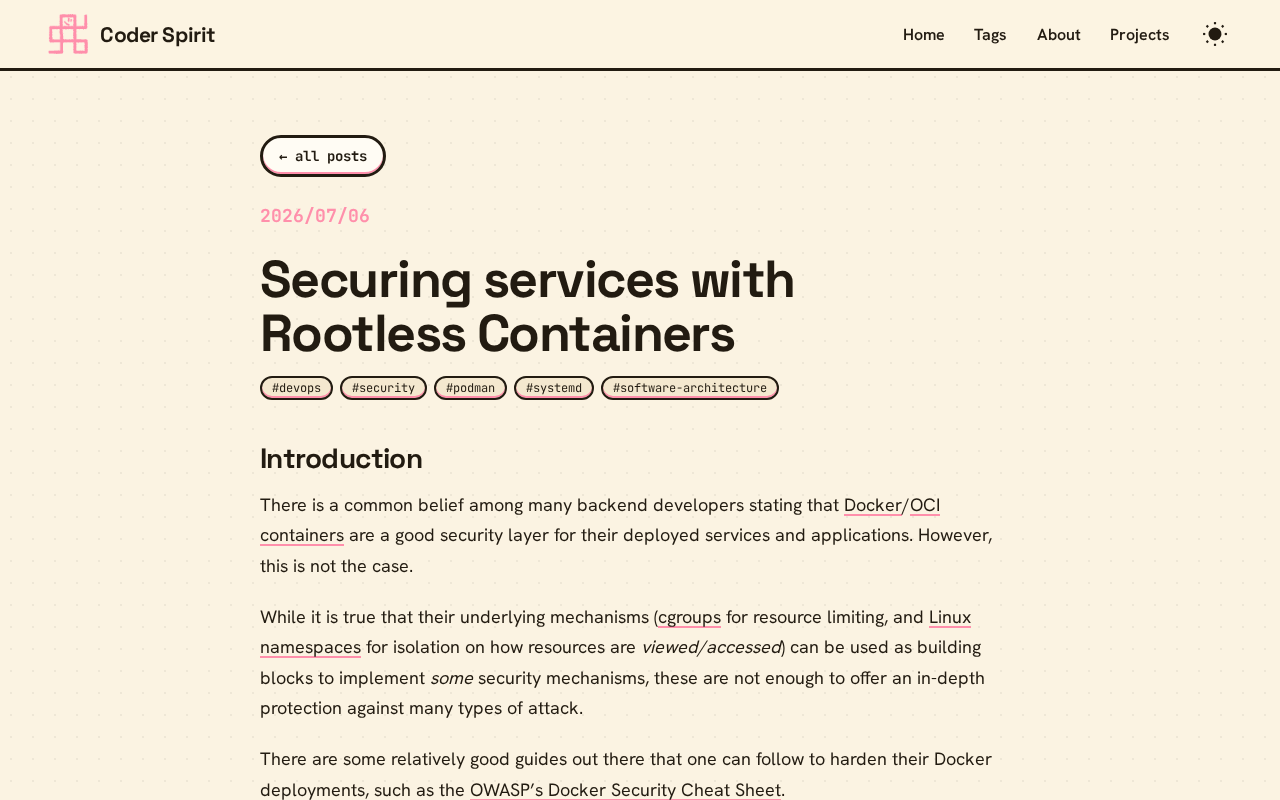
A comprehensive guide to deploying services more securely using rootless containers.
This guide explores rootless containers as a security-first approach to service deployment. It covers the technical foundations including Linux user namespaces and daemonless architecture (Podman), explains how they mitigate container escape risks by enforcing the principle of least privilege, and addresses practical deployment considerations like port binding, storage performance, and Kubernetes ecosystem support.
What Are Rootless Containers
Container technology has become a cornerstone of modern service deployment, but traditional container runtimes (such as Docker daemon running with root privileges) have a long-overlooked security concern: once a container process is compromised, attackers can leverage root privileges to cause serious damage to the host machine. Rootless Containers were created specifically to address this problem.
In the traditional Docker architecture, running the daemon with root privileges was a historical design choice. Early container technology required manipulation of kernel resources like cgroups, network namespaces, and filesystem mounts—operations that typically require privileged capabilities such as CAP_SYS_ADMIN in Linux. CVE-2019-5736 in 2019 was a textbook example: attackers could overwrite the runc binary on the host, achieving a complete escape from container to host with root-level code execution. The emergence of such critical vulnerabilities accelerated the community's push toward rootless container solutions.
Rootless containers refer to running the entire container lifecycle without requiring root privileges—from building images to running and managing containers, everything is performed by an unprivileged user. This means that even if a process inside the container is compromised, the attacker's privileges are limited to that ordinary user rather than the host's superuser privileges, significantly reducing the attack surface.
The core value of this approach lies in the principle of least privilege: a service should only have the minimum permissions necessary to perform its function. Rootless containers extend this security practice from the code level to the infrastructure level.
Technical Principles Behind Rootless Containers
User Namespaces
The technical foundation of rootless containers is the Linux kernel's user namespace feature. Through user namespaces, the root user (UID 0) inside a container is mapped to an unprivileged user ID on the host. In other words, the process inside the container believes it has root privileges, but from the host's perspective, it's just an ordinary user.
User namespaces are a feature that Linux kernel has been progressively refining since version 3.8 (2013), and they belong to the Linux namespace family. Linux has 8 types of namespaces (mount, UTS, IPC, PID, network, user, cgroup, time), among which user namespaces are unique—they are the only namespace type that unprivileged users can create. The core mechanism is implemented through UID/GID mapping via /proc/[pid]/uid_map and /proc/[pid]/gid_map files. For example, UID 0 inside the container might map to UID 100000 on the host, and UIDs 1-65535 inside the container map to UIDs 100001-165535 on the host. This mapping range is typically pre-configured for each user in /etc/subuid and /etc/subgid.
This mapping mechanism gives containers the isolation capabilities they need to run while avoiding exposure of actual host root privileges to the container. When a container needs to access certain resources, the kernel performs permission checks based on the mapping rules.
Daemonless Architecture
Unlike traditional Docker, which relies on a persistent daemon running as root, rootless container tools like Podman adopt a daemonless architecture. Each container runs directly as a child process of the user process, eliminating a high-privilege central daemon as a potential single point of attack.
Podman is primarily developed by Red Hat, and its full name is Pod Manager. Its design goal is to provide an interface fully compatible with the Docker CLI (you can even set alias docker=podman), while making fundamental architectural changes. Podman uses the fork-exec model to directly invoke OCI runtimes (such as crun or runc) to start containers. The parent process of each container process is the user's shell or conmon (container monitor) process that launched it. Complementing Podman, Buildah focuses on image building, and Skopeo handles image transfer and inspection—together they form a complete container toolchain. In comparison, Docker's architecture is a multi-layer call chain of client → dockerd → containerd → containerd-shim → runc, where the dockerd layer runs as root, becoming a concentrated point of attack surface.
This architecture not only improves security but also simplifies the system's trust model—users have full responsibility and control over the containers they start, without needing to interact with a privileged service.
Security Advantages and Practical Benefits of Rootless Containers
Deploying services with rootless containers provides direct benefits on several levels:
- Reduced attack surface: The damage from container escape attacks is significantly limited. Even if attackers break through the container boundary, they face only an ordinary user account rather than full system control.
- Elimination of privileged daemon risk: The daemonless architecture removes the root daemon as a high-value attack target.
- Compliance alignment: Many security compliance frameworks emphasize the principle of least privilege, and rootless containers naturally align with such requirements.
- Multi-user environment friendly: On shared servers, different users can each run containers without interfering with each other, and administrators don't need to configure privileges for each user.
Understanding the mechanics of container escapes helps appreciate the defensive value of rootless containers. Common escape paths include: exploiting kernel vulnerabilities (such as Dirty COW CVE-2016-5195), abusing improperly configured capabilities (such as CAP_SYS_PTRACE allowing debugging of host processes), creating privileged containers through mounted Docker sockets (/var/run/docker.sock), and leveraging information leaks from pseudo-filesystems like procfs/sysfs. In rootless container scenarios, even if an attacker achieves an escape, since the process UID at the host level is an unprivileged user, the kernel will deny access requests to other users' files and system resources, strictly confining the damage within that user's permission boundary.
Key Considerations for Production Deployment
Despite the clear advantages of rootless containers, there are some limitations and trade-offs to consider during actual deployment.
Networking and Port Binding
Rootless containers cannot bind privileged ports below 1024 (such as 80, 443) by default. When deploying web services, this requires additional handling, such as port forwarding or configuring the kernel parameter net.ipv4.ip_unprivileged_port_start.
Storage and Filesystem Performance
Rootless mode typically uses userspace filesystem drivers like fuse-overlayfs, which may have subtle performance differences compared to kernel-space overlay. fuse-overlayfs is a userspace overlay filesystem implementation designed specifically for rootless containers. Traditional kernel-space overlayfs requires CAP_SYS_ADMIN privileges to perform mount operations, which ordinary users cannot use directly. fuse-overlayfs bypasses this limitation through the FUSE (Filesystem in Userspace) framework, but since each file operation requires context switching between userspace and kernel space, I/O-intensive workloads may observe a 5-15% performance overhead.
Notably, starting from Linux kernel 5.11, kernel-space overlayfs supports mounting within user namespaces (with specific configuration), which may eliminate this performance gap in the future, allowing rootless containers to achieve full parity with traditional modes in storage performance.
Additionally, file permission mapping under user namespaces requires special attention when mounting volumes.
Ecosystem Maturity and Tooling Support
With the maturation of tools like Podman and Buildah, along with the Kubernetes ecosystem's gradual support for rootless runtimes, rootless containers have moved from an experimental feature to production-ready.
In the Kubernetes ecosystem, support for rootless containers has gone through multiple stages. Kubernetes 1.22 began supporting running kubelet as a non-root user (experimental), and at the container runtime level, containerd has supported rootless mode since version 1.6, with CRI-O gradually following suit. It's important to note that the runAsNonRoot: true enforced by the restricted level in Pod Security Standards is a different concept from rootless runtimes—the former controls the user identity of processes inside the container, while the latter concerns the permission model of the runtime itself. Truly end-to-end rootless Kubernetes deployments (such as the usernetes project) are still under active development, but single-node and small-scale cluster scenarios are already practically usable.
In certain scenarios that depend on special kernel capabilities or hardware access, falling back to privileged mode may still be necessary.
Conclusion
Rootless containers represent a significant evolution in container security practices. Through user namespaces and daemonless architecture, they embed the principle of least privilege into the infrastructure layer, effectively reducing the cascading risk after a service is compromised. For security-conscious teams, migrating from traditional root containers to rootless containers is a worthwhile security hardening investment.
Of course, no security technology is a silver bullet. Rootless containers should be used in conjunction with image scanning, network isolation, runtime monitoring, and other measures to build a defense-in-depth strategy. As container technology becomes increasingly prevalent, understanding and adopting rootless deployment will become a fundamental skill in service operations.
Related articles
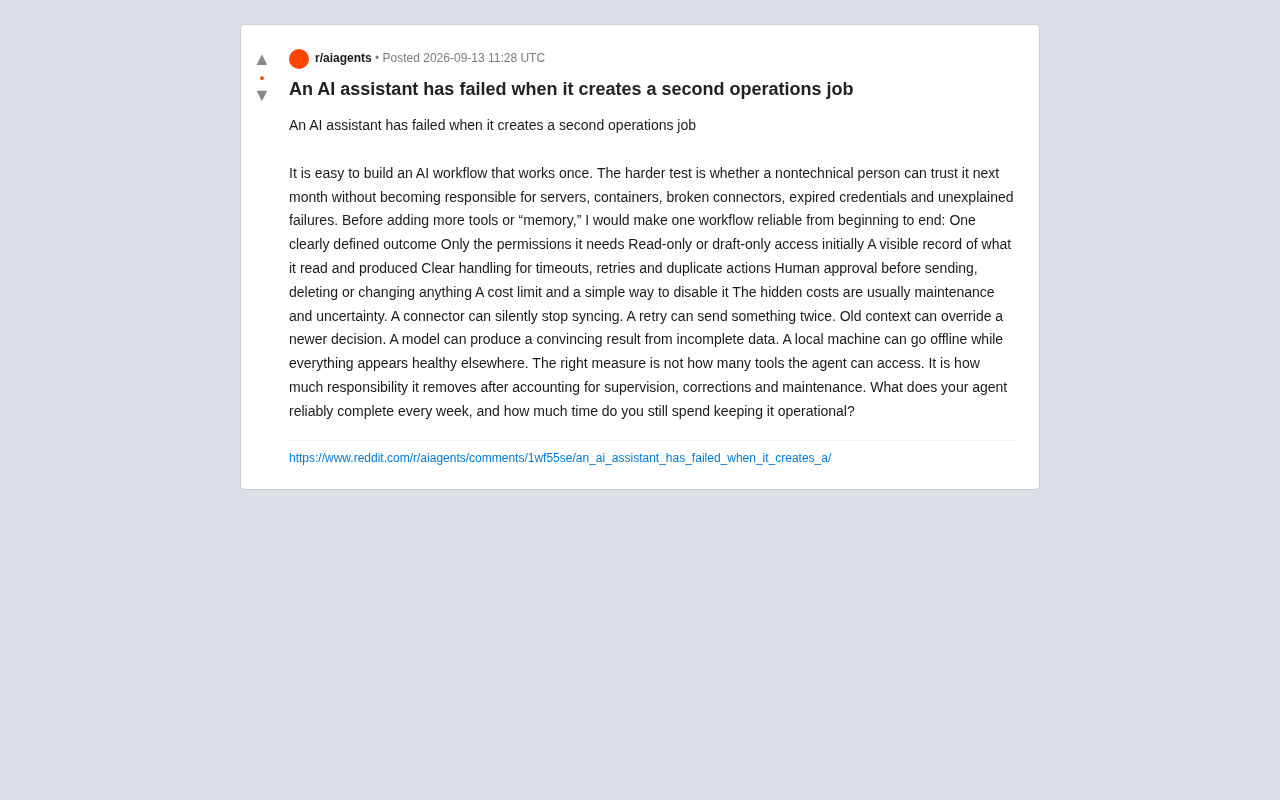
The True Failure of an AI Assistant: When It Creates a Second Operations Job
A Reddit user reframes how to judge AI assistants: they fail when they create a second ops job. Learn how to build end-to-end reliable workflows and measure Agent value by net benefit, not tool count.

AI Agent Permission Management: Is Writing Roles Manually the New Hidden Tax?
As AI Agent counts grow, manually defining permission roles is becoming a hidden operational burden. This article explores scalability challenges, auto-generated roles, and the security risk of prompt injection bypassing permission checks.

Vibe Coding 5 Mobile Games with Claude Code: Ad Monetization Beats Subscriptions
An indie dev built 5 iOS casual games with Claude Code vibe coding. His verdict: AdMob ads plus ASO optimization outperform subscriptions for casual games.