RTX 5090 Becomes a Smuggling Favorite: From Gaming GPU to Black Market Hard Currency

RTX 5090 appears on smuggling lists, reflecting gray-market GPU flows driven by export controls and AI compute hunger.
A viral Reddit post shows the RTX 5090 listed alongside cigarettes on smugglers' product manifests, revealing high-end consumer GPUs entering gray distribution. Tightening export controls narrow legal purchase paths, while AI training and local LLM deployment drive rigid demand for large-VRAM flagship cards, creating massive cross-regional price gaps and arbitrage. Smuggled GPUs drain retail inventory, raise prices for ordinary gamers, and may trigger stricter controls — a "control-arbitrage-recontrol" cycle. This signals compute assetization distorting the consumer hardware ecosystem.
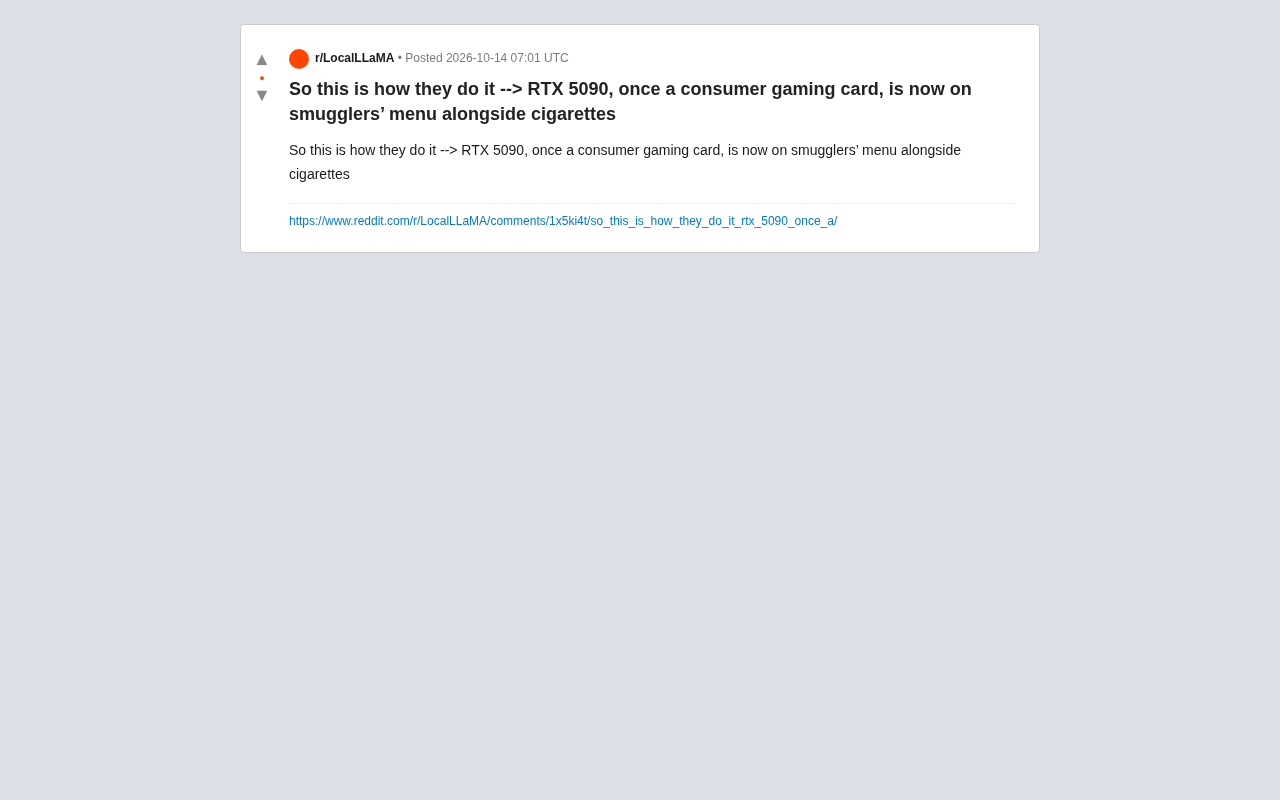
A viral Reddit post has surfaced a striking observation: the RTX 5090, once destined for gamers' PC cases, is now appearing on smugglers' "product lists" alongside cigarettes. This is no joke — it's a realistic portrait of how high-end consumer hardware, squeezed by export controls, regional pricing gaps, and AI compute hunger, has been forced into gray-market distribution channels.
From Gaming Card to Contraband: The Identity Split of a GPU
The RTX 5090 is NVIDIA's flagship consumer GPU. By product positioning, it belongs in the build lists of gamers, content creators, and enthusiasts. But the Reddit user's remark — "So this is how they do it" — exposes an awkward truth: when a GPU's resale profit margin is high enough, its form factor small enough, and its demand rigid enough, its distribution logic is no longer determined by retail channels but by gray-market price differentials.
Cigarettes have long been a staple on smuggling manifests because high tax rates and addictive demand create a stable arbitrage opportunity. The fact that the RTX 5090 is being compared to them suggests it has acquired similar characteristics in certain regional markets — scarce, in rigid demand, high unit price, easy to transport. A GPU is not a cigarette, but when it's stuffed into a backpack, stripped of its packaging, and disguised as "personal use" while crossing borders, the smuggling economics are nearly identical.
What is CUDA?
CUDA (Compute Unified Device Architecture) is a general-purpose parallel computing platform and programming model introduced by NVIDIA in 2006. It allows developers to directly invoke thousands of GPU compute cores for non-graphical computation using languages like C/C++. It is precisely the CUDA ecosystem that transformed NVIDIA GPUs from "gaming peripherals" into the default hardware for AI training: mainstream deep learning frameworks such as PyTorch and TensorFlow use CUDA as their primary backend, and a vast number of papers, open-source projects, and engineering codebases run on CUDA by default.
This means that when users buy a GPU, they are not just buying hardware — they are buying compatibility with an entire software ecosystem. Although AMD and Intel have introduced alternatives like ROCm and oneAPI, the gap in migration cost and ecosystem maturity remains significant. This "ecosystem lock-in" gives NVIDIA's high-end cards a near-irreplaceable rigid demand, and also makes the gray-market premium far larger than for ordinary electronics — buyers are willing to pay high prices not just for compute power, but to be able to run CUDA code.
Export Controls and Compute Hunger: The Real Drivers of the GPU Black Market
The flow of high-end GPUs into gray channels is driven primarily by an extreme supply-demand mismatch. On one hand, some countries and regions impose export restrictions on high-performance computing chips, tightening legal channels; on the other hand, demand for VRAM and compute from AI training, inference, and local large-model deployment continues to swell, and consumer flagships like the RTX 5090 — with their large VRAM and high bandwidth — have become a "budget alternative" for small and mid-sized teams and individuals.
When legal purchase paths are blocked or costs are driven up, demand doesn't disappear — it simply shifts. This is exactly the gap smugglers target: they don't need to understand CUDA or the Transformer architecture, they just need to know that the same card sells at official price in Location A and can fetch several times that in Location B. Behind the Reddit thread's humor lies an underground supply chain fed by controls, arbitrage, and compute anxiety.
What are high-end GPU export controls?
Export controls refer to a government restricting the export of specific goods, technologies, or software to specific countries or regions through legal or administrative means. Since 2022, the United States has implemented multiple rounds of semiconductor export restrictions against China, primarily under the Export Administration Regulations (EAR), enforced by the Bureau of Industry and Security (BIS). Controlled items cover advanced-node chips, GPUs, EDA tools, and semiconductor equipment. Controlled chips are typically gated by metrics such as "Total Processing Performance" (TPP) and "performance density." NVIDIA has released "special edition" chips such as the A800, H800, and H20 to sidestep these red lines.
The direct effect of controls is narrower legal channels: official prices in target regions are driven up, official quotas shrink, and AI compute demand does not disappear because of controls. This is the soil in which smuggling economics is born — when controls create a sufficiently large price gap between Location A and Location B, gray channels will spontaneously fill it. High-performance consumer cards like the RTX 5090, even if positioned as gaming GPUs, get swept into this distribution logic.
The Dual Harm of Gray Distribution to Gamers and the Market
For ordinary gamers, active GPU smuggling means retail channel inventory is further drained. When scalpers and smugglers are willing to sweep stock at higher prices, the retail supply curve is forcibly shifted upward, and users who genuinely want to build a PC must either pay a premium or wait. The "out of stock at launch" cycle for flagship cards is partly driven by this cross-regional arbitrage.
For market order, the prosperity of gray channels in turn stimulates stricter controls, creating a "control — arbitrage — re-control" cycle. Under compliance pressure, manufacturers may further tighten regional allocation, and the ultimate cost is still borne by end consumers. GPUs turning from gaming hardware into contraband is not a victory for gamers — it is a signal that the entire consumer hardware ecosystem is being distorted by the financialization of compute.
Why has VRAM become a scarce resource in the AI era?
LLM inference and fine-tuning are extremely sensitive to VRAM capacity and bandwidth. Take a 7B-parameter model: at FP16 precision, the weights alone require roughly 14GB of VRAM, and LoRA fine-tuning needs additional space for gradients and optimizer states; as parameter counts grow, requirements rise linearly or even super-linearly. The RTX 5090, with 32GB of GDDR7 VRAM and extremely high bandwidth, sits right at the threshold of "being able to run small-to-mid models locally," giving it natural appeal to individual developers and small teams.
Compared to data-center-class H100/H200 cards that cost tens of thousands of dollars and come with restricted procurement channels, consumer flagship cards have a clear advantage in cost per unit of VRAM. This "affordable large VRAM" positioning serves both gamers and AI practitioners, and the stacking of these two demand streams further amplifies the incentive for cross-regional arbitrage. VRAM capacity is therefore not just a spec sheet number — it is the key variable determining whether a card lands on a gray-market distribution list.
When Hardware Becomes Hard Currency: What We Need to Think About
The RTX 5090 appearing on a smuggling manifest is essentially a metaphor for the "assetization of compute." When the financial attributes of a consumer GPU overshadow its entertainment attributes, its price, flow, and availability are no longer determined by gamers. This Reddit user's sigh is worth reflecting on for hardware manufacturers, regulators, and users alike: are we turning a compute tool that should be universally accessible into a scarce commodity only a few can touch?
In the short term, news of smuggled GPUs will continue to make the rounds as conversation fodder. In the long term, only by letting compliant supply catch up with real demand can the RTX 5090 return to where it belongs — a gamer's PC case, not a smuggler's backpack.
One-line Summary
RTX 5090 appears on smuggling manifests, reflecting gray-market distribution of high-end GPUs amid export controls and AI compute hunger.
Paragraph Summary
A viral Reddit post points out that the RTX 5090 appears alongside cigarettes on smugglers' product lists, revealing that high-end consumer GPUs are entering gray distribution channels. The article argues that tighter export controls narrow legal purchase paths, while AI training and local large-model deployment drive rigid demand for flagship cards with large VRAM. Together, these create massive cross-regional price gaps and arbitrage opportunities, giving GPUs smuggling economics similar to cigarettes. Smuggled GPUs drain retail inventory and push up prices, ultimately hurting ordinary gamers, and may provoke stricter controls — forming a "control — arbitrage — re-control" cycle. The author notes this is essentially a signal of compute assetization and financialization distorting the consumer hardware ecosystem, and only aligning compliant supply with real demand can return GPUs to gamers' PC cases.
Related articles

Build an AI Super Employee System at Zero Cost: A Full Breakdown of Automated Agent Workflows
A deep breakdown of the AI super employee system demoed on Bilibili: agent orchestration, digital human voiceovers, map and enterprise lead generation, 24/7 customer service, and legal modules. We analyze the business logic and compliance risks behind zero-cost signup to help entrepreneurs judge the real ROI of this AI digital employee system.

The Essential Difference Between Chatbots and AI Agents: Crossing from Conversation to Execution
What's the difference between a chatbot and an AI agent? Based on the MCP series on the Learn Tech channel, this article uses examples like booking flights and summarizing notes to explain: a chatbot only gives answers, while an agent actually completes tasks through a think-act-observe loop. It breaks down the four core components—model, tools, memory, and goal—as well as MCP's role as a bridge, and discusses agents' applicable boundaries and permission risks.

Free GitHub Repo: 342 Hours of AI Courses, from Math to MCP Servers
A free GitHub repo offers 342 hours of AI courses: 523 lessons across 20 phases, from math fundamentals to agent building and MCP servers. Nearly 100,000 learners have started.