Running 1.58-bit BitNet LLMs on an ESP32S3 Cluster: Pushing the Limits of Edge AI

An ESP32S3 microcontroller cluster runs a 1.58-bit BitNet LLM, probing the hardware floor of edge AI.
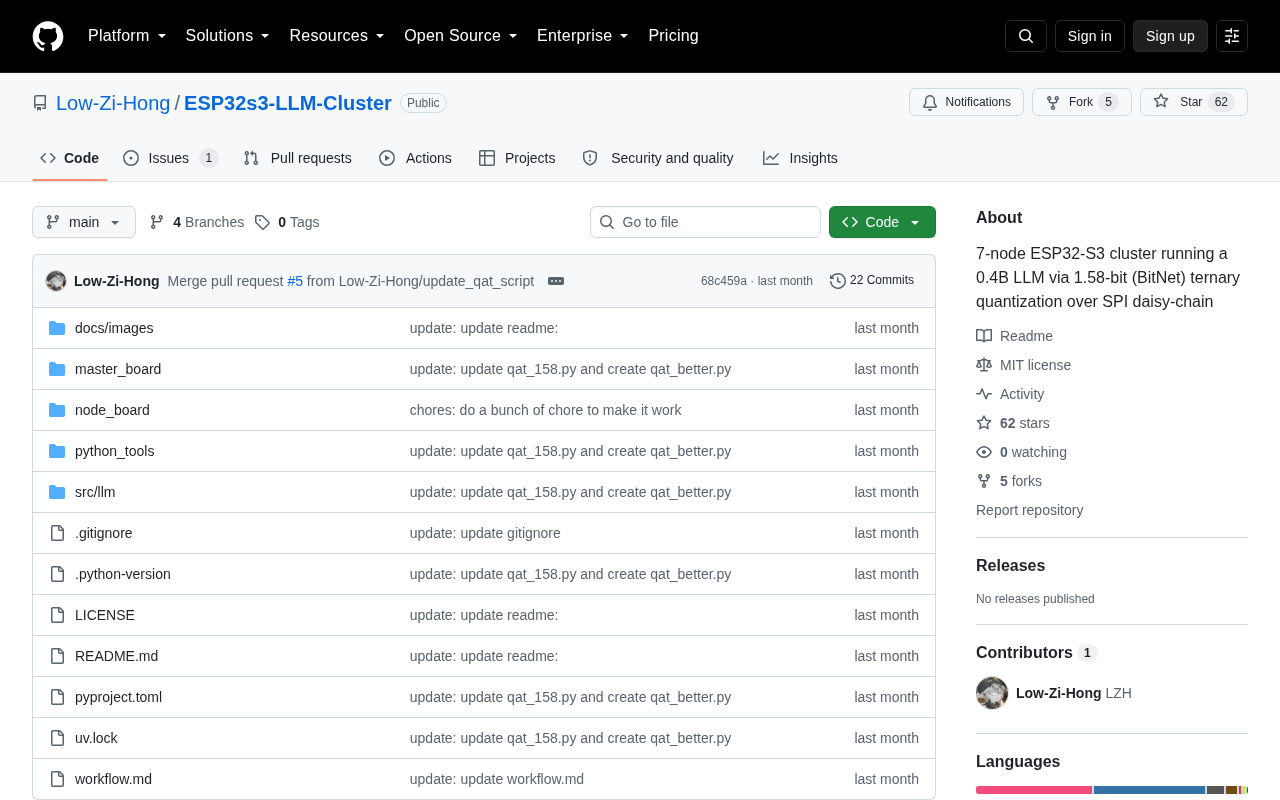
A developer project deploys a 1.58-bit BitNet quantized language model on a cluster of inexpensive ESP32S3 microcontrollers, challenging assumptions about the minimum hardware required for AI inference. BitNet constrains neural network weights to -1, 0, or +1, cutting memory usage to roughly one-tenth of 16-bit floats and reducing matrix multiplications to simple additions. Since a single ESP32S3 has only a few megabytes of RAM, the project uses pipeline parallelism across multiple chips — though inter-chip communication bandwidth and latency remain key bottlenecks. The value lies not in replacing cloud LLMs, but in expanding the boundary of offline, low-power, low-cost AI deployment for use cases like networkless smart sensors and local privacy-preserving processing.
When Large Language Models Meet Microcontrollers
At a time when deploying large language models typically means spinning up data centers packed with high-end GPUs, a project from the developer community has taken the exact opposite approach: building a cluster of inexpensive ESP32S3 microcontrollers to run a 1.58-bit (BitNet) quantized language model. At first glance, the idea seems almost absurd — the ESP32S3 is a low-power chip designed primarily for IoT devices, wearables, and embedded control, with compute and memory specs that fall orders of magnitude short of what modern neural networks typically demand. Yet it's precisely this contrast that gives the project its unique experimental value.
The project was shared on Hacker News and, while discussion is still in its early stages, it touches on an increasingly important question in the AI world: how far can we compress models to bring intelligence truly down to the edge?
The ESP32S3 is a microcontroller from Espressif, featuring a dual-core Xtensa LX7 processor running at up to 240 MHz, along with vector instruction extensions (PIE — Processor Instruction Extensions) designed for neural network acceleration. It typically comes with 512 KB of on-chip SRAM, expandable to 8 MB or even 16 MB via SPI-connected PSRAM. Compared to the earlier ESP32, the S3 series added dedicated instruction set enhancements targeting AI inference, enabling more efficient 8-bit integer matrix operations. Even so, these specs remain extremely limited compared to the gigabytes of VRAM that GPU-based LLM inference typically requires. This orders-of-magnitude gap between hardware capability and task demand is precisely what makes extreme quantization — like BitNet — not an optional optimization, but a hard prerequisite for running language models on such devices.
What Is 1.58-bit BitNet?
BitNet is a class of extreme quantization schemes that has attracted considerable attention in recent years. Traditional neural network weights are typically stored as 16-bit or 32-bit floating-point numbers, whereas BitNet constrains each weight to just a handful of discrete values. The "1.58-bit" in the name refers to a ternary quantization scheme where each weight can only take one of three states: -1, 0, or +1. From an information-theoretic standpoint, log₂(3) ≈ 1.58 bits — and that's where the name comes from.
Why Ternary Quantization Is a Game-Changer
Compressing weights down to three values delivers two decisive advantages. First, memory footprint drops dramatically — theoretically around a 10× reduction compared to 16-bit floats, which is critical for microcontrollers where RAM is measured in kilobytes or a few megabytes. Second, computation is radically simplified: when weights are only -1, 0, or +1, the floating-point multiplications in matrix operations degrade into additions and subtractions, with zero weights skipped entirely — yielding meaningful inference efficiency even on chips without dedicated floating-point units.
This is why BitNet is often described as a quantization paradigm "built for edge devices." It doesn't simply squeeze a large model into a small device — it redesigns the computation from the ground up at the architecture level.
It's worth noting that BitNet is not simply a post-training quantization technique applied to a standard model. It requires the ternary constraints to be introduced during training itself — what's known as Quantization-Aware Training (QAT). This means weight updates during backpropagation already operate within the ternary space, rather than training a high-precision model first and truncating it afterward. This distinction matters enormously: applying such extreme quantization post-training causes catastrophic accuracy degradation, whereas models trained from scratch using the BitNet approach can maintain relatively usable language capabilities at smaller parameter counts. Microsoft Research's BitNet b1.58 papers demonstrate that, at equivalent parameter scales, 1.58-bit models can achieve perplexity scores approaching those of full-precision models — providing a theoretical basis for deploying genuinely "usable" language models on resource-constrained hardware.
What the ESP32S3 Cluster Achieves
A single ESP32S3 chip is extremely resource-limited — typically a dual-core processor, a few hundred kilobytes of SRAM, and some external PSRAM. Even a heavily quantized language model would quickly hit both memory and compute ceilings on a single chip. By using a cluster approach, the project distributes different layers or portions of the model across multiple ESP32S3 chips, which coordinate via inter-chip communication to complete a single end-to-end inference pass.
The Challenges of Distributed Inference
Running distributed inference on a microcontroller cluster is far from straightforward. The communication bandwidth and latency between chips is nowhere near the high-speed interconnects found in data centers, and model partitioning strategy, intermediate activation transfer, and synchronization across nodes all become performance bottlenecks. The value of this project lies precisely in validating a possibility: that even under such constrained hardware conditions, language model inference can be made to run through careful model quantization and task distribution.
It functions more as a proof of concept — demonstrating the hardware floor that extreme quantization combined with distributed computing can reach.
The most common distribution strategy in microcontroller clusters is pipeline parallelism: the Transformer model is split by layer, with each ESP32S3 responsible for computing a subset of consecutive layers. Once a chip finishes its computation, it passes the activations to the next chip, forming a pipeline. This differs from tensor parallelism used in data center GPU clusters, which requires extremely high interconnect bandwidth to efficiently split single-layer matrix operations. Pipeline parallelism places relatively lower demands on inter-chip bandwidth, but the trade-off is that processing each token requires a full end-to-end pass, with inference latency accumulating linearly across nodes. Common inter-chip communication methods on ESP32S3 — including SPI, I2C, and UART — typically operate at bandwidths in the low megabits-per-second range, making activation transfer one of the core throughput bottlenecks of the entire system.
The Broader Vision for Edge AI
The real-world significance of experiments like this isn't that an ESP32S3 cluster could replace cloud-based LLMs — it's that they expand the frontier of where AI can be deployed. When a model can run entirely offline, on low-power, ultra-low-cost hardware, a new class of applications becomes possible: smart sensing devices that work without internet connectivity, privacy-sensitive local voice processing, and autonomous decision-making in environments where network access is unavailable.
From a technology evolution standpoint, the combination of extreme quantization schemes like BitNet with purpose-built low-power chips is steadily advancing the vision of "intelligence everywhere." While today's results remain squarely in the realm of hobbyist and researcher exploration, this kind of bottom-up innovation has a history of producing unexpected engineering breakthroughs.
Closing Thoughts
At its core, the attempt to run a BitNet model on ESP32S3 is an attempt to answer one question: how low can the minimum hardware cost of intelligence actually go? It splices together two domains that rarely intersect — extreme model quantization and embedded microcontrollers — and uses an almost geek-defying approach to probe the physical limits of edge AI. The project is still in its early stages and the discussion hasn't fully unfolded, but the direction it represents is worth watching closely: only when models are small enough and efficient enough can AI truly permeate every tiny device around us.
Related articles

M&M's Spent Millions Replacing Artificial Blue Dye — Why Is It So Hard?
Mars spent millions trying to replace artificial blue dye in M&M's with spirulina, but thick material clogs pipes and residue risks mold, forcing a full production-line rebuild. Here's the engineering behind the reformulation.
Teammate Wanted for Meta Global AI Developer Hackathon: Computer Vision & Medical AI
A Reddit developer seeks teammates for the Meta Global AI Developer Hackathon, focusing on computer vision and medical AI. This article analyzes the track logic, skills-complementarity needs, and topic selection strategy behind this teaming signal.

Multiple Claude Models Hit by Errors: A Postmortem of Fable 5.1, Sonnet 5.5, and Haiku 5.5
Claude Fable 5.1, Sonnet 5.5, Haiku 5.5, and Opus 5.5 fast mode saw elevated errors; Anthropic identified and resolved the issue in 17 minutes. This postmortem covers the timeline, the technical reasons for the multi-model cascading failure, and practical lessons for retry and degradation strategies.