RustDesk: A Complete Guide to the Open-Source Self-Hosted Remote Desktop
A comprehensive guide to RustDesk, the open-source self-hosted alternative to TeamViewer.
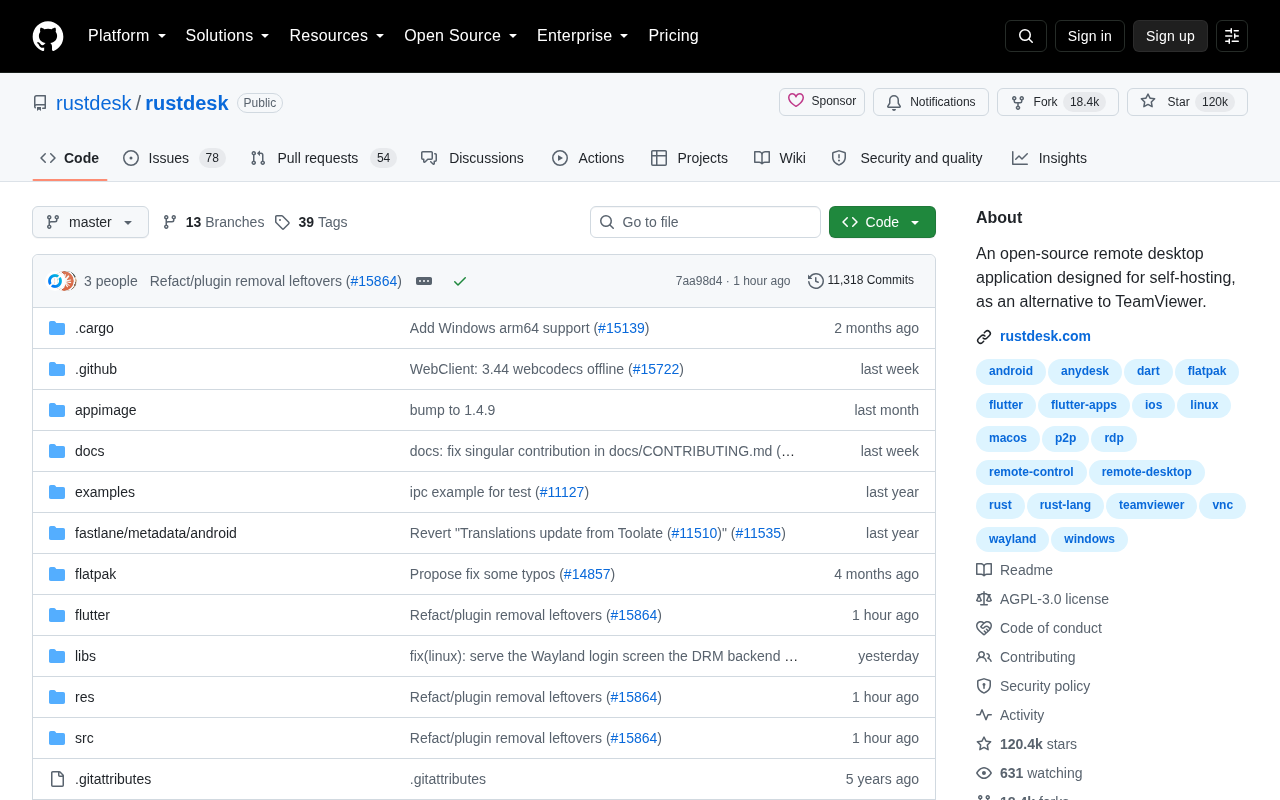
RustDesk is an open-source remote desktop application built in Rust, designed as a self-hosted alternative to TeamViewer and AnyDesk. With over 120K GitHub Stars, it offers NAT traversal, end-to-end encryption, cross-platform support, and full data sovereignty through private relay and signaling servers. This guide covers its technical architecture, deployment considerations, and ideal use cases.
The Open-Source Force in the Remote Desktop Market
In an era where remote work and technical support are increasingly commonplace, remote desktop software has become essential for many individuals and businesses. The history of remote desktop protocols dates back to the 1990s, with Microsoft's RDP protocol and AT&T's VNC protocol serving as the two cornerstones of the field. Modern remote desktop software has evolved continuously on this foundation, with the core challenges being how to achieve low-latency screen transmission over limited bandwidth, accurate input event synchronization, and secure end-to-end encryption. For a long time, commercial products like TeamViewer (released in 2005) and AnyDesk have dominated the market by solving connection challenges in home and enterprise networks through NAT traversal and cloud relay servers. However, their licensing costs, usage restrictions, and privacy concerns arising from routing all data traffic through third-party servers have driven an increasing number of users to seek alternatives.
RustDesk has emerged precisely against this backdrop. As an open-source remote desktop application, its key selling point is self-hosting capability, giving users full control over their data flow. The project has accumulated over 120,000 Stars and 18,000 Forks on GitHub, and continues to grow at a pace of approximately 130 new Stars per day — a clear testament to its popularity within the developer community.
What Is RustDesk: The Core Positioning of an Open-Source Remote Desktop
An Open-Source Alternative to TeamViewer
RustDesk's positioning is crystal clear: to be the open-source alternative to TeamViewer. It is developed in Rust, which inherently gives it natural advantages in memory safety, runtime performance, and cross-platform capability. The Rust language was initiated by Mozilla Research in 2010 and released version 1.0 in 2015. Its core innovation is the "Ownership System" — through a compile-time Borrow Checker, it guarantees memory safety and thread safety without introducing a garbage collection (GC) mechanism. Traditional C/C++ programs often suffer from security vulnerabilities caused by dangling pointers, buffer overflows, and data races. Microsoft has disclosed that approximately 70% of security vulnerabilities in its products stem from memory safety issues, and Rust eliminates these risks at the language level. Rust has now been adopted by core infrastructure including the Linux kernel, Android, and the Windows driver framework, and the U.S. National Security Agency (NSA) and the White House have repeatedly recommended using memory-safe languages to replace C/C++. Using it to build a remote desktop tool that demands low latency and high stability is a sound technical choice.
The Core Value of Self-Hosting
RustDesk's biggest differentiator is self-hosting. Unlike most commercial remote desktop software that forces traffic through the vendor's servers, RustDesk allows users to set up their own relay and signaling servers.
In a remote desktop connection, signaling servers and relay servers play different but critical roles. The signaling server handles the connection establishment phase — it helps two devices discover each other, exchange connection metadata, and negotiate communication parameters, similar to a switch in a telephone network. The relay server, on the other hand, acts as an intermediary data-forwarding node when a direct peer-to-peer (P2P) connection cannot be established (for example, when both parties are behind strict NAT or firewalls), forwarding screen images and operation commands from one end to the other. RustDesk prioritizes establishing a P2P direct connection via UDP hole punching for optimal performance, and only falls back to relay mode when traversal fails.
Self-hosting these servers means:
- All connection data can be transmitted on servers you control. Even in relay mode, data only passes through infrastructure under your control, preventing third parties from accessing sensitive information;
- Enterprise intranet environments can be deployed completely offline, meeting compliance and security requirements;
- No more artificial limitations imposed by commercial software on the number of connections or devices.
For enterprises, government agencies, and privacy-conscious individual users who value data sovereignty, this feature is extremely attractive. Data Sovereignty refers to the principle that data should be subject to the laws of the country or region where it resides. With regulations such as the EU's General Data Protection Regulation (GDPR), China's Data Security Law, and Personal Information Protection Law coming into effect, enterprises must consider cross-border data flow issues when choosing remote desktop tools. When using commercial remote desktop software, connection data may pass through relay servers located overseas, which could legally constitute data export and trigger additional compliance obligations or even legal risks. The self-hosting model allows enterprises to deploy all servers within geographically compliant regions, fundamentally avoiding cross-border data issues — which is particularly important for regulated industries such as finance, healthcare, and government.
Deep Dive into RustDesk's Technical Advantages
Why Develop in Rust
RustDesk's name itself reveals its technical foundation. The Rust language is renowned for "memory safety without GC," capable of eliminating a large class of memory vulnerabilities at compile time while delivering runtime performance close to C/C++. Rust retains the design philosophy of zero-cost abstractions, providing the convenience of a high-level language without sacrificing runtime performance. For applications like remote desktop that require real-time screen transmission and input event handling:
- Low latency: Rust's high performance ensures smooth screen transmission and responsive operations;
- Stability: Memory safety features significantly reduce the risk of crashes and security vulnerabilities;
- Cross-platform: Rust's excellent cross-platform support enables RustDesk to cover Windows, macOS, Linux, Android, iOS, and even Web environments.
NAT Traversal and Connection Optimization
One of the biggest network challenges facing remote desktop connections is NAT (Network Address Translation) traversal. The vast majority of home and enterprise devices sit behind NAT devices (routers) without public IP addresses, making it impossible for two devices both behind NAT to directly access each other. RustDesk's solution combines standardized technologies such as STUN (Session Traversal Utilities for NAT) and TURN (Traversal Using Relays around NAT). The STUN server helps devices discover their public addresses and NAT types, then attempts to establish a direct P2P connection via UDP hole punching. Statistics show that the P2P direct connection success rate is approximately 70%-85% in typical network environments. When both parties are behind strict environments like Symmetric NAT, hole punching fails, and the relay server steps in to forward data, ensuring the connection remains available.
Screen Transmission and Codec Technology
Screen transmission in remote desktop is essentially a real-time video encoding problem. RustDesk supports multiple codecs, including VP8/VP9 (open-sourced by Google), H.264/H.265 (requiring hardware acceleration support), and specialized encoding methods optimized for static images. Unlike video streaming, the remote desktop scenario has unique characteristics: the screen is static most of the time, with changes occurring only when the cursor moves or windows update. Therefore, efficient dirty rectangle detection — encoding and transmitting only the regions of the screen that have actually changed — is critical for reducing bandwidth consumption and latency. RustDesk also supports hardware codec acceleration, leveraging GPU-dedicated encoding engines (such as NVIDIA NVENC, Intel Quick Sync) to offload CPU burden, which is especially crucial as 4K displays become increasingly prevalent.
Out-of-the-Box and Flexible Deployment in Parallel
RustDesk provides official public servers, allowing users to use it immediately with zero configuration after downloading the client, offering an experience similar to TeamViewer's instant connectivity. For users with higher requirements, private servers can be deployed for fully autonomous control. This dual-track approach of "ready out-of-the-box yet deeply customizable" caters to the needs of both casual and professional users.
Open-Source Community Ecosystem and Trust
Community Trust Behind the GitHub Numbers
With over 120,000 Stars, RustDesk ranks among the top tier of open-source projects. More importantly, the 18,000 Forks indicate that a large number of developers are not just watching the project but actively participating in secondary development and contributions. The steady growth of 130 Stars per day demonstrates that RustDesk's popularity is not a flash in the pan but continues to attract new users.
Open-Source Transparency Ensures Security
For software like remote desktops that handle highly sensitive operations such as screen content and keyboard input, code auditability is critical. This philosophy aligns with Kerckhoffs' Principle in the security field — a system's security should not rely on the secrecy of its design, but rather on the secrecy of its keys. Open-source software allows security researchers worldwide to review the code, and this "many eyes" effect can discover and fix security vulnerabilities more quickly.
Users of closed-source commercial software have no way to confirm whether their data is being misused. RustDesk's open-source nature allows anyone to audit the code, verify its security claims, and even compile it independently, compare binaries, and conduct independent security audits of critical modules — a level of security assurance that closed-source software simply cannot provide. This transparency is itself a powerful endorsement of trust.
Of course, open source does not automatically equal secure. The Log4Shell vulnerability in 2021 and the XZ Utils backdoor incident in 2024 both demonstrated that open-source projects also face supply chain attack threats. However, open source at least provides the possibility of discovering and responding to these threats, whereas similar backdoors in closed-source software may never be found.
Use Cases and Selection Recommendations
Who Should Use RustDesk
- IT support teams: Those who need frequent remote assistance and face high commercial software licensing costs;
- Privacy-conscious enterprises: Organizations that want all remote connection data to flow through their own servers, especially regulated industries such as finance, healthcare, and government bound by GDPR, Data Security Law, and similar regulations;
- Developers and tech enthusiasts: Those who prefer open-source, customizable tools and are willing to set up their own services;
- Cross-platform users: Those who need to switch flexibly between multiple operating systems.
Things to Consider Before Deployment
As an open-source self-hosted solution, RustDesk does have a learning curve. If private deployment is needed, users must have a certain level of server administration capability, including server network configuration (such as opening ports and firewall rules), SSL certificate management, and ongoing security update maintenance. Additionally, while it is already quite mature, it may still need to be compared with established commercial products before making a decision on certain enterprise-grade features (such as complex permission management, large-scale device management, and audit logging).
Conclusion
RustDesk represents a quintessential example of open-source software continuously challenging commercial giants in the professional tools space. With the technical advantages of the Rust language, data sovereignty assurance through self-hosting, and an active community ecosystem, it has become a highly competitive alternative to TeamViewer and AnyDesk.
For any user who cares about cost, privacy, and control, RustDesk deserves a place on the shortlist of remote desktop tools. As the community continues to grow, its future development potential is equally worth looking forward to.
Related articles

GPT-Next Leak, Gemini 4 Argon Imminent: AI News Roundup
GPT-Next leak suggests extreme efficiency; OpenAI's 28-day shipping pledge boosts speed 50%; Gemini 4 Argon nears release; Anthropic subscription value report sparks debate.

GPT-Next Leaked, Gemini 4 Argon Speeds Up, Fable 5.5 May Launch Today
OpenAI's GPT-Next model leaks, expected to be extremely low-cost and possibly part of the 28-day release plan; Gemini 4 Argon internal testing accelerates, NanoBanana 2.1 is live; Semi Analysis tests show Claude Max's equivalent API value is about 5 times that of ChatGPT Pro; Fable 5.5 may launch today.

Gemini 4 Argon Launches Globally: Key Highlights from the AI Daily Brief
Google opens Gemini 4 Argon globally across Pro and Ultra subscriptions and the API, and demonstrates robot control. This article rounds up open-source models, Agent infrastructure, cost transparency, and safety governance updates.