RuVector Open-Source Toolkit: Giving AI Search Adaptive Memory

RuVector is an open-source adaptive search toolkit that lets retrieval systems learn from experience by recording search paths and reusing query memory.
RuVector is an open-source toolkit that solves the problem of isolated queries and lack of knowledge accumulation in traditional search. Its core capability is recording search paths, reusing query memory, and adaptively adjusting retrieval settings. Adaptation occurs at the strategy layer without retraining foundation models, making it lightweight and interpretable. Use cases include customer service and recommender systems; third-party benchmarks are still lacking.
When Search Starts to "Remember" Experience: What Problem RuVector Solves
Traditional search treats every query in isolation: what you searched for once, you have to start over from scratch the next time. RuVector aims to change that. According to shares on the Reddit community and Product Hunt, this is an open-source toolkit whose core capability is adapting from experience—it records search paths, reuses useful context, and makes subsequent queries smarter.
This positioning hits a real pain point: most retrieval systems only optimize "single-hit accuracy" and don't care about "knowledge accumulation across multiple queries." RuVector treats "query memory" as a first-class citizen—essentially adding an accumulable experience layer to search.
Core Mechanisms: Search Paths, Query Memory, and Adaptive Settings
RuVector provides an explorable toolbox, not a black-box product. In the official demo, Explorer lets users intuitively see three things:
- Search path: how a query converges step by step to results; the path itself can be observed and debugged;
- Query memory: which historical queries are relevant to the current need, and how they are reused;
- Adaptive search settings: retrieval parameters that the system adjusts based on experience.
Another practical design is the comparison view of "result quality vs. search effort." Retrieval systems usually face a trade-off between accuracy and cost, and RuVector makes this trade-off explicit, letting developers intuitively judge whether the extra compute is worth it.
The difference between the retrieval strategy layer and the model weight layer: In retrieval systems, the strategy layer is responsible for deciding "how to search," including tunable parameters such as query expansion, path selection, and result ranking; whereas the model layer (e.g., embedding models) and its weights determine the semantic representation capability of "what can be found." RuVector's adaptation happens at the strategy layer, meaning it optimizes results by adjusting retrieval parameters without changing the underlying model weights, so updates are lightweight, interpretable, and easy to roll back.
The trade-off between accuracy and cost (Quality vs. Effort): In retrieval systems, improving result quality often requires more computational investment, such as deeper retrieval paths, more candidate reranking, or more complex query expansion. RuVector's comparison view makes this trade-off explicit, helping developers judge whether extra investment brings appreciable accuracy gains, so they can adjust strategy according to business needs.
Clear Boundaries: Browser Demo Does Not Train Foundation Models
Commendably, the official documentation is very clear about capability boundaries: the browser demo only adjusts search settings and does not retrain foundation models.
This statement seems conservative but is actually important. It means RuVector's "adaptation" happens at the retrieval strategy layer, not the model weight layer—memory is lightweight, interpretable, and rollbackable. For teams wanting to introduce adaptive retrieval in production, this layered design is easier to implement and audit than "end-to-end retraining."
Foundation models and retrieval augmentation: Foundation models usually refer to general-purpose models pretrained on large-scale corpora (such as language models or embedding models), whose weights are generally fixed after deployment. Retrieval augmentation uses external knowledge or historical information at inference time to improve output quality without changing the model itself. RuVector's "adaptation" falls under retrieval augmentation—it optimizes retrieval strategy by reusing query memory rather than retraining foundation models, thus avoiding high training costs and the risk of catastrophic forgetting.
Use Cases: From Customer Service Assistants to Recommender Systems
The official application directions include customer service assistants and recommender systems. What these two scenarios have in common is: user needs are highly repetitive, and context reuse is highly valuable.
Take customer service assistants as an example: similar questions recur, and if the system can remember "which retrieval path solved the problem last time," both response quality and speed improve. The same applies to recommendation scenarios—historical query patterns themselves are valuable signals. Combined with its open-source nature (GitHub repository ruvnet/ruvector), developers can modify retrieval strategies themselves without being tied to a closed-source service.
Highlights and Open Questions of Open-Source Adaptive Memory
From community feedback, RuVector's appeal lies in turning the rather academic concept of "adaptive memory" into a hands-on tool: a browser demo, Explorer visualization, and open-source code. According to the Product Hunt page and Reddit discussion, it is more like a scaffold for experimentation and secondary development.
What requires judgment: currently, public information mainly comes from the project's own description, lacking third-party benchmarks to quantify the actual gains from "adaptation." The comparison view of search effort vs. result quality is a good starting point, but real effectiveness still depends on specific data distributions. For developers, what's worth doing is running Explorer on your own business corpus to see whether query memory really reduces the cost of repeated retrieval.
Overall, the approach RuVector represents—explicitly accumulating search experience and limiting adaptation to the strategy layer—is more pragmatic than simply piling on model parameters. Open source lets this approach be verified, and that itself is its greatest value.
One-line Summary
RuVector is an open-source adaptive search toolkit that lets retrieval systems learn from experience by recording search paths and reusing query memory.
Paragraph Summary
RuVector is an open-source toolkit aimed at solving the problem that traditional search treats each query in isolation and lacks knowledge accumulation. Its core capability is recording search paths, reusing query memory, and adaptively adjusting retrieval settings to make subsequent queries smarter. Through Explorer visualization, users can observe search paths, query memory, and adaptive parameters, and compare result quality with search effort. The official documentation clearly states that the browser demo only adjusts search settings and does not retrain foundation models, so adaptation happens at the strategy layer and is lightweight, interpretable, and rollbackable. Use cases include customer service assistants and recommender systems, and developers can build on the GitHub repository. Currently, third-party benchmarks are lacking, and actual gains need to be verified with real corpora.
Related articles

M&M's Spent Millions Replacing Artificial Blue Dye — Why Is It So Hard?
Mars spent millions trying to replace artificial blue dye in M&M's with spirulina, but thick material clogs pipes and residue risks mold, forcing a full production-line rebuild. Here's the engineering behind the reformulation.

Teammate Wanted for Meta Global AI Developer Hackathon: Computer Vision & Medical AI
A Reddit developer seeks teammates for the Meta Global AI Developer Hackathon, focusing on computer vision and medical AI. This article analyzes the track logic, skills-complementarity needs, and topic selection strategy behind this teaming signal.
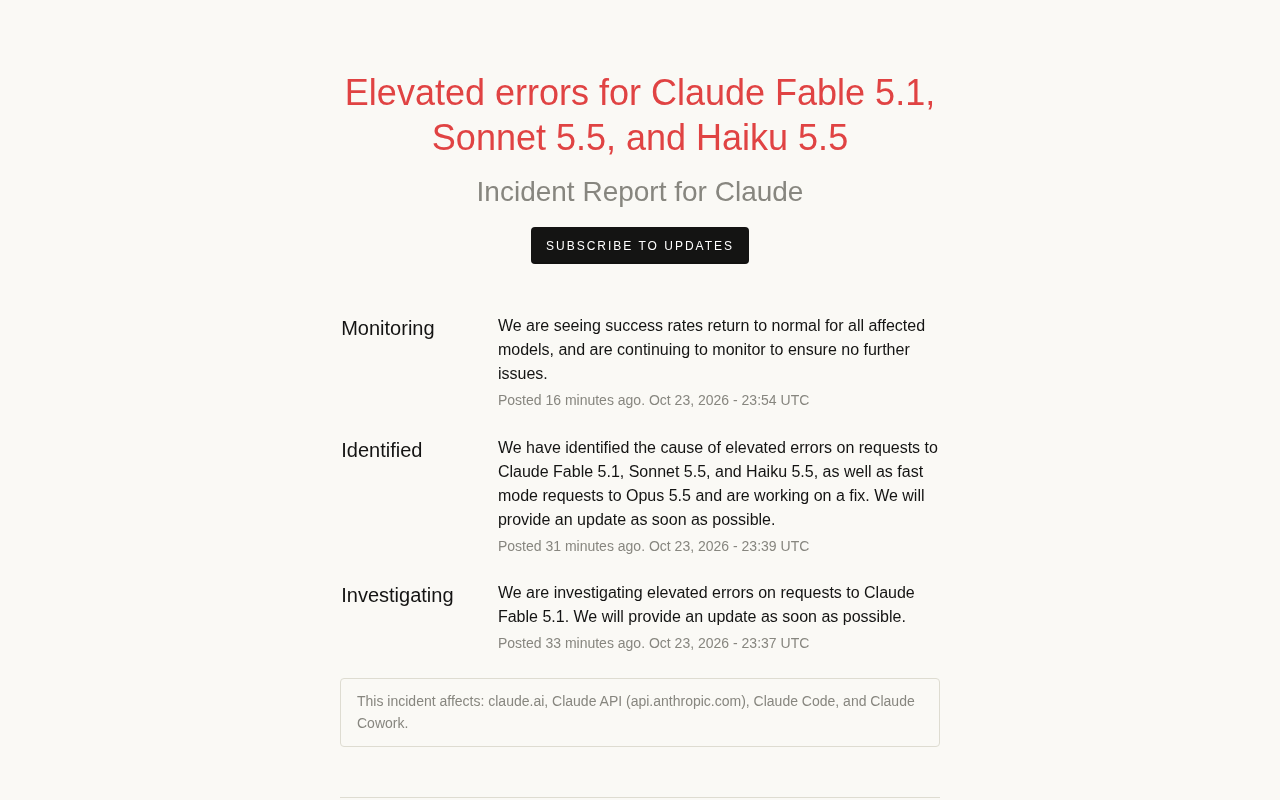
Multiple Claude Models Hit by Errors: A Postmortem of Fable 5.1, Sonnet 5.5, and Haiku 5.5
Claude Fable 5.1, Sonnet 5.5, Haiku 5.5, and Opus 5.5 fast mode saw elevated errors; Anthropic identified and resolved the issue in 17 minutes. This postmortem covers the timeline, the technical reasons for the multi-model cascading failure, and practical lessons for retry and degradation strategies.