Safari 27.3 Introduces Adaptive Dark Mode: A Look at WebKit's New Feature

Safari 27.3 introduces Adaptive Dark Mode, dynamically adjusting based on page content rather than simple inversion.
Apple's WebKit team announced that Safari 27.3 introduces "Adaptive Dark Mode," which no longer simply follows or ignores system settings but dynamically adjusts dark presentation based on page content characteristics, aiming for a more natural browsing experience while preserving original design intent. Compared to forced dark schemes that achieve dark effects through inversion or dimming, it emphasizes avoiding image distortion and abnormal contrast. The news received 260 points and 165 comments on Hacker News; developers acknowledge its potential to improve readability on unadapted sites but worry that browser intervention in rendering will weaken control over the final output. The article advises front-end developers to re-examine prefers-color-scheme strategies, watch for interactions with adaptive behavior and cross-browser differences, and consult the original WebKit post for trigger conditions and configuration options.
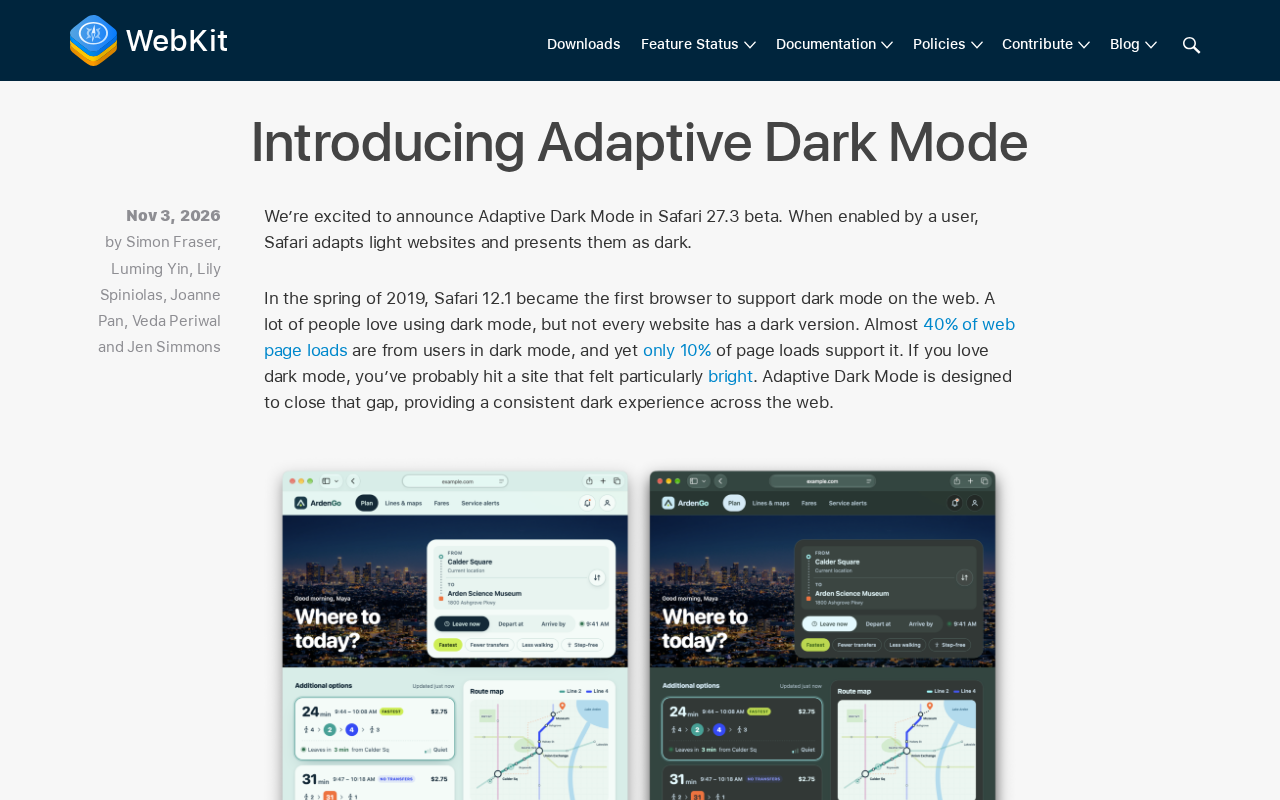
Apple's WebKit team announced on the official blog that Safari 27.3 introduces a new feature called "Adaptive Dark Mode." The news quickly sparked discussion on Hacker News, where the post garnered 260 points and 165 comments, showing the developer community's strong interest in changes to browser rendering behavior.
What Problem Does Adaptive Dark Mode Solve?
Traditional dark mode at the browser level usually offers only two choices: fully follow the system, or completely ignore system settings. For web developers, this means either manually writing two color schemes or relying on the CSS media query prefers-color-scheme for adaptation.
Adaptive Dark Mode takes a different approach. It attempts to let the browser dynamically adjust how dark mode is presented based on the characteristics of the page content itself, rather than simply forcing all pages through a uniform dark filter. The WebKit blog positions this feature as providing a more natural dark browsing experience while preserving the page's original design intent.
How It Differs from Forced Dark Mode
Interestingly, some browsers have previously offered a "forced dark" option that achieves dark effects by inverting or dimming page colors, but such approaches often lead to distorted images, abnormal contrast, and other issues. Adaptive Dark Mode emphasizes "adaptive," meaning it may make judgments based on factors such as the page's color distribution, background brightness, and text contrast, rather than applying a one-size-fits-all color inversion.
prefers-color-scheme is a user-preference feature in CSS media queries, with values of light or dark, used to let stylesheets sense the operating system's or browser's light/dark theme setting. Developers typically define two sets of color tokens using CSS custom properties (CSS variables) and switch variable values within that media query, achieving dark adaptation at low cost. Its limitation is that it can only express the user's global preference, cannot reflect an individual page's design intent, and lacks awareness of page content. Additionally, the feature only takes effect when developers actively write styles, and it cannot address existing websites or third-party embedded content—one of the motivations for introducing adaptive adjustment at the browser level.
Forced dark mode was first popularized in some mobile browsers and system-level rendering, with typical implementations involving color inversion, brightness reduction, or hue rotation of the page. These algorithms perform global transformations based on pixels or computed styles without understanding semantics, so problems frequently arise such as inverted images, distorted brand colors, and imbalanced contrast in shadows and borders. The industry has used the color-scheme meta tag and CSS property to give browsers hints, declaring that a page already supports dark mode or should not be automatically processed, thereby allowing forced transformations to skip specific elements. The difference with adaptive approaches is that they shift the basis for judgment from fixed rules to an evaluation of the page's color distribution and readability—essentially moving from a "uniform filter" to "conditional intervention."
Reactions from the Developer Community
The buzz on Hacker News reflects the sensitivity of this feature. Among the 165 comments, developers focused on several aspects: whether browser intervention in page rendering would affect design consistency, whether the adaptive algorithm would introduce unpredictable visual differences, and whether developers would need to adjust their existing CSS strategies accordingly.
According to feedback from the Hacker News discussion thread, some developers believe this helps improve readability for websites that have not yet adapted to dark mode; others worry that automatic intervention at the browser level will weaken developers' control over the final presentation. Such divisions are common whenever browsers introduce any new rendering-layer feature.
Impact on Web Development Practices
For front-end developers, the introduction of Adaptive Dark Mode means re-examining dark mode adaptation strategies. If browsers begin automatically handling some dark scenarios, developers' existing prefers-color-scheme media query logic may interact with the browser's adaptive behavior.
Compatibility Considerations
Since the feature is currently only introduced in Safari 27.3, cross-browser behavior will inevitably differ. When testing dark mode, developers need to pay extra attention to actual rendering results in Safari to avoid conflicts between design mockups and the browser's automatically adjusted output. The original WebKit blog post provides technical details of the feature, and developers are advised to consult it directly to understand specific trigger conditions and configurable options.
Cross-browser differences are particularly pronounced with dark mode: Chrome and Edge offer forced dark toggles, Firefox has a similar color scheme override mechanism, and Safari's adaptive strategy has different trigger conditions from the former. In practice, feature detection rather than browser sniffing can be used to determine capabilities—for example, checking relevant properties or media queries via CSS.supports, and retaining complete prefers-color-scheme fallback styles for unsupported environments. It is also recommended to treat dark mode as a separate matrix dimension in visual regression testing, covering screenshot comparisons across Safari, Chromium, and Firefox to catch deviations caused by automatic adjustments early.
Conclusion
Safari 27.3's Adaptive Dark Mode is an attempt by the browser to respond more precisely to user preferences at the rendering level. Whether it will be widely accepted by developers and users depends on the actual performance of the adaptive algorithm and the developer community's willingness to adapt. The lively discussion on Hacker News has already proven that any change in browser rendering behavior touches a nerve in the Web ecosystem.
Original link: https://webkit.org/blog/18541/introducing-adaptive-dark-mode/
Related articles

9 AI Subscription Plans Compared: The Real Cost Per 100M Tokens Revealed
Bilibili creator tests 9 AI subscription plans from Volcano, Alibaba, Tencent, Baidu, Zhipu, Xiaomi, MiniMax and more, converting them all to real cost per 100M tokens, breaking down fixed-quota vs. three-tier coefficient billing and how caching, time-of-day discounts, and window limits affect actual quota.

Vibe Coding for Beginners: Expressing Intent Instead of Handwriting Code
What is Vibe Coding? A 137-episode Bilibili course defines it: the core is expressing intent, not writing code. This article analyzes Vibe Coding's productivity logic, target audience, and entry expectations to help beginners decide if it's worth learning.

LangChain Beginner's Guide: An Agent Development Roadmap from LangGraph to Deep Agents
Clarify the encapsulation relationship among LangChain, LangGraph, and Deep Agents, and master the learning path and selection logic for agent development frameworks—suitable for beginners in large model development.