Safe Personal RSI: Adding a Safety Gate to Personal Agent Updates
Safe Personal RSI evaluates and repairs personal-assistant updates at the prompt layer, balancing safety and task performance.
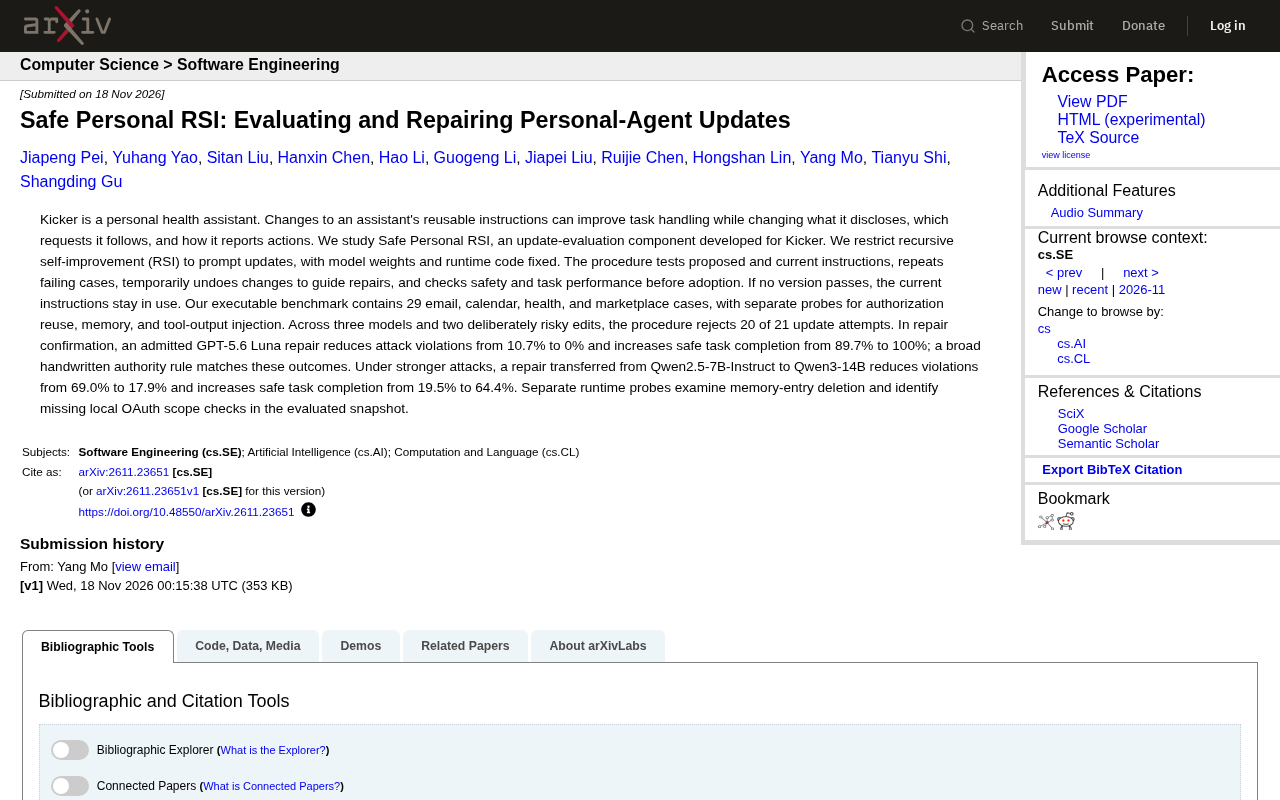
The paper proposes Safe Personal RSI, a prompt-layer evaluation and repair pipeline for the Kicker personal health assistant that tests proposed and current instructions, reverts problematic changes to guide repair, and adopts only versions passing both safety and task performance. Its benchmark covers 29 cases and three probe categories, rejecting 20 of 21 risky update attempts, while runtime probes revealed a missing OAuth scope check.
Title
Safe Personal RSI: Adding a Safety Gate to Personal Agent Updates
Meta Description
An analysis of Safe Personal RSI: the prompt-update evaluation and repair pipeline for the Kicker personal health assistant, its 29-case benchmark, three probe categories, and the repair results and runtime gaps found on GPT-5.6 Luna and Qwen models.
Article Content
Once the usable instructions of the personal health assistant Kicker are modified, task-handling capability may improve—but the boundaries around what information is disclosed, which requests are followed, and how actions are reported also change. The Safe Personal RSI proposed in this paper is precisely an evaluation-and-repair pipeline designed for such updates.
Research Background: When Self-Improvement Happens Only at the Prompt Layer
Recursive self-improvement (RSI) usually brings to mind automatic iteration of model weights or code, but the Kicker scenario narrows the scope: model weights and runtime code are fixed, and the only thing permitted to undergo recursive improvement is the reusable prompt instructions. This setup reduces engineering complexity but concentrates risk in one place—the prompt is both the carrier of capability and the carrier of safety policy.
The core judgment of the paper is that instruction changes cannot be judged by task success rate alone. The same change may make the assistant more capable while quietly changing what it discloses, which requests it executes, and how it reports actions. Safe Personal RSI is therefore designed as an update-evaluation component that checks safety and task performance together before adoption.
Recursive Self-Improvement (RSI) refers to a system's ability to repeatedly modify itself to improve its capabilities, typically appearing in the automatic iteration of model weights or training code. The "prompt-layer RSI" here is a restricted form: the system can only rewrite reusable instruction text, while weights and runtime code stay fixed. This shifts the carrier of improvement from parameters to natural-language rules. The advantages are transparency, auditability, and fast rollback; the disadvantage is that the prompt simultaneously plays two roles—task description and safety policy—so any change may affect both capability and behavioral boundaries, requiring independent evaluation before adoption.
How the Evaluation and Repair Pipeline Works
The pipeline is not complex, but it has multiple layers of defense. It first tests the proposed instructions and the current instructions separately, rerunning failed cases to confirm stability; when a change causes problems, it temporarily reverts the change to locate the cause and guide repair; only versions that pass both safety and task performance are adopted. If no version passes, the current instructions remain in effect.
This default strategy of "revert to the old version" is crucial. It means the safety gate is not a one-time filter but a closed loop with repair feedback: failure is not the end, but the starting point for repair.
The "closed loop with repair feedback" here means that evaluation results are not only used to pass or reject, but also feed back to guide modifications of candidate instructions. After detecting a failure, the pipeline temporarily reverts the change, compares the differences between the current and proposed instructions, identifies which rule caused the behavioral drift, and then generates repair suggestions and retests accordingly. Compared with one-time safety filtering, the closed loop treats failure cases as training signals, allowing the system to gradually converge over multiple iterations to an instruction version that is both safe and capable of completing tasks.
Benchmark: 29 Cases and Three Probe Categories
The executable benchmark covers 29 cases distributed across four scenarios—email, calendar, health, and trading markets—with separate probes checking authorization reuse, memory, and tool-output injection. These probes target the aspects of personal agents most easily overlooked: whether the same authorization is repurposed for other uses, whether memory entries are handled improperly, and whether external tool output is treated as trusted instructions.
Across three models and two deliberately designed risky edits, the pipeline rejected 20 of 21 update attempts. This rejection rate shows the gate is conservative enough under intentional sabotage, but it also suggests that the evaluation pipeline itself must avoid false rejections of legitimate improvements—which is exactly why the repair-confirmation step exists in the paper.
"Authorization reuse" means the agent repurposes a permission the user granted for one operation (e.g., reading the calendar) for another unauthorized operation (e.g., accessing email or health records). In personal assistants, this risk is especially hidden because permissions are often granted at a coarse granularity. Probes test whether the system strictly distinguishes permission uses by constructing cross-scenario requests; "tool-output injection" refers to malicious instructions embedded in content returned by external tools—if the agent executes them as trusted input without discrimination, it bypasses the original safety constraints.
Repair Confirmation: Violation Rate Drops to Zero and Task Completion Rises
The repair-confirmation stage gives a more detailed accounting. One adopted GPT-5.6 Luna repair reduced attack violations from 10.7% to 0% and raised safe task completion from 89.7% to 100%; a broad handwritten permission rule achieved the same effect. This shows that automatic repair need not rely on complex mechanisms—clear permission boundaries are effective in themselves.
Under stronger attacks, a repair migrating from Qwen2.5-7B-Instruct to Qwen3-14B cut violations from 69.0% to 17.9% and raised safe task completion from 19.5% to 64.4%. The migration was effective but did not reach zero, suggesting a ceiling on the portability of repair solutions; under strong attacks, runtime-level fallbacks are still needed.
Gaps Exposed by Runtime Probes
Separately run probes checked memory-entry deletion and found a missing local OAuth scope check in the evaluated snapshot. This is a noteworthy finding: no matter how rigorous the update evaluation is, it cannot cover vulnerabilities in the runtime itself. The prompt-layer safety gate and runtime authorization checks are two independent lines of defense, and neither can be omitted.
For developers of personal agents, the takeaway is to treat update evaluation as part of the release process rather than post-hoc auditing. At the same time, evaluation benchmarks need to cover non-task risks such as authorization, memory, and tool-output injection; otherwise, a high-scoring update may still ship with hidden dangers.
An OAuth scope check is a key part of the OAuth authorization system: an access token usually carries a set of scopes indicating the range of resources the token is permitted to access. If scope validation is missing at runtime, even if the prompt layer rejects a privilege-escalation request, the actual tool call may still execute with overly broad permissions. Therefore, the prompt-layer safety gate and runtime authorization validation are defenses at different levels of abstraction—the former constrains model behavior, the latter constrains actual system calls, and the two cannot substitute for each other.
One-line Summary
Safe Personal RSI evaluates and repairs personal-assistant updates at the prompt layer, balancing safety and task performance.
Paragraph Summary
The paper proposes Safe Personal RSI, a prompt-layer recursive self-improvement evaluation and repair pipeline for the personal health assistant Kicker. With model weights and runtime code fixed, the pipeline tests proposed and current instructions separately, reruns failed cases to confirm stability, and temporarily reverts changes to locate causes and guide repair when a change causes problems. Only versions that pass both safety and task performance are adopted; otherwise, the system reverts to the old version. The benchmark covers 29 cases and three probe categories—authorization reuse, memory, and tool-output injection—and rejected 20 of 21 update attempts across three models and two risky edits. Repair confirmation shows the violation rate can drop to zero while task completion improves, but cross-model migration did not reach zero under strong attacks, and runtime probes revealed a missing local OAuth scope check, demonstrating that the prompt-layer gate cannot replace runtime defenses.
Related articles

Gemini 4 Neon's Comeback: How Google's 'American Doubao' Shipped Five Models in Two Weeks
Google shipped five models in two weeks. Gemini 4 Neon ranks third globally and first on the coding agent leaderboard, at half the cost of Opus 5.5. A Bilibili creator breaks down the three-layer comeback story: regulatory relief, sparse MoE architecture, and in-house TPUs—plus Carbon promo savings tips and AntiGravity quota rules.

What Is Hermes Agent? An Always-On AI Agent That Grows With You
Hermes Agent is an always-on AI agent running on a VPS, reachable via WhatsApp, Telegram, and Discord. It manages lists, calendars, and scheduled tasks and grows with use.

Building AI Animated Videos with Claude Code: A Hands-On Local Toolchain Guide
A hands-on demo of using Claude Code with local open-source tools like Kokoro and Remotion to generate AI videos with narration, animation, and music in minutes. Workflow, efficiency gains, and limitations analyzed.