Same BMW 3 Series: Electric Version Is $4,400 Cheaper Than Gas

BMW's new 3 Series EV undercuts its gas counterpart by $4,400, marking a turning point in EV cost competitiveness.
BMW's new 3 Series arrives with its electric variant priced roughly $4,400 below the gasoline version — a rare pricing reversal that marks a milestone in EV cost evolution. The shift is driven by a decade of steep battery cost declines, the structural simplicity of electric powertrains, and shared-platform efficiencies. For consumers, the green premium is gone; for the industry, market forces are replacing subsidies as the engine of electrification.
The Signal: EVs Are Now Undercutting Gas Cars on Price
BMW has offered up a remarkably symbolic comparison: the all-new BMW 3 Series is available in both gasoline and fully electric versions — and the electric variant is priced approximately $4,400 lower than its gas-powered counterpart. Just a few years ago, this would have been nearly unthinkable. For a long time, EVs commanded a premium over comparable combustion vehicles, largely due to the high cost of batteries.
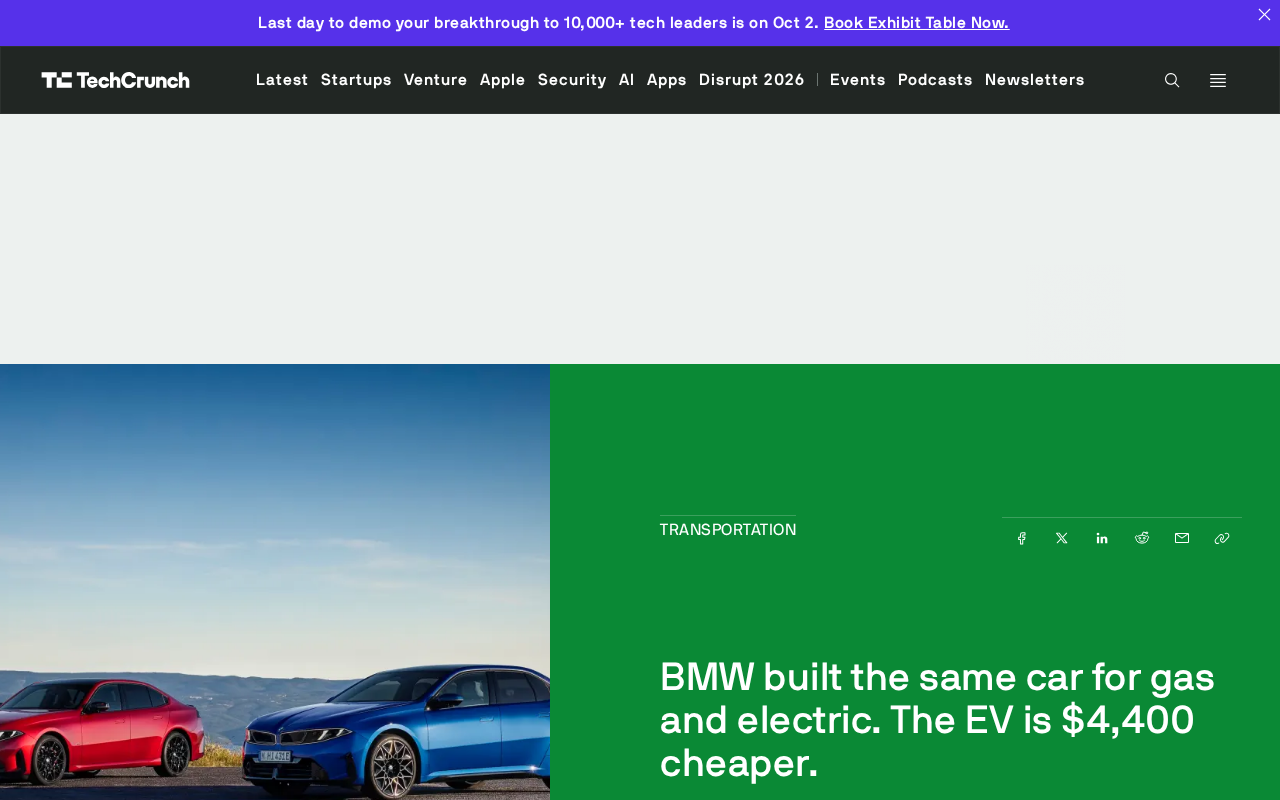
When the same car, on the same platform, with essentially the same design language is cheaper in its electric form, the message is clear: EVs have rapidly closed — and in some cases reversed — the cost gap with traditional combustion vehicles. This is no longer a subsidy-driven anomaly. It's a structural shift born from a maturing supply chain.
Why the Electric Version Can Be Cheaper
The core driver behind falling EV costs is the battery. Over the past decade, the per-unit cost of automotive battery packs has declined steadily, driven by economies of scale, advances in materials science, and a more mature supply chain. Once the most expensive component in an EV, batteries are no longer a "premium part" — and with that, the inherent cost disadvantage of EVs over combustion vehicles has begun to erode.
On the other side of the equation, electric powertrains are structurally simpler. Compared to the complex mechanical systems required for a combustion vehicle — engines, transmissions, exhaust systems — electric motors and their drivetrains have fewer parts and simpler assembly, which translates into cost advantages at scale.
BMW's decision to build both powertrain variants on a shared platform also helps spread R&D and manufacturing costs. When gas and electric vehicles roll off the same production line, automakers can adjust capacity more flexibly based on demand, without having to shoulder the full weight of dedicated EV-exclusive development.
The pace of battery cost reduction has far exceeded early industry forecasts. Around 2010, EV battery pack costs were above $1,000 per kWh. By 2023, that figure had fallen to below $150/kWh, with some leading battery manufacturers approaching $100/kWh in mass production. The industry broadly agrees that at around $100/kWh, the manufacturing cost of EVs reaches rough parity with combustion vehicles. Key factors driving this trend include: a shift in cathode chemistry away from cobalt dependency toward lower-cost systems like lithium iron phosphate (LFP), improvements in cell manufacturing yield rates, and the massive-scale capacity buildouts by top-tier battery makers like CATL and LG Energy Solution. This decade-long cost curve decline is the true underlying reason behind BMW's pricing reversal.
What This Means for Consumers and the Industry
For everyday consumers, this means choosing an EV no longer requires paying a "green premium." When the electric version is cheaper at the point of purchase, and you layer on top of that the lower energy and maintenance costs over a vehicle's lifetime, the total cost of ownership advantage for EVs becomes even more compelling.
For the broader automotive industry, this represents an important inflection point. The primary forces driving electrification in the past were regulation and subsidies. But when price competitiveness emerges organically from the market, consumer demand becomes a far more durable engine of growth. The fact that legacy automakers are now offering gas and electric options on the same platform also reflects the industry's current transitional moment — maintaining combustion models to serve existing demand while using the electric version's price advantage to draw more buyers toward electrification.
The concept of the "Green Premium" was systematically articulated by Bill Gates in his book How to Avoid a Climate Disaster. It refers to the extra price consumers pay for choosing a more environmentally friendly product. The historically higher cost of EVs over combustion vehicles — often several thousand dollars — was a textbook green premium: buyers had to pay with their wallets for their environmental convictions. The existence of this premium long constrained mainstream EV adoption, since most car-buying decisions are still driven primarily by price. When that premium reaches zero — or flips negative — the potential market for EVs expands beyond early adopters willing to pay for sustainability, reaching the broader mainstream consumer base. That shift has a nonlinear, accelerating effect on EV penetration rates.
Closing Thoughts
BMW's 3 Series pricing comparison is a snapshot of the broader EV cost race. It demonstrates that the price gap between electric and combustion vehicles is narrowing — and in some cases reversing — faster than many expected. As battery technology and economies of scale continue to evolve, "the electric version is cheaper" may shift from being a news headline to simply being the industry norm.
Related articles

DeepSeek V4.1 Pro Enters Testing, Gemini 4 Pro Benchmark Leaked
DeepSeek V4.1 Pro enters early per-account testing and is hidden from the public selector; MiniMax M3.1 Flash preview hits TokenPlan; Gemini 4 Pro benchmarks leak with 2M token context and pricing.

Qwen 4 First Test Leaks: Performance Rivals Opus 5.5, DeepSeek V4 Series Surfaces
Early Qwen 4 test outputs leak, with front-end generation said to rival Opus 5.5; DeepSeek V4 Mini, Flash, and Pro names appear in a code repo; Ant Group's Ling-3.1-flash surfaces too. Here's the latest on model tiering and on-device lightweight models.

OpenCode Makes DeepSeek V4.1 Flash Free, AI Daily Roundup
AI daily roundup: OpenCode makes DeepSeek V4.1 Flash free, StepFun Step5 Preview and Ling 3.1 Flash open-sourced, Grok Voice 3.0 tops speech leaderboard, Matrix Game 4.0 open-sourced, and the EU opens its first AI Act enforcement probe into OpenAI and Anthropic.