Same Price, Different Bill: AI Agent Billing Traps and Cost-Saving Routing Strategies
At the same token price, Agent costs can differ by 10x—control them with effort levels, compression, caching, and routing.
The article shows that three mainstream models share the same list price ($2 per million input, $10 per million output), yet per-task Agent costs can differ by more than 10x. Three causes: reasoning effort applies to all output tokens, so maximum effort makes thinking the bulk of the bill; the context cliff reprices the entire request past 272K; and prefix caching cuts repeated input to 5% but breaks with timestamp changes at the start. Since no single model wins every step—Argon for repo planning, Sonnet for terminal tasks, Sol cheapest for routine rounds—the author proposes four-way routing, cutting a 24-round fix from $9.94 to $1.18, about 88% saved.
Title
Same Price, Different Bill: AI Agent Billing Traps and Cost-Saving Routing Strategies
Meta Description
With the same per-token list price, AI Agent bills can differ by 10x. This article breaks down three billing traps—reasoning effort, the context cliff, and cache invalidation—and offers actionable cost-control solutions: routing models by step, logging four-bucket telemetry, and compression guards.
Article Content
Your AI Agent completes a task and returns code that's only 3,200 tokens—about 3 cents. But the bill shows $7.56. The model you used has the same per-token price as its two major competitors. Where did the extra $7.53 go?
This is the problem the Mainframe channel dissected in a workshop. The author uses three mainstream models as examples—Sol, Gemini Fold's Argon, and Claude Sonnet 5.5—all priced at $2 per million input tokens and $10 per million output tokens. Show that table to a finance team and the conclusion would be: all three cost the same. For a single question-and-answer, that conclusion barely holds; for an Agent, it's completely wrong.
Why the Same Unit Price Can Produce a 10x Different Bill
The problem lies in the Agent's loop structure. An Agent isn't like a chatbot that ends after one exchange—it repeatedly calls tools within a loop, reads results, and appends them to the history. Every round resubmits the full history, and every round can trigger reasoning tokens, cache invalidation, and context repricing.
The workshop broke down a bill using a set of rounded example numbers: 842,000 uncached input tokens at $2 per million = $1.68; 584,000 reasoning tokens (the "thinking" you can't see) at the output rate = $5.84; plus 3 cents of visible code, totaling $7.56. The output you actually read is less than 1% of the total cost. The unit price is real, but it isn't your bill.
Reasoning tokens are the "thinking" content a model generates internally before producing its final answer, typically invisible in the API response or billed separately. OpenAI's o-series, Anthropic's extended thinking, and Google's Gemini thinking modes all fall into this category. They're billed at the output rate and often account for the vast majority of an Agent's total output—in this article's example, reasoning tokens make up 77% of the bill. The key point: reasoning volume is controlled by the reasoning effort level, and that level applies to every output token, not just the final text. So turning up the effort dial multiplies thinking costs exponentially—this is the primary reason identical unit prices produce wildly different bills.
Trap 1: Reasoning Effort Is a Price Knob, Not a Quality Knob
All three providers offer settings that control how much the model "thinks." Artificial Analysis ran all models on the same set of tasks and reported cost per task: Sol at 72 cents, Argon at about $2, and Sonnet 5.5 at maximum effort at $7.60. Same list price, bills differing by more than 10x.
Sonnet's money goes to reasoning: at maximum effort, roughly 193,000 output tokens per task, mostly thinking. Anthropic's own documentation says the effort level applies to every output token—thinking, text, and tool calls themselves. For Agent coding on Sonnet 5.5, the docs recommend starting at medium, escalating to high for difficult tasks, and using maximum only when your own evaluations prove it pays off.
Treat the effort level as a price knob you set per step, not a quality knob. Leaving it at maximum permanently costs you a 10x bill.
Trap 2: The Context Cliff—Cross by One Token and Everything Gets Repriced
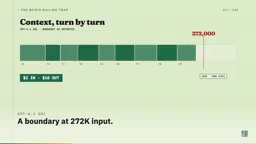
In the Agent loop, every tool result is appended to the history, and the prompt grows every round. On Sol, there's a boundary at 272,000 input tokens: below it, normal rates; one token over, and the entire request is repriced—not just the overflow, but every token in the context. The request is billed at double the input rate and 1.5x the output rate.
A single large log file read at the wrong moment can double your price for every subsequent round. The workshop's countermeasure is a compression guard: trigger at 250,000 tokens, keep the most recent four rounds intact, write everything earlier to an on-disk checkpoint, and replace it in the prompt with a short summary. Compression changes the prompt and requires rebuilding the cache once, but that's far cheaper than paying double every round after crossing the cliff.
Context cliff refers to the billing rule switching from "linear billing per actual token" to "the entire context recalculated at a higher rate" once the prompt length crosses a threshold. It differs from the common "truncation when exceeding the context window": the latter is a capacity issue, the former a pricing issue. The typical mechanism is tiered rates for long contexts (e.g., input doubles past 128K or 256K), but the billing base is the entire request, not just the overflow. For Agents, history accumulates every round, so a single large file read can permanently push all subsequent rounds over the threshold, causing sustained double spending. The countermeasure is proactive compression: replace old rounds with summaries before the threshold and accept a one-time cache rebuild cost.
Trap 3: Caching Is the Biggest Hidden Discount—and the Easiest to Break
Every loop round resubmits the same system prompt, coding standards, and tool definitions. Sonnet 5.5 reads cached input at 10 cents per million—5% of the normal rate; caching writes cost $2.50, cache entries live for 5 minutes and refresh on each use. Sol caches automatically when the prompt is at least 1,024 tokens, also at 10 cents. Argon has no explicit caching; implicit caching is also 10 cents but only works if the beginning of your prompt stays unchanged—change the first line and the discount disappears.
Argon's $2/$10 is an introductory price; starting December 1 it becomes $4.20.
Another common bug: putting the current time at the start of the system prompt. Caching matches from the first token, so the moment the clock ticks, every token after it misses. The fix is simple—static content first, changing content after the breakpoint.

Prefix caching relies on token-by-token matching from the start of the prompt: only the prefix that exactly matches the previous request hits the cache and gets the discounted rate. Once any position mismatches, all tokens after that position are rebilled at the uncached rate. This explains why placing timestamps, random IDs, or user input at the start of the system prompt catastrophically destroys hit rates. The standard engineering practice is "static first, dynamic last": stable content like system prompts, tool definitions, and coding standards goes at the front, while variable content (current task, timestamp, retrieval results) goes after the cache breakpoint. Cache entries typically have a time-to-live (e.g., 5 minutes) that refreshes on each hit, so high-frequency looping Agents benefit naturally, while the first call after a long idle period requires a fresh write.
No Single Model Wins Every Step: Route by Step
If Sol is cheapest per task, why not use it for everything? Because different steps have different winners.
Large multi-file refactoring: DeepSWE tests whether a model can read an entire repository, trace cross-module dependencies, and write correct multi-file changes. Argon scores 77.9%, ahead of Opus 5.5's 74.2%—and Opus costs twice as much per token. Note that Google ran Argon's score on its own test framework, while competitor scores come from leaderboards and system cards. Argon also leads on financial documents, scoring 65.4% on Val's finance agent versus Claude Fable 5.1's 58.9%.
Terminal tasks: Terminal bench puts the Agent in a real shell to run commands, read stack traces, fix packages, and get tests passing. Anthropic reports Sonnet 5.5 at 70.6%, lower in independent runs—Artificial Analysis measured 64, still ahead of Argon's 57. On Val's leaderboard, Opus is first and Sonnet second. Vendor numbers should be read as upper bounds, not your average. For terminal scenarios, Claude leads.
But what about cost? Val's data shows cost per terminal test: Sonnet at $16.51, Argon at $17.64, and Sol at just $1.72. And routine rounds—passing tool JSON, checking status, choosing the next tool—are the bulk of the loop, which is exactly where Sol's low per-task cost and cheap cached input shine.
An extra warning for security work: Anthropic's production models carry conservative cybersecurity safeguards that block a lot of security work. Vetted defensive parties can apply to the cybersecurity verification program for fewer restrictions. If your Agent does legitimate security testing, plan ahead so steps don't fail mid-run.

Build Your Router: Four Work Types, Four Routes
The workshop provides a routing scheme you can drop directly into your own orchestrator. The core idea is to tag each step with one of four categories: repo planning, terminal loop, status triage, and command-line security.
- Planning steps all go to Argon as a single call: read the codebase once, write the full plan, hand off—no looping. Note that Argon's 1 million is the context window (input); output is capped at 65,536 tokens.
- Security steps go through a gate: if the organization isn't verified, stop and explain why, escalating to a human—better than failing mid-run.
- Terminal loops go to Sonnet 5.5: adaptive thinking, effort fixed at high, never maximum. Keep effort fixed throughout the loop, because Anthropic's docs say changing top-level effort between requests restarts the cache.
- Default steps (status checks, tool selection, JSON triage) go to Sol at medium effort: automatic caching, and cache keys let you inspect hit rates by route.
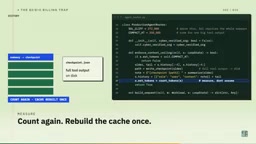
Telemetry should record four buckets, not two: cached input, uncached input, visible output, and reasoning output. When the bill spikes, two buckets can't tell you whether the cache broke or the Agent started overthinking—four can.
Audit checks should also assert: from round 2 onward, on Sonnet or Sol, zero cached tokens before the breakpoint means something changed. This catches the most common bug before launch.
Model routing means the orchestrator dispatches each step to a different model based on task type, rather than using a single model throughout. Its economics come from two facts: different models excel in different capability dimensions, and price doesn't map linearly to capability. Effective routing requires three prerequisites—stable classification of steps (planning, terminal execution, status triage, security review, etc.), measured quality and token consumption for each step type, and unified handling of caching and compression at the routing layer to avoid paying cache rebuild costs repeatedly when switching models. Routing's benefit should be measured by "total cost per task," not "price per million tokens," because what a cheaper model saves in a long loop is often orders of magnitude, not a percentage.
How Much Does Routing Save: A 24-Round Fix Task Compared
The same 24-round bug fix, two ways. Single model at maximum effort with a timestamp breaking the cache: 1.92 million uncached input tokens, 610,000 reasoning tokens, $9.94. After routing: round 1 Argon maps the repo, rounds 2–18 Sonnet at high effort with caching runs the fix, rounds 19–24 Sol formats the PR and updates the ticket—185,000 uncached tokens, 1.73 million cached tokens, 64,000 reasoning tokens, $1.18. About 88% saved in the example.
The takeaway here isn't the price per million tokens—it's the number of tokens burned per completed task. Log four buckets, cap the effort level, compress before the cliff, assert cache hits in staging, and route each step to the fewest tokens—that's the right unit for Agent cost control.
One-line Summary
At the same token price, Agent costs can differ by 10x—control them through effort levels, compression, caching, and routing.
Paragraph Summary
The article notes that three mainstream models share the same list price ($2 per million input, $10 per million output), yet per-task costs in an Agent loop can differ by more than 10x. There are three reasons: the reasoning effort level applies to all output tokens, so maximum effort makes thinking tokens the bulk of the bill; the context cliff reprices the entire request once the 272K boundary is crossed; and prefix caching can cut repeated input to 5%, but timestamp or other changes at the start invalidate everything. Since no single model wins every step—Argon excels at repo planning, Sonnet at terminal tasks, Sol is cheapest for routine rounds—the author proposes routing by four work types, cutting cost from $9.94 to $1.18 in a 24-round fix example, saving about 88%.
Related articles

64GB Laptop Running LLMs: Only 46.7GB Actually Usable
ASUS ProArt 16 test: only 46.7GB of a nominal 64GB is usable for models; the 128GB model is officially capped at 120B parameters. We break down the 9,000 yuan gap.
Ollama Beginner's Tutorial: A Getting Started Guide to Local LLM Deployment
Ollama beginner's tutorial: Learn what Ollama is, its core features, and the value of local LLM deployment. Covers open-source and free, cross-platform, CPU/GPU scheduling, API integration, and more to help you quickly get started with local LLM management.
Row-Bot 5.3.0 Released: Built-in Browser and Security Approval Redefine AI Agents
Row-Bot 5.3.0 arrives on Windows, macOS, and Linux with an in-app browser, real-input computer control, tiered approvals, sandboxed pages, ~40% less context, and background tasks.