Samepage Artifacts: An AI Writing Platform That Auto-Generates PRDs

Samepage Artifacts auto-generates PRDs and product docs using context-aware AI for product teams.
Samepage Artifacts is a context-aware writing platform designed for product teams that automatically generates document drafts including PRDs, release notes, feature briefs, and weekly reports. By understanding team context and maintaining connections between documents, it transforms PMs from document creators into reviewers, breaking down information silos and reducing repetitive writing work.
The Documentation Dilemma for Product Managers
In the software development process, product managers (PMs) serve as the critical bridge connecting technology, design, and business. Yet a significant portion of their daily work is consumed by documentation: PRDs (Product Requirements Documents), release notes, feature briefs, weekly updates... These documents are not only voluminous but also require frequent context-switching between different tools and workflows.
A PRD (Product Requirements Document) is one of the most essential documents in the product development lifecycle, typically containing feature descriptions, user stories, acceptance criteria, priority rankings, and more. A complete PRD can span dozens of pages and requires continuous iteration. Beyond PRDs, product managers also maintain product roadmaps, competitive analyses, user research reports, and other supporting documents. According to industry research, product managers spend an average of 30%-40% of their working hours writing and maintaining documentation — a figure that can be even higher in large organizations.
What makes matters worse is that these documents are closely interrelated, yet traditional tools keep them siloed. A feature definition in a PRD, an update record in release notes, and a progress summary in a weekly report are all essentially discussing the same set of product features. Yet PMs are forced to repeatedly enter similar information across multiple documents while manually maintaining consistency.
Samepage Artifacts, which recently launched on Product Hunt, targets precisely this pain point. Positioning itself as a "context-aware, connected writing platform," it aims to redefine how product teams collaborate on documentation. The product received 82 upvotes on launch day, ranking 11th.
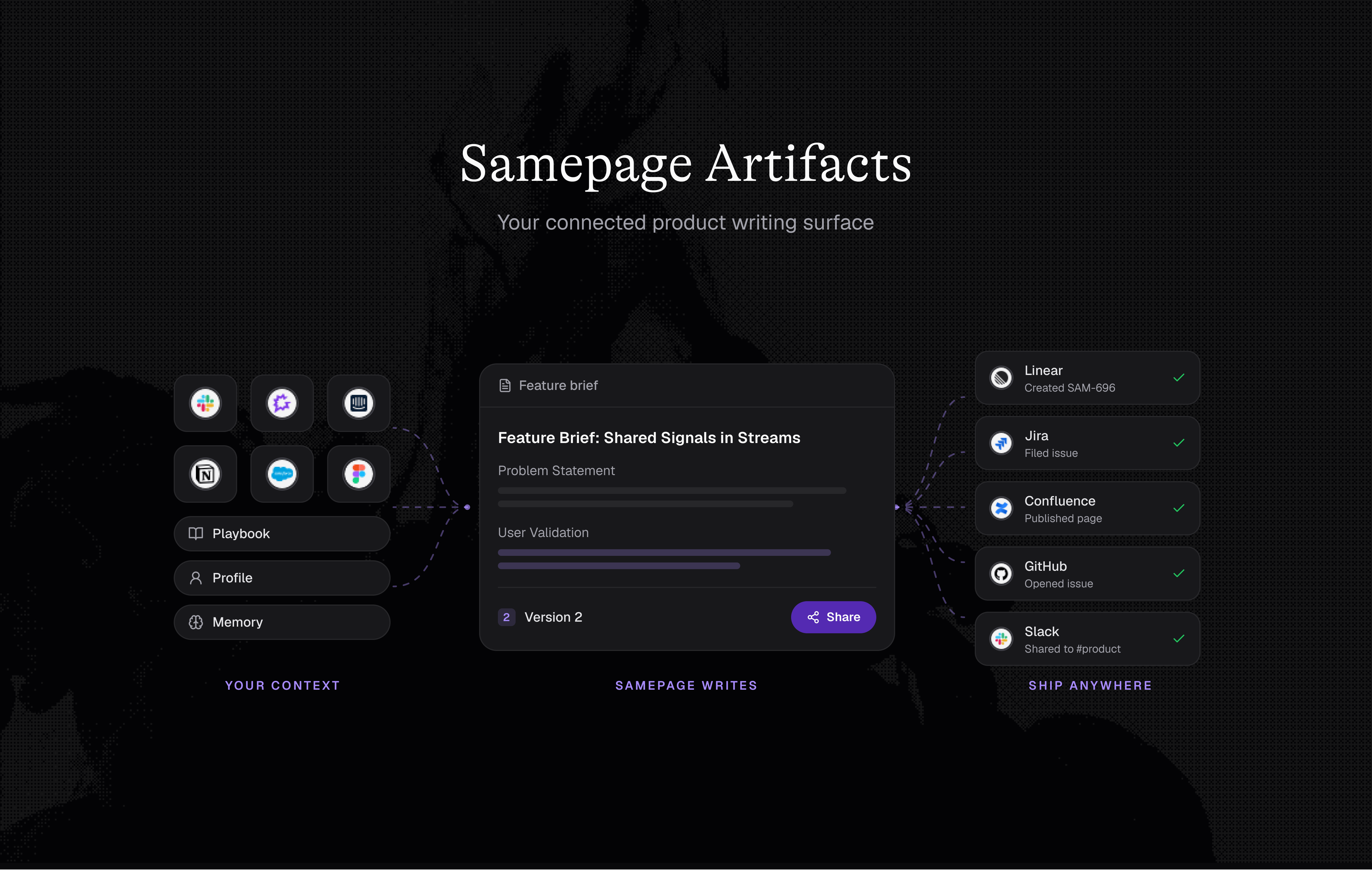
Core Philosophy: Documents Auto-Generated and Waiting for You
Samepage Artifacts' central product promise is that document drafts are "automatically generated and waiting for you." Behind this lies a fundamental design shift: transforming PMs from passive creators into active reviewers.
From Blank Pages to Intelligent Drafts
Traditional writing tools present users with a blank page where everything starts from scratch. Artifacts takes a radically different approach: based on the team's existing contextual information — product discussions, feature plans, development progress — it proactively generates document drafts for PMs.
For example, when you need to write release notes, the system has already compiled a draft based on recently completed features. When you need to submit a weekly report, the key developments for the week have already been pre-summarized. The PM's workflow shifts from "creating from scratch" to "reviewing and refining," dramatically lowering both the psychological barrier and time cost of documentation work.
How Context Awareness Works
"Context-aware" is the technological core of Samepage Artifacts. Rather than generating each document in isolation, the system understands what the entire product team is working on, what has been accomplished, and what comes next. This holistic understanding is the prerequisite for generating high-quality, highly relevant document drafts.
From a technical implementation perspective, Context-Aware Computing was first proposed by Schilit et al. in 1994, referring to systems that can perceive and leverage environmental information to provide relevant services. In AI writing, context awareness is typically implemented through RAG (Retrieval-Augmented Generation) technology: the system first retrieves relevant information fragments from existing knowledge bases, then feeds these fragments as context into large language models for content generation. This requires efficient vector retrieval capabilities and precise semantic matching algorithms, along with unified structural processing of different data sources.
For product managers, this means no longer needing to repeatedly "explain" project context to the tool — the system already knows.
A Connected Writing Platform: Breaking Down Document Silos
Beyond auto-generation, the other core feature Artifacts emphasizes is the "connection" between documents.
Documents No Longer Operate in Isolation
A product team's various documents are inherently interrelated. Samepage Artifacts treats PRDs, release notes, feature briefs, weekly reports, and other documents as a connected whole rather than independent files. When underlying product information changes, related documents can sense and synchronize updates, reducing communication costs caused by information inconsistency.
This "connected" design philosophy aligns with the popular "bi-directional links" and "knowledge graph" concepts in knowledge management. The concept of Bi-directional Links traces back to Vannevar Bush's Memex vision proposed in 1945, later gaining widespread recognition around 2020 with the popularity of tools like Roam Research and Obsidian. The core idea is: when Document A links to Document B, Document B also automatically records the reference from A, forming a networked knowledge structure. Knowledge Graph is a concept introduced by Google in 2012, organizing information through entity-relationship-entity triple structures. In product management scenarios, a feature can be a node in a knowledge graph, connected to PRDs, design files, development tasks, test cases, release notes, and other document nodes, forming a complete product knowledge network.
The difference is that Artifacts focuses this concept on the vertical scenario of product management, making connection relationships more aligned with PMs' actual workflows.
A Vertical Focus Dedicated to Product Teams
Samepage Artifacts doesn't position itself as a general-purpose writing tool. Instead, it explicitly serves "product teams." The document types it supports — PRDs, release notes, feature briefs, weekly reports — are all high-frequency document formats used by product managers.
This vertical strategy is quite wise in today's fiercely competitive AI productivity tool market. Vertical SaaS, as opposed to Horizontal SaaS, focuses on serving specific industries or roles rather than providing cross-industry general functionality. According to research by Bessemer Venture Partners, while Vertical SaaS targets smaller addressable markets, it typically achieves higher customer retention rates and willingness to pay because its product fits more closely with user workflows. In the AI tool space, this trend is particularly evident: general-purpose AI assistants (like ChatGPT) can handle a wide range of tasks, but in specific professional scenarios, vertical tools with domain fine-tuning and workflow optimization often deliver more precise and reliable outputs.
General-purpose tools offer broad coverage but struggle to achieve excellence in specific scenarios. Tools that deeply serve a particular role can optimize for specific workflows and deliver more precise value.
The Verticalization Trend in AI Productivity Tools
Samepage Artifacts is categorized under Productivity, SaaS, and Artificial Intelligence — reflecting the evolutionary direction of its market segment.
From General Assistants to Role-Specific Assistants
As large language model capabilities mature, AI writing tools have evolved from early-stage general text generation into professional assistants tailored to specific roles and scenarios. The success of products like Notion AI and GitHub Copilot has already proven that embedding AI capabilities into users' existing workflows is far more effective than asking users to switch to a standalone conversational interface.
Artifacts follows exactly this path — rather than requiring PMs to learn complex new operations, it integrates AI capabilities into the natural interaction of "auto-generating drafts." What users experience isn't "I'm using an AI tool" but rather "my documents are already ready."
Hurdles Still to Overcome
Products like this also face practical challenges. First is depth of data integration — to achieve true context awareness, the system needs extensive integrations with project management tools, code repositories, design files, and more, placing high demands on technical integration capabilities.
A typical product team's tool stack includes: project management tools (Jira, Linear, Asana), code repositories (GitHub, GitLab), design tools (Figma), communication platforms (Slack, Lark), documentation tools (Confluence, Notion), and more. Each tool has different API specifications, data formats, and permission models. Additionally, enterprise data security compliance is an unavoidable concern — product documents often involve unreleased features, business strategies, and other sensitive information. How data flows securely between systems and whether it will be used for model training are critical considerations in enterprise procurement decisions.
Second is generation quality and trustworthiness — PM documents often involve important decisions, and if AI drafts contain factual errors, they could actually introduce risk. The inherent "hallucination" problem of large language models — where models generate content that appears reasonable but is actually incorrect — is particularly dangerous in product documentation scenarios, as an incorrect feature description or inaccurate release timeline could mislead an entire team's work direction.
Furthermore, as a newcomer on Product Hunt, Artifacts' current 82-vote result, while placing it in the top tier, still lags behind leading productivity tools. Whether it can truly deliver on its "auto-generation" promise will need to be validated across numerous real-world use cases.
Conclusion: A New Documentation Option Worth Product Managers' Attention
Samepage Artifacts represents a clear trend in AI productivity tools: moving from general-purpose to vertical specialization, and from passively waiting for input to proactively generating content. For product managers long burdened by documentation work, a tool that understands team context, automatically prepares various document drafts, and maintains connected consistency between documents holds considerable appeal.
Whether it can establish a firm foothold in this competitive landscape will depend on whether its depth of contextual understanding and quality of content generation can reach a "ready to use" standard. Regardless of the outcome, this product philosophy of reconstructing workflows around specific professional roles is worth ongoing attention from product managers and their teams.
Related articles

Decision Threshold Design for Trading AI Agents: Fixed Thresholds vs. Dynamic Adjustment
Exploring decision threshold design for trading AI Agents: why fixed thresholds fall short, how to build dynamic thresholds with cost-sensitive learning, and key practical considerations.

GPT-5.6 Sol Ultrafast: A Deep Dive into LLM Inference Acceleration Techniques
Deep dive into GPT-5.6 Sol Ultrafast inference acceleration techniques, covering quantization, distillation, speculative decoding, and the industry shift from capability to efficiency.

How Sparse Attention Papers Sugarcoat Their Results: Four Common Tricks Exposed
Deep dive into how sparse attention and KV Cache compression papers sugarcoat experiments — cherry-picked tasks, unfair baselines, hidden failures, and more.