Decision Threshold Design for Trading AI Agents: Fixed Thresholds vs. Dynamic Adjustment

Trading AI Agents should use dynamic, cost-sensitive thresholds rather than fixed ones for optimal decisions.
This article examines a core design challenge for trading AI Agents: whether to use fixed or dynamic decision thresholds. It explains why fixed thresholds are suboptimal when error costs vary dramatically across transactions, introduces cost-sensitive learning and Bayesian decision theory as foundations for dynamic thresholds, and explores multi-tier action designs. Practical considerations including error cost quantification and regulatory explainability requirements are also discussed.
The AI Decision-Making Challenge in Trading
In fintech and automated risk control, more and more developers are building AI Agents capable of autonomous decision-making. An AI Agent is a software system that can perceive its environment, reason autonomously, and take actions to achieve specific goals. Unlike traditional rule engines, AI Agents typically possess a degree of autonomous decision-making ability, dynamically adjusting behavioral strategies based on contextual information in uncertain environments. In financial trading scenarios, the rise of AI Agents is closely tied to the growing capabilities of Large Language Models (LLMs)—developers can leverage LLMs' reasoning abilities, combined with structured financial data, to build intelligent systems that understand transaction semantics, assess risk, and execute a variety of actions.
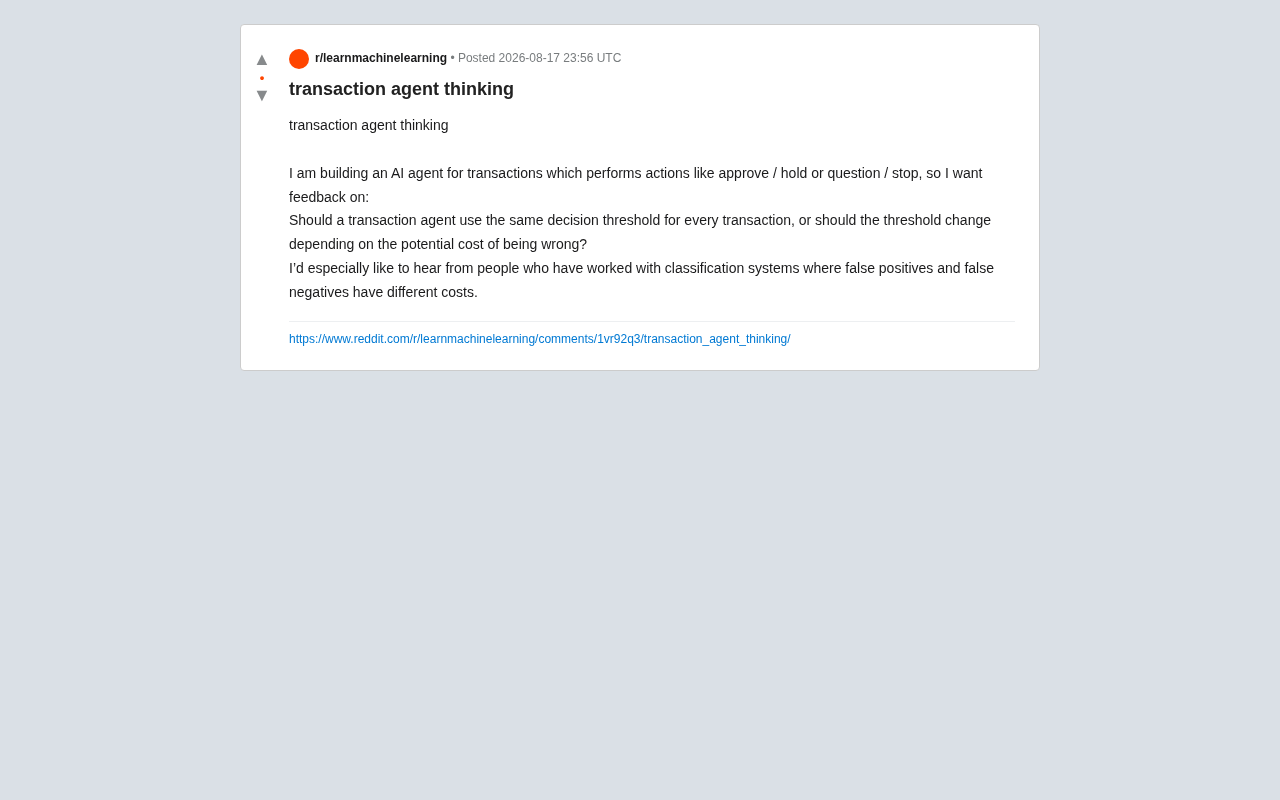
Recently, a developer shared on Reddit a trading AI Agent project they were building. The Agent can execute a series of actions including "approve," "hold," "question," and "stop."
The developer raised a technically profound question: Should a trading Agent use the same decision threshold for all transactions, or should it dynamically adjust thresholds based on the "potential cost of making a wrong decision"? This seemingly simple question actually touches on the most fundamental trade-off in machine learning classification system design—how to find the right balance between False Positives and False Negatives.
In statistics, false positives and false negatives are core concepts of the Confusion Matrix. In risk control scenarios, a false positive means incorrectly flagging a legitimate transaction as fraud and blocking it, while a false negative means incorrectly passing a fraudulent transaction as legitimate. There is an inherent tension between these two types of errors—reducing the rate of one often increases the other, a trade-off visualized on what's known as the ROC curve (Receiver Operating Characteristic Curve). The industry commonly uses Precision-Recall curves to visualize this trade-off and select an operating point appropriate for the business scenario.
Why Fixed Thresholds Are Often Suboptimal
The Cost of Errors Varies Dramatically Across Transactions
In traditional binary classification systems, we typically set a fixed probability threshold (e.g., 0.5), triggering an action whenever the model's risk score exceeds it. However, in transaction risk control, this "one-size-fits-all" approach has clear shortcomings.
Consider two extreme scenarios: a $10 small purchase versus a $100,000 large wire transfer. If the Agent incorrectly blocks the legitimate $10 transaction (false positive), the damage is merely a minor degradation in user experience. But if the Agent incorrectly approves the fraudulent $100,000 transaction (false negative), the financial loss is catastrophic.
This illustrates that the expected cost of a decision depends not only on the probability of the model being wrong, but also on the actual consequences when an error occurs. Using a fixed threshold for both types of transactions clearly cannot minimize overall risk.
The Theoretical Foundation of Cost-Sensitive Learning
In machine learning, this problem is known as "Cost-Sensitive Learning." The core idea is: rather than simply optimizing accuracy, directly optimize expected cost. Traditional classifiers assume all misclassifications carry equal penalties during training, while cost-sensitive learning introduces asymmetric loss functions so the model can account for the differentiated costs of different error types during both training and inference. Common implementation approaches include: assigning different weights to different classes in the loss function, cost-based resampling of training data, and cost-weighted threshold adjustment at the decision stage.
For a given transaction, we can define:
- C(FP): False positive cost (the price of incorrectly blocking a legitimate transaction)
- C(FN): False negative cost (the price of incorrectly approving a fraudulent transaction)
The optimal decision threshold can be derived through Bayesian decision theory. Bayesian decision theory is the foundational framework of statistical decision theory, with the core idea of selecting the decision that minimizes expected loss given prior probabilities and a loss function. Specifically, for a transaction where the model outputs a posterior probability P(fraud|x), the optimal decision threshold t* satisfies: t* = C(FP) / (C(FP) + C(FN)). When false negative costs far exceed false positive costs (i.e., C(FN) >> C(FP)), the optimal threshold should be lowered, making the system more inclined to block suspicious transactions; conversely, the threshold should be raised to reduce interference with legitimate transactions. This formula provides a rigorous mathematical foundation for dynamic threshold design.
Design Approaches for Dynamic Thresholds
Incorporating Transaction Amount into the Threshold Function
For this developer's scenario, a directly feasible approach is to make the decision threshold a function of the transaction amount (and other risk factors), rather than a static constant.
Specifically, the logic works like this: the larger the transaction amount, the lower the risk score threshold required to trigger a "stop" or "question" action. In other words, as potential losses increase, the system's risk tolerance should decrease accordingly. This way, a large transaction with only a moderate risk score might still be flagged for additional verification, while a small transaction can be approved under more lenient conditions.
From an engineering perspective, the threshold function can be a simple piecewise linear function (e.g., dividing amounts into tiers, each with a corresponding threshold) or a more refined continuous function (e.g., modeling the threshold as a logarithmic or sigmoid function of the amount). The choice depends on the balance between business complexity and explainability requirements.
Multiple Action Tiers with Multi-Level Thresholds
You might not have noticed, but this developer's Agent is not a simple binary "approve/reject" system—it has four action tiers: "approve, hold, question, and stop." This actually provides greater flexibility for dynamic threshold design.
The four-tier action design corresponds to an Ordinal Classification problem in machine learning, where categories have a natural ordering (approve < hold < question < stop). This differs from traditional multi-class classification, where categories are treated as equal—ordinal classification must respect the progressive relationship between categories. From an engineering standpoint, this tiered mechanism aligns with the 3D Secure protocol widely used in the payments industry: not all suspicious transactions need to be outright rejected. For transactions in the risk gray zone, additional identity verification steps (such as SMS codes or biometric authentication) can reduce risk, striking a balance between security and user experience.
A sensible approach is to set multiple threshold intervals:
- Low risk interval: Directly approve
- Medium-low risk interval: Hold, await further information
- Medium-high risk interval: Question, require additional user verification
- High risk interval: Stop, block directly
Each interval boundary can dynamically shift based on factors like transaction amount, account history, geographic anomalies, and more. The benefit of this tiered design is that it avoids blunt "black-or-white" decisions, providing a buffer zone for transactions with higher uncertainty.
Key Practical Considerations
Quantifying Error Costs Is Far from Easy
While the theoretical framework for cost-sensitive learning is clear, the biggest challenge in practice is often how to accurately quantify the cost of each type of error. False positive costs include not just direct revenue loss, but also user churn and brand reputation damage—factors that are difficult to monetize directly. False negative costs, beyond direct fraud losses, may also involve regulatory fines and recovery costs.
In practice, quantifying these hidden costs typically requires cross-departmental collaboration. For example, user churn costs can be estimated through Customer Lifetime Value (CLV)—a single false block might drive a user to a competitor, with long-term losses far exceeding the individual transaction amount. Quantifying regulatory fines requires referencing historical penalty cases and regulatory guidelines. Some mature financial institutions build a "Cost Matrix" that consolidates direct and indirect costs of various error types into a unified quantitative framework, updating it regularly based on business data and market conditions.
It's recommended to establish a quantifiable, iterative cost assessment framework from the design phase, continuously calibrating it through A/B testing and historical data backtesting.
The Explainability Challenge of Dynamic Thresholds
While dynamic thresholds are more precise, they also introduce a new problem—explainability. When every transaction has different decision criteria, explaining "why this transaction was blocked" to regulators, business stakeholders, and even blocked users becomes significantly more complex.
In finance, AI system explainability is not merely a technical aspiration—it's a legal and regulatory hard requirement. The EU's General Data Protection Regulation (GDPR) grants users the "right to an explanation," meaning when automated decisions significantly impact individuals, users have the right to understand the logic behind the decision. The U.S. Equal Credit Opportunity Act (ECOA) and Fair Credit Reporting Act (FCRA) similarly require financial institutions to provide specific adverse factor explanations when denying applications. Common explainability techniques include SHAP (SHapley Additive exPlanations) values and LIME (Local Interpretable Model-agnostic Explanations)—local interpretability methods that can quantify each feature's contribution to a single decision. For example, they can clearly inform a user: "This transaction was flagged primarily because the transaction amount was abnormally high (40% contribution) and the transaction location was inconsistent with historical patterns (35% contribution)."
Therefore, when introducing dynamic thresholds, it's essential to build a comprehensive decision logging and explanation mechanism alongside, ensuring every action can be traced back to specific risk factors and cost trade-off logic.
From Fixed Rules to Risk-Adaptive Systems
Returning to the developer's original question, the answer is quite clear: A trading AI Agent should not use a uniform fixed threshold for all transactions, but should dynamically adjust based on the potential cost of making wrong decisions.
This is not only the theoretically optimal solution—it also aligns with the business intuition that "significant transactions require stricter scrutiny." In fact, this concept is not entirely new in finance—traditional banks' Anti-Money Laundering (AML) systems and fraud detection systems have long employed amount-based tiered review mechanisms, though most of these rely on manually crafted hard rules. The value of AI Agents lies in their ability to automatically learn more granular, more dynamic risk thresholds from data while processing far more feature dimensions than human-crafted rules can handle.
For any developer building risk-control AI Agents, shifting from a "fixed rules" mindset to a "risk-adaptive" mindset is a critical step toward improving overall system effectiveness. Of course, going dynamic also means higher engineering complexity and stricter explainability requirements, demanding pragmatic trade-offs between precision and maintainability.
Key Takeaways
Related articles

Uber Deploys ChatGPT Work Company-Wide: AI in the Workplace Enters the Scaled Implementation Phase
Uber deploys ChatGPT Work to 30,000+ employees, extending it from engineering to all roles. We analyze its expert-engineer pairing, end-to-end automation, and questions of AI control and power concentration—insights for scaling AI in the workplace.

Shift at Midnight Hands-On: When "ID Verification" Becomes Alien Hunting
Shift at Midnight blends ID verification with horror survival in a four-player co-op game. We break down its inspection mechanics and chaotic humor.

Zelensky Recounts the Outbreak of War: I Need Ammunition, Not a Ride
Zelensky recalls the first day of war in a YouTube interview: farewell to family, rejecting Biden's evacuation offer with "I need ammunition, not a ride," and how Bucha shaped his stance on compromise and peace talks.