Sample Complexity of Risk-Sensitive Reinforcement Learning: A Near-Optimal Theoretical Breakthrough

New paper achieves near-optimal sample complexity for recursive entropic risk RL, closing the exponential upper-lower bound gap.
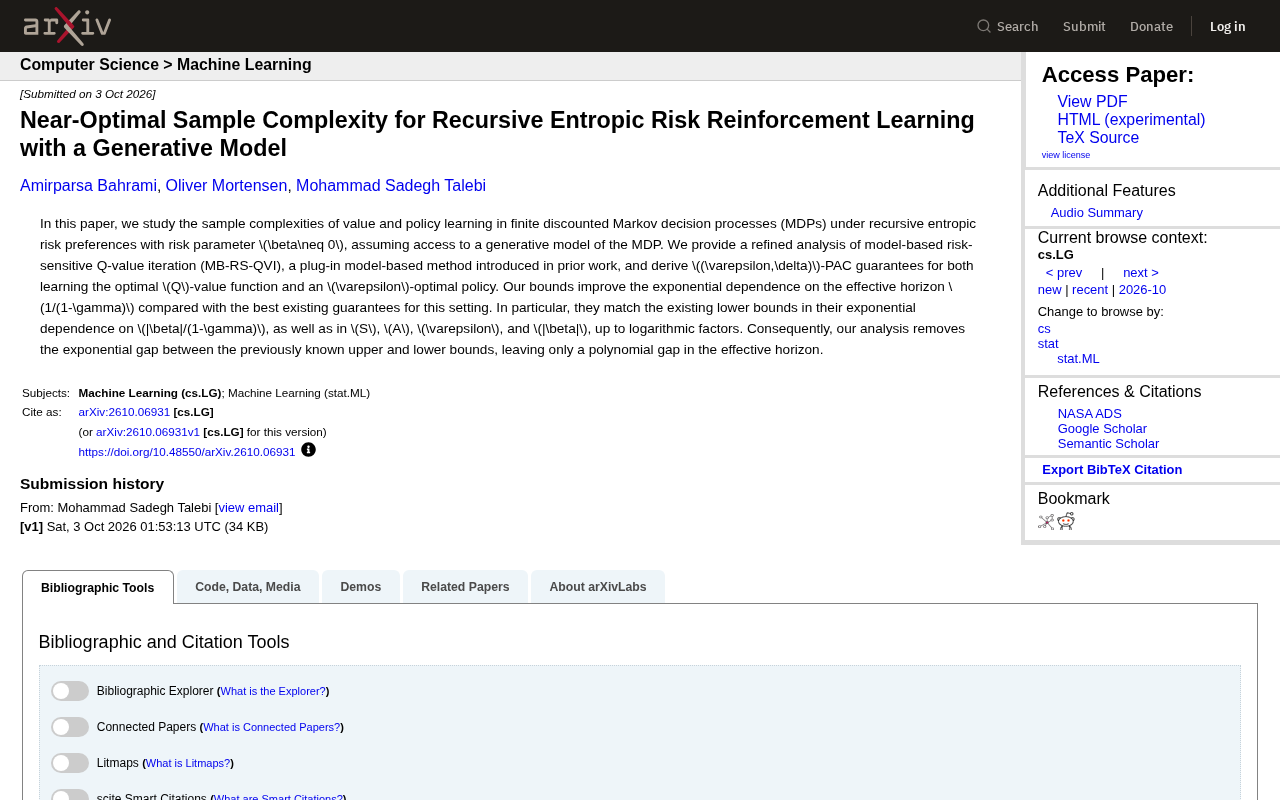
This arXiv paper delivers a near-optimal sample complexity analysis for RL under recursive entropic risk preferences (β≠0) in finite discounted MDPs. Focusing on the generative model setting and refining the existing MB-RS-QVI algorithm, it establishes (ε,δ)-PAC guarantees whose exponential dependence on |β|/(1−γ) matches known lower bounds and aligns logarithmically in S, A, and ε — eliminating the prior exponential gap and leaving only a polynomial gap in effective horizon. The result precisely characterizes the intrinsic difficulty introduced by coupling the recursive risk parameter with the discount factor, providing a reliable theoretical baseline for future risk-sensitive RL research.
When deploying reinforcement learning (RL) in practice, maximizing expected return is rarely enough — risk management matters too. A newly released arXiv paper delivers a near-optimal sample complexity analysis for RL under recursive entropic risk preferences, bridging a longstanding exponential gap between upper and lower bounds. This represents a significant advance in the theory of risk-sensitive reinforcement learning.
Why Study Risk-Sensitive Reinforcement Learning
Traditional RL aims to maximize cumulative expected return. But in high-stakes domains like finance, healthcare, and autonomous driving, chasing expected reward alone isn't enough — decision-makers also need to control outcome variance and tail risk.
The Entropic Risk Measure is a classical tool for capturing such preferences. It uses a risk parameter β to tune sensitivity to risk: β > 0 encodes risk aversion, β < 0 encodes risk seeking, and β → 0 recovers the standard expected return objective.
This paper studies value learning and policy learning in finite discounted Markov Decision Processes (MDPs) under recursive entropic risk preferences (β ≠ 0). The term "recursive" means the risk measure is applied in a nested, layer-by-layer fashion at each step — a structure more aligned with dynamic programming than applying a single risk measure to the full trajectory, and more intuitive for sequential decision-making.
Recursive (time-consistent) risk measures differ meaningfully from non-recursive ones. The non-recursive approach applies a risk measure once to the entire trajectory's cumulative return — for example, computing the CVaR (Conditional Value at Risk) of the total return directly. This is mathematically simple but suffers from time inconsistency: a plan that looks optimal at time t may no longer appear optimal when re-evaluated at time t+1, making it incompatible with dynamic programming. Recursive entropic risk measures instead nest the risk operator at every time step, taking the form $\rho_t(r_t + \gamma \rho_{t+1}(\cdots))$. This satisfies time consistency and can be directly integrated with Bellman equations to derive optimality conditions. The trade-off is significantly increased analytical complexity — the recursive nesting causes the risk parameter β and discount factor γ to appear coupled at an exponential scale in the effective horizon 1/(1−γ), which is the central challenge in risk-sensitive RL sample complexity research.
The Core Question: How Many Samples Does It Take?
Sample complexity is a central metric in RL theory. It answers the question: how many environment interactions does an algorithm need to learn a sufficiently good policy with high probability?
The paper assumes access to a generative model of the MDP — that is, the algorithm can query any state-action pair for a sample. This is a standard setup in theoretical analysis that separates the exploration problem from the core challenge of statistical estimation and planning efficiency.
Under this setting, the authors target (ε, δ)-PAC guarantees — meaning that with confidence 1−δ, the learned Q-value function or policy differs from the optimal solution by at most ε.
The generative model (simulator) is one of the standard assumptions in theoretical RL research, systematically introduced by Kakade (2003) and others. Under this setting, the algorithm can input any state-action pair (s, a) and immediately receive an i.i.d. next-state sample and reward, without needing to explore from an initial state along trajectories. This is equivalent to having a "random-access" environment simulator. Compared to online exploration, the generative model avoids exploration bottlenecks caused by insufficient coverage, allowing sample complexity analysis to focus purely on statistical estimation: how many samples per (s, a) are needed to adequately estimate the transition distribution? In risk-neutral MDPs, the optimal sample complexity under the generative model has been shown to be $\tilde{O}(SA/((1-\gamma)^3\varepsilon^2))$ (Azar et al., 2013). This paper pursues a similarly near-optimal guarantee in the risk-sensitive setting, where the additional exponential factor originates from the nonlinear nested structure of recursive risk measures.
Method and Results: A Refined Analysis of MB-RS-QVI
The paper does not propose an entirely new algorithm. Instead, it performs a more refined theoretical analysis of a model-based risk-sensitive Q-value iteration method (MB-RS-QVI) introduced in prior work. This is a plug-in approach: first estimate the MDP's transition model from collected samples, then run risk-sensitive Q-value iteration on the estimated model.
The key contribution lies in improving the sample complexity's exponential dependence on the effective horizon 1/(1−γ). Specifically, the new bound:
- Matches the known lower bound in its exponential dependence on |β|/(1−γ);
- Aligns with the lower bound up to logarithmic factors in the state count S, action count A, accuracy ε, and risk parameter |β|.
This means the new analysis eliminates the exponential gap between upper and lower bounds that existed in prior work, leaving only a polynomial gap in the effective horizon. In theoretical research, narrowing an exponential gap to a polynomial gap is a qualitative improvement — it shows that the existing algorithm is already close to the information-theoretic lower limit in statistical efficiency.
The core logic of the plug-in (estimate-then-plan) approach is to decouple statistical estimation from dynamic programming. In the first phase, $n$ samples per (s, a) are used to estimate the transition kernel $\hat{P}(\cdot|s,a)$. In the second phase, risk-sensitive Q-value iteration is run on the estimated model $\hat{P}$ until convergence. Error analysis for such methods typically proceeds in two steps: first bounding the model estimation error (the distance between $\hat{P}$ and the true $P$), then analyzing how much Q-value iteration amplifies that error. In the risk-neutral setting, this amplification factor is roughly $1/(1-\gamma)$. In the recursive entropic risk setting, each Bellman operator involves nonlinear exponential operations, making the error amplification mechanism far more complex and ultimately producing an exponential dependence on the effective horizon. The refined analysis in this paper more carefully tracks this error propagation process, proving that MB-RS-QVI's actual exponential dependence is of the form $e^{O(|\beta|/(1-\gamma))}$, matching the information-theoretic lower bound and ruling out redundant exponential factors that appeared in prior upper bounds.
Significance of This Work
From a theoretical perspective, this paper provides a near-optimal characterization of sample complexity for risk-sensitive RL, clarifying the intrinsic difficulty arising from the joint effect of risk parameter β and effective horizon. The exponential term coupling β and 1/(1−γ) in the entropic risk measure is precisely what makes risk-sensitive problems harder than risk-neutral ones, and the new analysis captures this exactly.
From a practical perspective, although the paper operates under the idealized generative model setting, its findings provide a reliable baseline and theoretical reference point for designing risk-sensitive RL algorithms in more realistic settings such as online exploration and function approximation.
It is worth noting that a polynomial gap in the effective horizon remains, leaving room for future work to further tighten the bounds or improve the algorithm itself.
Summary
Through a refined analysis of MB-RS-QVI, this work achieves near-optimal sample complexity results in the specific area of recursive entropic risk RL — an important piece of the puzzle in risk-sensitive decision theory. For researchers focused on RL safety and robustness, it clearly defines "just how hard it is to learn a good risk-sensitive policy."
Related articles

macOS Is No Longer UNIX: Apple Didn't Renew Certification, But the Technology Is Unchanged
Apple did not renew macOS's UNIX certification, and the Open Group has removed Apple's entry. This article analyzes the technical reality behind the expiration, Apple's possible intentions, and the practical impact on developers.

Building Stateful Multi-Agent Systems with Azure Cosmos DB
Based on the official Azure Cosmos DB tutorial, this article explains how to use the Agent Memory Toolkit to add shared persistent memory to a multi-agent travel planner, covering short-term, long-term, episodic, and semantic memory plus cross-session state continuity.

Production AI Agent Operations: A Three-Step Framework for Observing, Evaluating, and Optimizing
Azure Cosmos DB team proposes a three-step framework for production AI Agent operations: observe trace tracking, evaluate with LLM as a judge and regression testing, optimize cost across RU, retrieval, memory, and LLM layers.