SAP Autonomous Enterprise and Claude: A Real-World Breakdown of Enterprise AI Architecture

SAP bets on Claude and MCP for its Autonomous Enterprise platform, but success depends on data governance and architecture design far more than model capability.
This article breaks down SAP's Autonomous Enterprise strategy from an enterprise architect's perspective. Rather than building a flagship LLM, SAP positions Claude as its preferred reasoning engine for complex tasks via the BAI platform, while MCP serves as the strategic integration foundation that standardizes agent-to-system communication. The article emphasizes that the gap between demo and production typically stems from master data quality, authentication infrastructure, and governance gaps — not model limitations. It distinguishes current capabilities from the future roadmap and offers practical guidance including a 90-day pilot framework, urging architects to start from business pain points, demand quantifiable results, and design for model-agnostic hybrid architectures.
SAP's bet on Claude and MCP (Model Context Protocol) as the backbone of its Autonomous Enterprise strategy has generated significant buzz. But beyond the launch-day marketing, what has this partnership with Anthropic actually delivered? What's available today, and what's still on the roadmap? This article dissects the real composition of this technology stack from the perspective of an enterprise architect doing a practical evaluation.
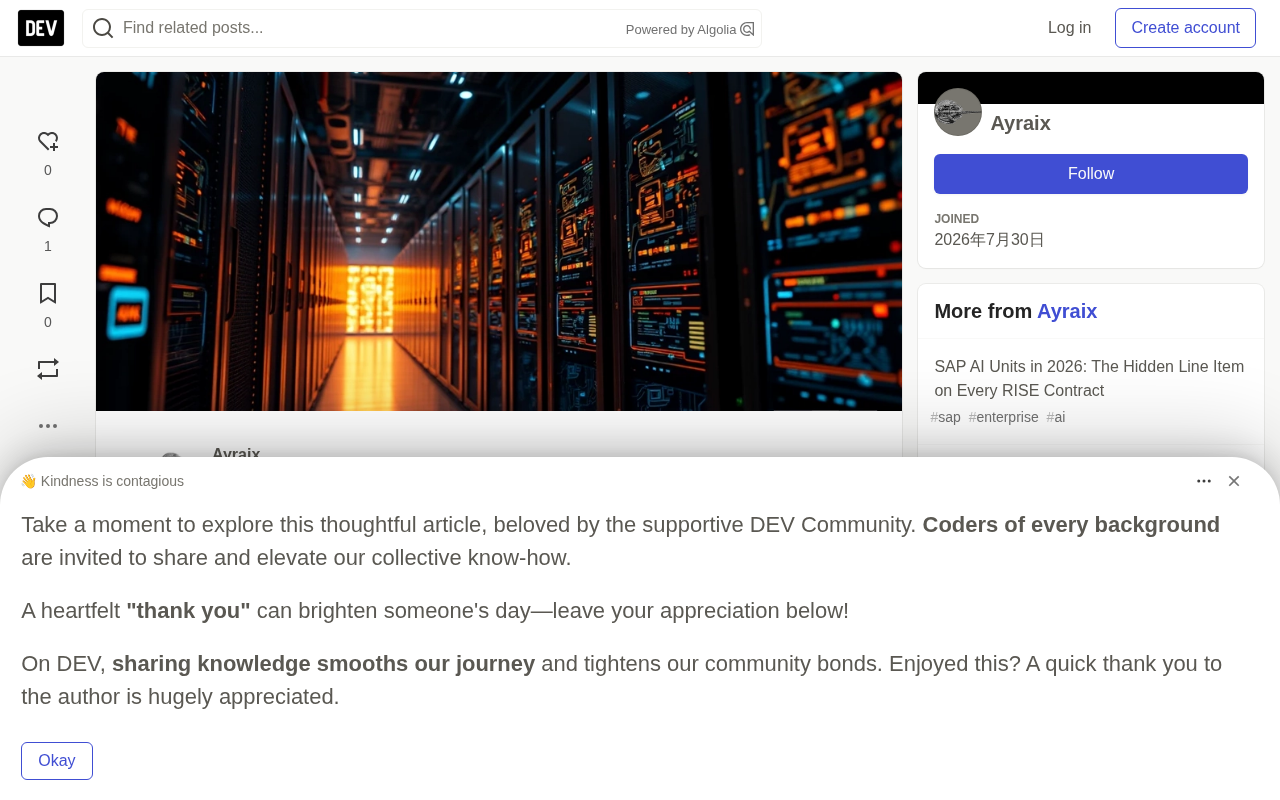
The Autonomous Enterprise Tech Stack: Cutting Through the Buzzwords
SAP's Autonomous Enterprise architecture is not a monolithic "AI black box" — it's a modular, extensible layered platform. Understanding its layered structure is a prerequisite for evaluating its value.
The foundation layer is the SAP Business AI (BAI) platform — essentially the "AI kernel" for SAP applications. It provides the AI runtime, model management, orchestration, and shared services, and serves as the central nervous system of the entire system.
The domain agent layer delivers pre-built, configurable agents for specific business scenarios, covering finance (AP/AR, travel and expense), procurement (requisition processing, supplier inquiries), HR (leave requests, policy Q&A), and supply chain (inventory checks, shipment tracking). These agents are a mix of SAP-delivered capabilities and partner extensions.
The interaction layer determines how users communicate with agents: it includes the SAP Joule copilot across applications, conversational interfaces within specific apps (such as guided buying in Ariba), embedded chat, and voice endpoints for hands-free scenarios.
The commercial model layer is where Claude and other LLMs reside. Critically, SAP is not using a proprietary flagship model here — instead, it accesses strategically selected third-party models through secure endpoints. SAP handles governance, routing, and enterprise-grade SLAs.
The core insight: this is not monolithic AI. It's a modular platform where SAP provides the "pipes and security" while calling on best-in-class models for specific reasoning tasks.
Claude's Real Role: Reasoning Engine, Not SAP's Secret Sauce
Contrary to some marketing impressions, SAP has not trained its own flagship LLM. Instead, it has made a deliberate architectural choice.
Claude is positioned as the preferred reasoning model, specifically for complex, multi-step reasoning tasks that demand high accuracy and low hallucination rates — such as financial close variance analysis, complex approval workflow optimization, or cross-domain policy interpretation. But it is not the only model. SAP's proprietary tabular model SAP-RPT-1 still handles pure structured data prediction, while models like Mistral and Cohere address specific data sovereignty compliance or latency-sensitive scenarios. In short, Claude is the "primary" model, not the "exclusive" one.
In terms of integration, Claude is delivered through managed endpoints on the SAP BAI platform. Customers do not need to contract directly with Anthropic — SAP handles API management, quota enforcement, and enterprise-grade SLAs. SAP's real value-add lies in the prompt engineering layer: domain-specific prompt templates, retrieval-augmented generation (RAG) from the SAP knowledge base, and a response validation layer that ensures outputs conform to SAP data models and business rules.
A concrete example: when a CFO asks Joule, "Why did actual manufacturing costs in Southeast Asia deviate 8.3% from forecast?", that query is likely routed to Claude on the BAI platform. The platform first enriches the prompt with relevant cost center data, production logs, and regional economic indicators before generating the analysis.
RAG (Retrieval-Augmented Generation) is one of the core techniques in SAP's prompt engineering layer and deserves its own explanation. Pure LLM parameter-based generation has clear limitations in enterprise settings: the model has no awareness of data created after its training cutoff, and it knows nothing about enterprise-private data (such as SAP internal cost center codes or custom business rules). RAG solves this by retrieving relevant document fragments from an external knowledge base at inference time and injecting them into the prompt context, allowing the model to "answer with evidence." SAP's specific approach stores the SAP knowledge base — including configuration documents, business rules, and vectorized representations of historical transaction data — in a vector database. When a user submits a query, the system first performs a semantic search to find the most relevant data fragments, then passes them along with the original question to Claude to generate a response. This is why the same Claude model, when running on SAP's platform, can accurately reference enterprise-specific account codes or approval hierarchies rather than producing generic financial analysis. The quality of domain data injection — not the model itself — is the key differentiating variable.
MCP: The Integration Foundation Where the Real Value Lives
While Claude has captured the headlines, the Model Context Protocol (MCP) may be SAP's more strategically significant contribution to the agentic ecosystem.
Standardized agent-to-system communication means that each agent-system pair no longer requires a custom integration. MCP provides universal read_table, execute_function, and generate_code interfaces that any agent — whether Claude, Copilot, or a custom Python script — can call through a unified API.
Security and governance boundaries are another core function of MCP. Every MCP interaction goes through authentication, authorization, and auditing. Administrators can define fine-grained permissions — for example, "Claude can display customer names in CRM queries but cannot display payment details."
True multi-agent orchestration also becomes possible: a scheduling agent can call an MCP-enabled HR agent to check employee availability, then call a facilities agent to book a conference room, all while maintaining context continuity and an audit trail.
A typical "SAP + Claude" production flow is hybrid: the user initiates a query via Joule or an app interface → it is routed to the relevant domain agent → the agent retrieves factual data from SAP backends via MCP → complex reasoning is handled by Claude on the BAI platform → the response is validated against SAP business rules before delivery → a full audit log is retained in SAP Cloud ALM.
MCP (Model Context Protocol) is an open protocol released by Anthropic in late 2024, designed to address the "integration fragmentation" problem between AI agents and external tools and data sources. Before MCP, every agent that needed to call a new system (such as SAP, Salesforce, or a database) required a custom-built connector, with maintenance costs growing exponentially as integrations multiplied. MCP takes inspiration from LSP (Language Server Protocol) — the protocol that enabled VS Code to support hundreds of programming languages through a single unified interface — and standardizes how models interact with tools as an open protocol. Technically, MCP defines three types of primitives: Resources (data retrieval), Tools (action execution), and Prompts (template reuse), transmitted via JSON-RPC 2.0, supporting both local process and remote HTTP/SSE connection modes. SAP's adoption of MCP in its agent ecosystem means that any MCP-compliant client — whether Claude, Microsoft Copilot, or an open-source framework — can access SAP backend capabilities through the same interface, eliminating the need to develop separate SAP connectors for each AI system. For large enterprises already operating in multi-cloud, multi-vendor environments, this significantly reduces the long-term maintenance burden of agent integration.
From Demo to Production: The Prerequisites Most Vendors Skip
The gap between an impressive demo and production reality is exactly where many enterprise AI projects fail. Genuine production deployment requires several non-negotiable foundations.
Master Data Quality (Non-Negotiable)
Consistent customer/vendor/material master data across systems, accurate hierarchies and classification data, and clean, deduplicated master data records — the "garbage in, garbage out" principle is doubly damaging for AI. More importantly, this requires an ongoing data governance process, not a one-time cleanup project.
Authentication and Authorization Infrastructure
This means properly configured single sign-on (SSO) across all touchpoints, defined and maintained role-based access control (RBAC), service-to-service authentication between agents and systems, and regular access review processes to prevent privilege creep.
Audit Logging and Monitoring
All MCP interactions should be logged to SAP Cloud ALM or a SIEM, with real-time anomaly detection on usage patterns, regular reviews of agent prompts and outputs for compliance, and a clearly defined retention policy for AI interaction logs.
Change Management and User Training
This includes setting realistic expectations about AI capabilities and limitations, training users on effective prompt engineering in business contexts, establishing clear escalation paths when AI gives incorrect recommendations, and monitoring for over-reliance or misuse.
Organizations that skip these foundations often find that regardless of how advanced the underlying model is, their AI initiatives deliver inconsistent results, create security risks, or fail to earn user trust.
Master Data in the SAP ecosystem refers to the baseline records for core business entities such as customers, vendors, materials, and employees — the data foundation for all business processes and analytics. Unlike transaction data (such as individual orders or invoices), master data is relatively stable. When errors or inconsistencies occur — for example, when the same vendor has two records in the procurement and finance systems with different code formats — those errors are amplified throughout the entire system chain. For AI agents, master data quality issues are particularly damaging: LLMs are fundamentally pattern-matching and reasoning engines that cannot correct factual errors in upstream data — they will simply reproduce incorrect conclusions with greater fluency and confidence. SAP's MDG (Master Data Governance) tool provides centralized master data governance capabilities, but its effective operation depends on continuous business process constraints — ensuring that every new addition or change to master data goes through an approval and validation process, rather than relying on periodic data cleanup projects as a remediation. Before launching any AI automation initiative, it is advisable to conduct a quantitative baseline assessment of master data completeness and consistency in the target business domain. This assessment is often a better predictor of project success than AI model selection.
Governance: The Unglamorous Work That Makes Everything Function
Successful enterprise AI requires not just technical implementation, but deliberately designed governance structures.
Data residency and model routing requires clearly defining which data can leave which jurisdictions, enforcing this technically through regional endpoints on the BAI platform, and providing logs and reporting to demonstrate compliance with GDPR, CCPA, or industry-specific regulations — with the ability to route specific workloads to sovereign models when necessary.
Human approval workflows need configurable thresholds that distinguish between automated execution and human-in-the-loop execution. For example: expense reports under $50 are automatically approved, $50–$500 require manager review, and over $500 require VP approval; financial journal entry suggestions require controller review before posting.
Coexistence with existing agent stacks is the pragmatic reality — most enterprises won't start from scratch, they'll integrate: n8n workflows can trigger MCP-enabled SAP agents and vice versa; local Ollama models handle general tasks while metered Claude handles SAP-specific reasoning. The goal is orchestration, not replacement — letting each system do what it does best.
Evaluation Framework: The 90-Day Pilot
Before enterprise-wide rollout, run a focused pilot: select a high-value, clearly scoped use case (such as "automatically generate variance commentary for the monthly financial close"); define clear success metrics (accuracy, time saved, user satisfaction); implement with full monitoring and governance controls; run for 60–90 days across multiple business cycles; compare against a baseline (manual process or existing automation); make a go/no-go decision based on quantifiable ROI, not demo impressions.
The Realistic Roadmap: What's Available vs. What's Coming
It's essential to separate near-term reality from long-term vision.
Currently available: Claude access via the BAI platform for designated reasoning workloads; MCP-enabled agents for finance, procurement, and HR domains; basic orchestration between SAP agents and external MCP-compatible tools; Joule integration across core S/4, SuccessFactors, and Ariba modules; administrative controls for agent permissions and usage monitoring.
Coming in the near term: an expanded domain agent library (supply chain, customer experience, HR core); more sophisticated multi-agent workflows with state management; an expanded MCP tool catalog covering deeper SAP modules; improved model routing capabilities (based on latency, cost, sovereignty); and better process optimization feedback loop integration with SAP Signavio.
Long-term vision: genuine autonomous decision-making within bounded contexts (such as automatic replenishment within policy limits); cross-enterprise agent federation (supplier agents negotiating with buyer agents); predictive agent deployment; and continuous learning from corrected outputs under appropriate governance guardrails.
Practical Recommendations for Enterprise Architects
If you are responsible for evaluating or implementing SAP Autonomous Enterprise with Claude, here is where to focus.
Start from the problem, not the technology: identify specific painful processes where human effort is wasted on repetitive, information-intensive tasks — such as consolidating regional financial reports, answering routine employee policy questions, or generating standard contract drafts.
Insist on quantifiable outcomes: reject vague promises like "productivity improvements." Demand specific metrics such as monthly hours saved, error rate reduction, cycle time improvements, or compliance score gains — and establish a baseline before implementation.
Design for a hybrid architecture: assume you will need to combine SAP's AI services with local LLMs (Ollama), specialized ML models, and traditional automation. Build an abstraction layer that routes work to the most appropriate engine.
Prioritize observability and governance: instrumentation is not optional. You need to know who is using what, at what cost, and whether it is generating value — and build review loops into critical workflows, especially those involving finance or compliance.
Plan for model evolution: Claude may not be the preferred reasoning engine tomorrow. Design integrations to be as model-agnostic as possible, and define clear criteria for when to switch or add alternative models.
The SAP and Anthropic partnership represents a pragmatic path for enterprise-grade LLM integration. But as with any technology, its success depends less on the raw capability of the model and more on how thoughtfully it is woven into existing people, processes, and technology landscapes. Treat it like any major enterprise architecture decision: with clear objectives, rigorous evaluation, and a focus on sustainable value creation.
Related articles

REA: Reverse Engineer Any App with AI, No Coding Required
REA is a viral open-source AI reverse-engineering tool that lets Claude, Codex, and other AI agents analyze any app and generate functional clones—no coding required. This article covers how it works, installation, a hands-on test, and legal risks.
2026 AI Coding Tools Comparison: Claude, ChatGPT, Gemini — Which Is the Best?
A 2026 comparison of five mainstream AI coding tools — Claude Code, ChatGPT Codex, Gemini, DeepSeek, and GitHub Copilot — on real projects, pricing, and code quality, to help you decide where that $20/month should go.

ChatGPT Codex Can Clone Any Software? Testing the Risks and the Truth
YouTube shorts claim ChatGPT Codex or Claude Code can clone Adobe, Excel, and Figma for lifelong free use. We break down the feasibility, legal risks, and DM-funnel tactics—and explain what AI coding tools are truly good for.