Scientific Expedition in the Okavango Delta: Technology and Indigenous Wisdom United in Conservation

Scientists and indigenous guides unite technology and traditional wisdom to protect the Okavango Delta's living ecosystem.
This piece follows a research team on the annual Transact expedition across the Okavango Delta — one of the world's largest inland deltas — where floodwaters drive a highly interconnected ecosystem in which any upstream change ripples through the entire system. The team's central finding is that this landscape is "one living connected system," requiring a systemic approach to conservation. Data collection pairs advanced scientific instruments with indigenous Local Ecological Knowledge (LEK), treating both as equally essential infrastructure. The article ultimately broadens its scope to argue that storytelling and cultural transmission are indispensable to conservation — making people care about what the data means.
A Scientific Journey Across the Okavango Delta
Every year, a research team sets out on what's known as the "Transact" — a multi-week expedition across the entire Okavango Delta in southern Africa. The mission has one core objective: to truly understand this landscape, because only through understanding can effective conservation follow.
This content comes from a sponsored video produced in partnership with De Beers, documenting the author's journey deep into the delta to collect wildlife and water quality data. It presents not just a nature expedition, but a conservation methodology that blends cutting-edge science with indigenous knowledge.
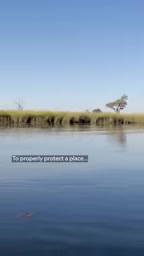
Tracking a "Living Connected System"
The research team's focus is on how changes upstream ripple through to life downstream. Along the way, they collect data on wildlife activity and water quality, working to map out the cause-and-effect chains across the entire watershed.
What makes the delta so extraordinary is its profound interconnectivity — from water sources to vegetation, from fish populations to large mammals, every element is linked to every other. The author repeatedly emphasizes throughout the film that this ecosystem is "one living connected system." Any disturbance at a single point can travel along the waterways to affect places no one would expect.
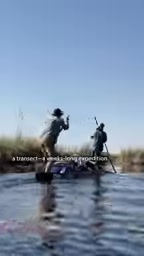
This systemic perspective also explains why conservation cannot fixate on a single species or zone — it must understand how water moves and how change propagates.
A Collaboration Between Cutting-Edge Technology and Indigenous Wisdom
One of the most compelling aspects of this expedition is the collaborative model behind its data collection. Scientists use advanced technology to record measurements, but they rely entirely on local experts — it is the traditional knowledge of indigenous guides that allows the team to navigate the delta's complex, ever-shifting terrain safely.
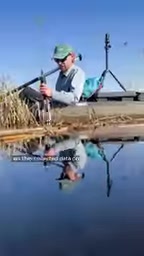
In other words, instruments and algorithms handle the "measuring," while generational survival knowledge handles the "navigating." Neither can function without the other. This partnership dismantles the singular narrative that technology alone is sufficient: in an environment of extreme complexity, indigenous knowledge is not a supplement to science — it is an equally essential infrastructure.
The delta's primary indigenous communities include the San (Bushmen) and the BaYei, among others, who have fished, hunted, and gathered here for generations, accumulating highly refined Local Ecological Knowledge (LEK) about waterway routes, flood timing, animal migration patterns, and even plant toxicity. In recent years, ecologists have increasingly recognized that LEK and scientific monitoring data are complementary: scientific instruments provide quantifiable, reproducible metrics, while the observations of long-term residents often contain decades — or even generations — of historical baseline data, capturing trend changes that short-term instrument monitoring might miss. Systematically incorporating LEK into conservation decision-making is a key agenda item in international frameworks such as the Convention on Biological Diversity (CBD), and is often referred to as "Two Knowledge Systems Integration."
Storytelling as Part of Conservation
The author closes with several thought-provoking questions: How much of this kind of connection have we already lost elsewhere? What role does storytelling play in maintaining it? And what does it even mean to reclaim it?
These questions elevate a scientific expedition to something more universal. Conservation is often framed as a purely technical challenge, but this content reminds us that understanding, narrative, and cultural transmission matter just as much. Data can tell us what is happening — but stories are what make people genuinely care about why it matters.
In the field of conservation communication, "narrative" is seen as a critical bridge between scientific data and public emotion. Research shows that raw data and warning-based messaging often fail to inspire sustained conservation behavior, while content anchored in specific people, places, and stories can significantly increase audience empathy and willingness to act. Brand-sponsored nature documentaries and editorial content are increasingly active in this space. It is also worth noting that De Beers' presence in Botswana involves complex trade-offs between resource extraction and conservation interests — and readers should maintain a critical awareness of narrative framing and funding sources when engaging with this type of sponsored content.
Conclusion: Understanding Before Conservation
The core insight from the Okavango Transact is simple: to protect a place, you must first understand it. And genuine understanding requires the precision of technology, the wisdom of indigenous experience, and storytellers willing to carry all of it forward.
As a piece of branded content, this film goes beyond scenic spectacle to present a replicable conservation philosophy — weaving together measurement, navigation, and narrative into a whole, much like the delta itself: deeply, inextricably connected.
Background
The Okavango Delta is one of the world's largest inland deltas, covering approximately 15,000 square kilometers in northern Botswana. Unlike most deltas, it does not flow into the ocean — instead, it fans out and dissipates into the Kalahari Desert. Each year, floodwaters flowing from the Angolan highlands spread across this basin, where most of the water eventually evaporates or seeps into the ground. This unique hydrological mechanism causes the delta to pulse with the annual floods, creating a seasonal mosaic of wetlands and islands that supports extraordinary biodiversity — and serves as a critical refuge for flagship species such as elephants, lions, and African wild dogs. It is precisely this dynamic, flood-driven, seasonally fluctuating character that makes the causal relationships between upstream and downstream so sensitive: any land-use change or climate shift within the watershed can propagate rapidly through the entire system, carried by water.
Related articles

LLaMA-Factory in Practice: A Complete No-Code Guide to Fine-Tuning Large Models
An introduction to LLaMA-Factory, the open-source fine-tuning tool: its 60.1K-star background, supported models and algorithms, local vs. cloud deployment, and CUDA setup steps.

Zeng Ming's Deep Retrospective: Why OpenAI May Not Be the Ultimate Winner — and Why the Corporate System Will Disappear
Zeng Ming's deep retrospective on the AI endgame: model companies are just infrastructure, OpenAI and Anthropic won't be the final winners; the next battle is the Agent entry point standard; the corporate system will disappear as AI restructures collaboration, and only mission-driven companies can survive the cycle.

OpenHands v1.28.0: OpenCode and PI Added as Built-in Agents, API Keys Requestable In-Conversation
OpenHands ships 5 releases in 21 days: v1.27.0 adds OpenCode and PI as built-in agents, v1.28.0 enables in-chat key requests. ACP integration, credential reuse, model list changes, and upgrade advice.