Screenshot or Frame Extraction? A Real-World Comparison of First-Frame Inputs for AI Video Continuation

A controlled experiment shows that video continuation first frames extracted from source video yield higher quality than screenshots.
The article presents a small controlled experiment by a Reddit user: for the same scene, frames extracted from the original video and screenshots of the playback image were used as first frames for Kling 4.0, Wan 3.0 Prime, and Seedance 2.5 to generate 10-second 720p continuation videos. MUSIQ scores sampled from nine frames per video show frame extraction leading on all three models, with Wan and Seedance ahead by more than ten percentage points, and maintaining an advantage at every sampled timestamp. The author attributes the gap to compositional shift from avoiding player controls in screenshots and processing-chain losses from pausing, region selection, saving, and secondary compression. The article also notes that MUSIQ only measures predicted image quality, not continuation coherence, and that each condition was run only once with inconsistent compositions, so the results should be seen as a directional hint rather than a conclusion.
An Overlooked Detail: Where Does the First Frame of a Continued Video Come From?
When using AI for video continuation, most discussions focus on model selection, prompt writing, and camera movement control, but one preparatory step is rarely taken seriously: how exactly should the first frame fed to the model be obtained?
A Reddit user ran a small controlled experiment that puts this question front and center. They prepared first frames for the same "Lost Horse campsite" scene in two ways — directly extracting frames from the original video, and taking screenshots of the playback image — then used each as the first-frame input to generate 10-second, 720p continuation videos on three models: Kling 4.0, Wan 3.0 Prime, and Seedance 2.5. Nine frames were sampled from each video to compute MUSIQ quality scores, and the results showed a fairly consistent direction.
The experiment is small in scale, but it touches on a real problem in workflow design: is the convenient screenshot operation quietly lowering the floor of generation quality?
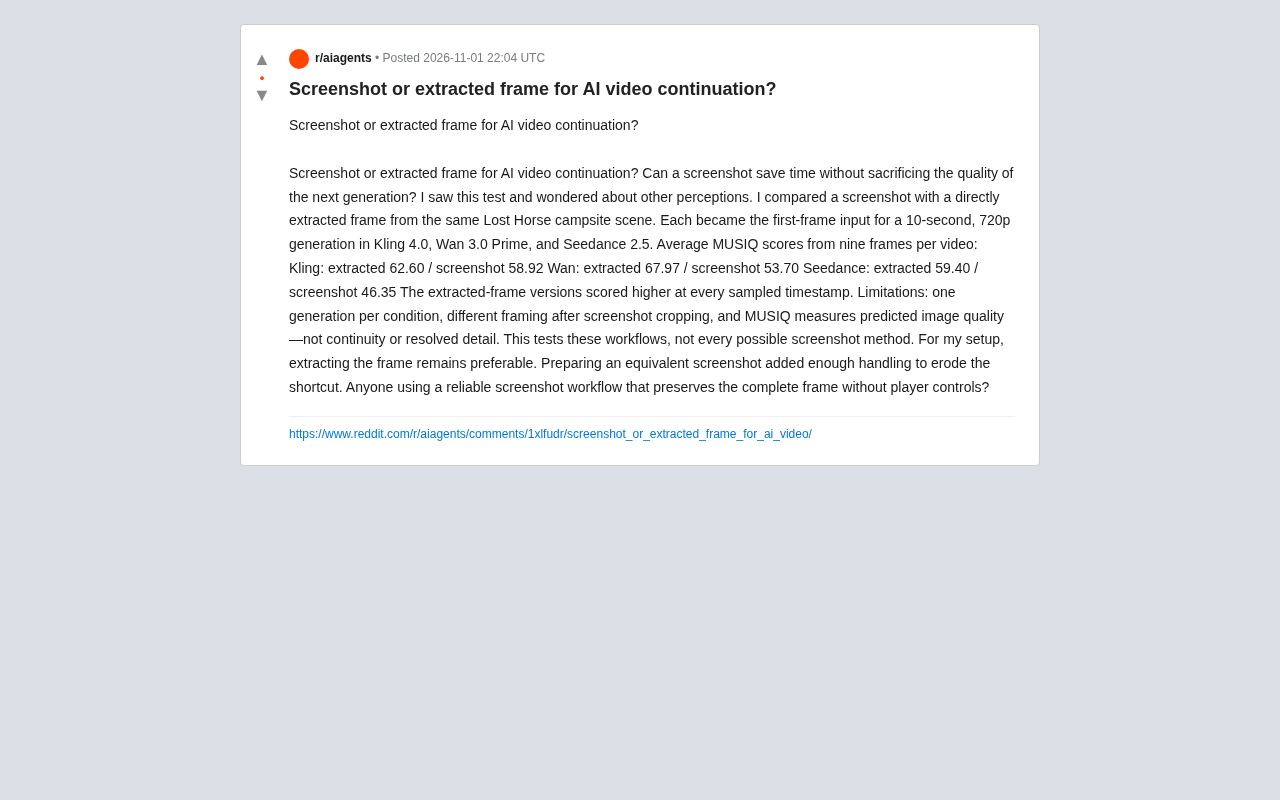
Measured Data: Frame Extraction Leads at Every Sampling Point
First, look at the average MUSIQ scores the author provided, which are the means of nine-frame samples:
| Model | Frame Extraction Input | Screenshot Input |
|---|---|---|
| Kling 4.0 | 62.60 | 58.92 |
| Wan 3.0 Prime | 67.97 | 53.70 |
| Seedance 2.5 | 59.40 | 46.35 |
On all three models, the frame-extraction versions scored higher than the screenshot versions, with the gaps especially pronounced for Wan and Seedance — the latter differing by more than ten percentage points. The author also added a key observation: at all sampled timestamps, the frame-extraction versions maintained their lead; this was not a chance fluctuation in a single frame.
MUSIQ is a type of no-reference image quality assessment metric that measures predicted image quality and does not directly reflect the temporal continuity or degree of detail restoration of a video. The author explicitly points this out, so these numbers are better understood as a signal that "differences in input quality propagate to the output" rather than as a ranking of any model's capabilities.
MUSIQ (Multi-scale Image Quality Transformer) is a no-reference image quality assessment model proposed by a Google research team. It works by splitting an image into a sequence of multi-scale image patches, aggregating global and local information through a Transformer structure, and finally regressing a predicted quality score. Because it does not require an original reference image, MUSIQ is often used to evaluate compressed, restored, or generated images. Scores range roughly from 0 to 100, with higher values indicating better predicted quality. Note that it is trained to align with human subjective judgments of "image quality," mainly reflecting dimensions such as sharpness, noise, and compression artifacts, and does not judge whether the content of the image is reasonable or whether consecutive frames are coherent. Therefore, in this experiment, MUSIQ is suitable as a quantitative proxy for "whether input quality propagates to the output," but it cannot replace an assessment of continuation consistency.
Why Screenshots Suffer: The Double Loss of Cropping and Compression
The author's judgment of the source of the gap is quite pragmatic: the screenshot process itself introduces additional loss.
The first layer is compositional shift. Screenshots often need to avoid player controls, progress bars, or subtitle areas, and even with careful operation it is hard to guarantee that the captured region exactly matches the pixel range of the original frame. The author specifically mentions in the experiment limitations that "the composition differs after screenshot cropping," which means the first frame the model receives may already be missing edge information, and the continuation naturally has to "guess" more content.
The second layer is the processing chain. A screenshot of equivalent quality requires extra operational steps — pausing, selecting a region, saving, and possibly secondary compression — which consume time and may introduce quality loss. The author's exact words are that preparing an equivalent screenshot for their workflow "adds enough processing overhead to erode the shortcut itself," and the final conclusion is that frame extraction is still preferable.
One detail: this experiment covered only one screenshot method, and the author admits it cannot represent all screenshot workflows. If someone could achieve lossless, full-frame, control-free screenshots, the conclusion might not be the same.
ffmpeg is an open-source audio and video processing toolset that can perform frame extraction, transcoding, cropping, concatenation, and more from the command line. A common way to extract a precise frame is ffmpeg -ss 00:00:05 -i input.mp4 -frames:v 1 output.png, where -ss specifies the time point and -frames:v 1 means output only one frame. Compared with screenshots, ffmpeg decodes the video stream directly and obtains the complete original pixel frame at that time point, without going through screen rendering and without bringing in player controls or subtitle overlays; it can also output lossless PNG to avoid secondary compression. For creators who need to prepare first frames in batches, it can also be scripted to export by timestamp, turning first-frame acquisition into a reproducible, version-manageable step rather than relying on occasional manual screenshots.
What This Means for Everyday Creation
For creators who incorporate AI video continuation into their regular workflow, the lesson of this experiment is not that "screenshots are definitely bad," but that first-frame preparation deserves to be optimized as an independent step.
If the source material is in a local video file, precise frame extraction with ffmpeg or editing software is usually more controllable in both composition and quality. If the source material comes from an online playback page, screenshots may seem easier, but the cropping done to avoid the player interface precisely touches the part of the first frame that should least be touched. The question the author poses at the end of the post also shows that this pain point is real: they are looking for a reliable screenshot workflow that preserves the complete image without including player controls, but there is no ready-made answer yet.
Another easily overlooked point is that different models have different sensitivities to input quality. In this test, Wan and Seedance showed steeper score drops for screenshot inputs, while Kling was relatively flat. This suggests that when switching models, the same first-frame preparation habits may not carry over; the tolerance for input-side issues varies with the model.
The Boundaries of the Experiment and Questions to Be Verified
It is still too early to treat this set of data as conclusive. The limitations listed by the author are worth noting one by one: each condition was generated only once, with no multiple sampling to rule out randomness; screenshot cropping led to different compositions, effectively changing two variables at once; and MUSIQ only measures predicted image quality, not continuation coherence or whether details are actually parsed.
These limitations point to some worthwhile follow-up validations: generate multiple times from the same first frame to see whether scores are stable; compare again with screenshots and frame extraction kept at exactly the same composition; and supplement the dimensions MUSIQ cannot see with human ratings or continuity metrics.
For ordinary users, a reasonable approach is to treat this experiment as a directional hint: in efficiency-oriented workflows, the loss at the first-frame acquisition step is easily underestimated. The extra bit of operational cost of frame extraction may be more worthwhile than expected.
One-line Summary
A controlled experiment shows that for video continuation, first frames obtained by frame extraction yield higher quality than screenshots.
Paragraph Summary
The article introduces a small controlled experiment by a Reddit user: for the same scene, frames extracted from the original video and screenshots of the playback image were used as first frames and fed into Kling 4.0, Wan 3.0 Prime, and Seedance 2.5 to generate 10-second 720p continuation videos, with MUSIQ scores computed by sampling nine frames from each video. The results show that the frame-extraction versions led on all three models, with Wan and Seedance differing by more than ten percentage points, and maintained their advantage at all sampled time points. The author attributes the gap to compositional shift caused by needing to avoid player controls in screenshots, as well as processing-chain losses from pausing, region selection, saving, and secondary compression. The article also emphasizes that MUSIQ only measures predicted image quality and does not reflect continuation coherence, and that each group in the experiment was generated only once with inconsistent compositions, so the conclusion should be regarded as a directional hint rather than a definitive one.
Related articles

Prompt Engineering for Beginners: From Writing Instructions to Systematic Design
A beginner's guide to prompt engineering: the difference between prompts and prompt engineering, the four roles of prompts, the six-step process and four goals, plus key limitations around capability ceilings, stability, hallucinations, context length, and cost.

GPT-6.2 Astra Leaked: Low-End Config Beats Previous Top-Tier, SVG Generation Stuns
Leaked GPT-6.2 Astra benchmarks and SVG demos surface: lowest inference tier beats previous top-tier; same batch includes Tencent HY4, Anthropic FlashProve model verification, DeepSeek V5 Ascend roadmap, and Binance security incident.

PolicyIK: Reinforcement Learning for High-Precision Robotic Arm Inverse Kinematics
PolicyIK uses goal-conditioned reinforcement learning to achieve high-precision robotic arm inverse kinematics, with 93.5% of simulated tasks within 1mm and 0.2° error, a deployment protocol raising success to 98.9%, and the ability to execute VLA policy commands.