SEAM: A Social App That Gives Communities a Shared Memory
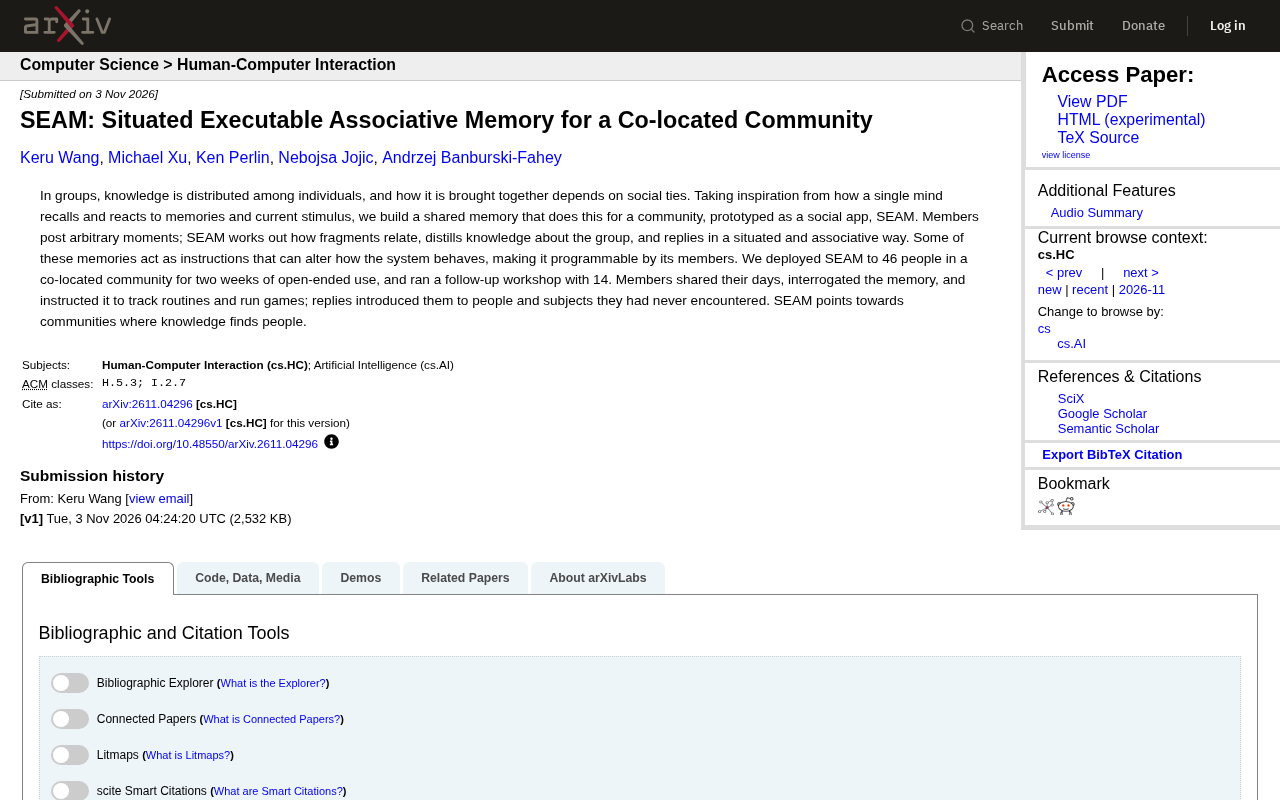
SEAM builds a community shared memory system that lets knowledge find people and shapes community connections.
SEAM is a community shared memory study prototyped as a social app. Members post life fragments; the system analyzes associations, distills group knowledge, and replies contextually and associatively, and can even be programmed by certain memories. A two-week open deployment with 46 members in a co-located community, plus workshops with 14, showed shared memory can surface new people and topics and become a new bond for connection.
From Individual Memory to Community Shared Memory
What makes human memory remarkable is its ability to link scattered fragments and surface them associatively when needed. Can a community have memory like this too? A study called SEAM explores exactly this question. Drawing inspiration from how the individual mind recalls and responds to memories and current stimuli, the researchers built a community-oriented shared memory system and prototyped it as a social app called SEAM.
The core idea of SEAM: within a group, knowledge is distributed across members, and how that knowledge comes together depends on social relationships. SEAM tries to let knowledge find people proactively, rather than making people expend effort searching for knowledge.
Distributed cognition is the key backdrop for understanding SEAM's design logic. Proposed by Edwin Hutchins and others, this concept holds that cognitive processes do not occur solely within individual minds but are distributed across social members, environmental tools, and symbol systems. In a community context, the knowledge each member holds is only a fragment; the real "group knowledge" lives in interpersonal networks and interactions. SEAM's vision is precisely an engineering attempt at this theory: rather than building a centralized knowledge base, the system relies on social relationships to organize, activate, and transmit distributed knowledge. This also explains why SEAM emphasizes "knowledge finds people proactively"—it simulates the way information naturally flows in a distributed cognitive system, rather than the passive response mode of traditional retrieval systems.
How SEAM Works
Members post arbitrary slices of life in SEAM—a sentence, a thought, an experience. The system automatically analyzes the connections between these fragments, distills knowledge about the group from them, and replies in a contextualized, associative way. These replies are not simple information retrieval but proactive associations based on shared memory, potentially leading members to people and topics they have never encountered before.
More unusually, some memories can act as instructions that change the system's behavior. This means SEAM is programmed by its members—the community is not only a contributor of memories but also a shaper of the system's behavior.
Contextualized associative replies differ from conventional keyword search or vector similarity matching. Traditional retrieval systems return results based on the semantic similarity between a query and documents, whereas SEAM's reply mechanism emphasizes two things: first, "contextualized," meaning it understands the meaning of a member's currently shared fragment in light of its context; second, "associative," meaning it not only returns directly related content but also performs multi-hop expansion along the chains of association between memory fragments, potentially surfacing people and topics the user has never encountered. This mechanism is closer to the way human recollection naturally moves from one thing to another, and it is the technical foundation that enables SEAM to foster new social connections.
Two-Week Field Deployment: Real Use by 46 People
The research team deployed SEAM in a co-located community, where 46 members used it openly for two weeks. The team then held follow-up workshops with 14 of them.
During use, members shared daily life, asked questions of the memory, and instructed it to track daily patterns or run games. Some members met people and topics they had never encountered before through SEAM's associative replies. This feedback shows that shared memory is more than information storage—it can become a new bond for community connection.
A co-located community refers to a group whose members are physically proximate and interact face-to-face in daily life, such as a campus, a dormitory building, or a workplace. Compared with purely online communities, co-located communities have tighter social relationships and a stronger foundation of trust, which favors the contribution and spread of knowledge in a shared memory system. But this also means SEAM's effectiveness in this setting may partly depend on the support of offline relationships, and whether the findings generalize to online communities with dispersed members and loose ties still requires further study. The study used a two-week open deployment rather than a controlled experiment, with the aim of observing spontaneous behavior and long-term interaction patterns in real use.
Implications for Community Knowledge Management
SEAM points toward a new form of community: knowledge is no longer a static document repository but a living memory embedded in social relationships that can proactively reach individuals. For practitioners focused on collaboration tools, community operations, and knowledge management, this direction suggests a possible shift from "people finding knowledge" to "knowledge finding people." Of course, the two-week deployment was limited in scale, and the long-term effectiveness of this model in larger communities remains to be validated.
One-line Summary
SEAM builds a community shared memory system that lets knowledge find people proactively and shapes community connections.
Paragraph Summary
SEAM is a study of community shared memory grounded in the associative mechanisms of individual memory, prototyped as a social app by its researchers. After members post slices of life, the system automatically analyzes fragment associations, distills group knowledge, and proactively replies in a contextualized, associative way—and can even be programmed by certain memory instructions. The team ran a two-week open deployment in a 46-person co-located community, with 14 people participating in follow-up workshops. Feedback shows that shared memory not only stores information but can surface people and topics members have never encountered, becoming a new bond for community connection. The article notes that this points toward a shift from "people finding knowledge" to "knowledge finding people," but the long-term effects of a small two-week deployment remain to be validated.
Related articles

9 AI Subscription Plans Compared: The Real Cost Per 100M Tokens Revealed
Bilibili creator tests 9 AI subscription plans from Volcano, Alibaba, Tencent, Baidu, Zhipu, Xiaomi, MiniMax and more, converting them all to real cost per 100M tokens, breaking down fixed-quota vs. three-tier coefficient billing and how caching, time-of-day discounts, and window limits affect actual quota.
Vibe Coding for Beginners: Expressing Intent Instead of Handwriting Code
What is Vibe Coding? A 137-episode Bilibili course defines it: the core is expressing intent, not writing code. This article analyzes Vibe Coding's productivity logic, target audience, and entry expectations to help beginners decide if it's worth learning.

LangChain Beginner's Guide: An Agent Development Roadmap from LangGraph to Deep Agents
Clarify the encapsulation relationship among LangChain, LangGraph, and Deep Agents, and master the learning path and selection logic for agent development frameworks—suitable for beginners in large model development.