Search Order Determines LLM Default Answers: Hidden Bias in Multi-Solution Puzzles
Language models tend to output default solutions in multi-solution constraint puzzles, rooted in search order rather than random preference; randomizing presentation order effectively broadens answer distribution.
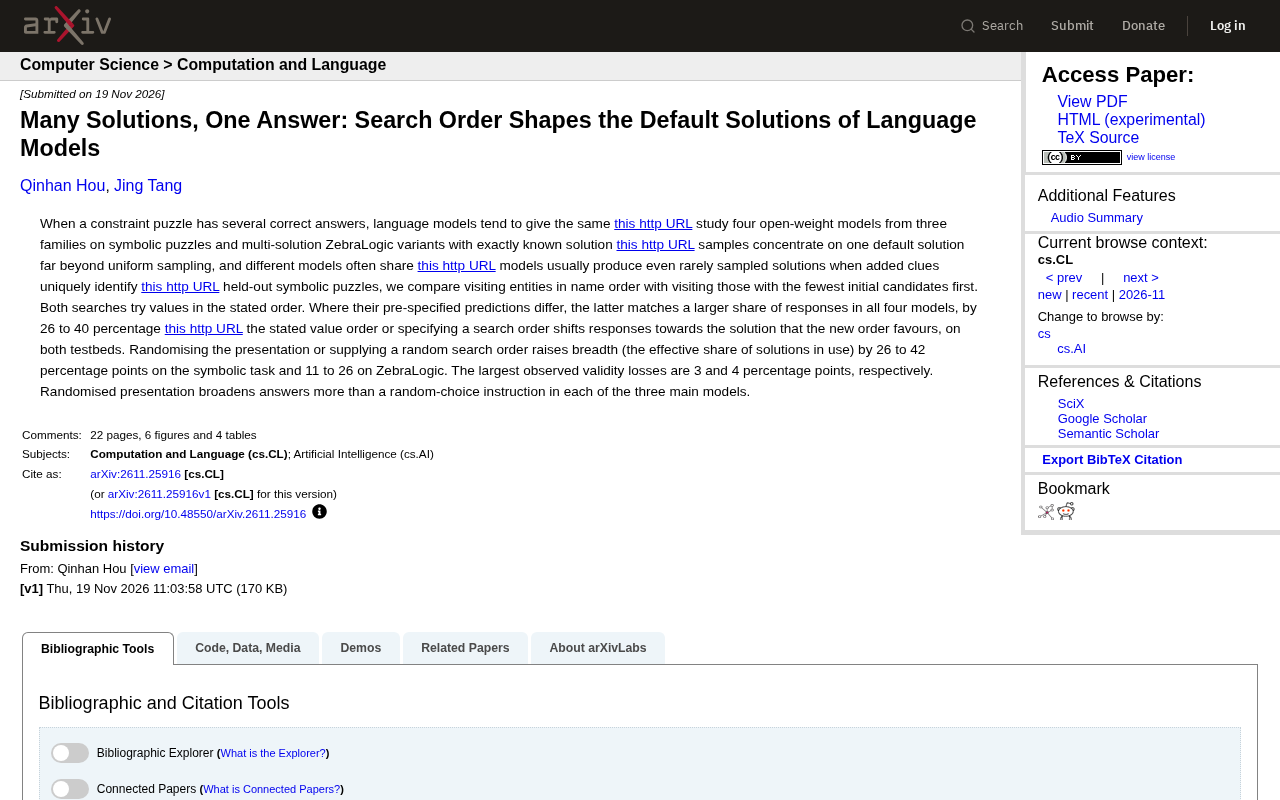
Research found that language models systematically concentrate on outputting the same default solution in multi-solution constraint puzzles, and different models often share this default solution. By comparing two entity visitation orders, researchers found that model responses highly align with solutions preferred by the search algorithm, with matching improvements of 26 to 40 percentage points, indicating that default solutions are byproducts of search order rather than intrinsic preferences. Reversing value order or specifying search order can shift responses toward solutions preferred by the new order. Randomizing presentation order significantly improves answer breadth (26-42 percentage points on symbolic tasks, 11-26 percentage points on ZebraLogic), with validity loss of only 3-4 percentage points, outperforming simply instructing the model to "choose randomly." This suggests practitioners should deliberately design presentation order in prompts to alleviate the default solution concentration problem.
When constraint puzzles have multiple correct solutions, language models tend to give the same default answer—this is not a coincidence, but a systematic behavioral pattern. Recent research reveals the mechanism behind this phenomenon: the model's search order profoundly influences which solution they ultimately choose.
The Default Solution Phenomenon in Multi-Solution Puzzles
Researchers examined four open-weight models from three families on symbolic puzzles and multi-solution ZebraLogic variants with precise solution sets. Repeated sampling results showed that model responses were abnormally concentrated on a single default solution, far exceeding the distribution expected from uniform sampling. More surprisingly, different models often shared the same default solution.
But models are not completely rigid. When clues are added to make a particular solution unique, models can usually correctly produce those solutions that are rarely selected in free sampling. This indicates that models have the capacity to represent these solutions, but exhibit selection preferences in multi-solution scenarios.
ZebraLogic is a benchmark test suite constructed by researchers, inspired by the classic "zebra puzzle" (Einstein's riddle). These puzzles provide a set of entities (such as different people, colors, pets, drinks, etc.) and several constraints, requiring reasoning about the attribute arrangement of each entity. Standard ZebraLogic is typically designed to have a unique solution, while the multi-solution ZebraLogic variant used in this paper deliberately reduces clues so that the puzzle has multiple legal solutions satisfying all constraints. This approach allows researchers to precisely control the size and structure of the solution set, thereby observing the model's selection distribution among multiple feasible solutions. Since the solution set is precisely known, researchers can determine whether the model's output solution belongs to the legal solution set and count the degree of concentration of the model on different solutions, providing a quantifiable experimental platform for analyzing the default solution phenomenon.
How Search Order Shapes Solutions
The study compared two entity visitation orders: visiting in name order, and prioritizing entities with the fewest initial candidates. Both searches try values in the declared order. Where pre-specified predictions differed, the latter search strategy matched a larger proportion of responses across all four models, with improvements reaching 26 to 40 percentage points.
This leads to a key inference: the model's default solution is not a random preference, but a byproduct of the search algorithm. When the prompt reverses the value order or specifies the search order, the model's responses shift toward solutions preferred by the new order. Results were consistent across both test platforms.
Search order in Constraint Satisfaction Problems (CSP) refers to the strategy in backtracking search that determines which variable to assign next and the order in which to try values. Common variable selection heuristics include "Minimum Remaining Values" (MRV), which prioritizes the variable with the fewest current legal candidate values, as this allows early detection of failure and pruning. The "prioritizing entities with the fewest initial candidates" compared in this paper is an embodiment of the MRV heuristic. In classical CSP solving, search order mainly affects solving efficiency; but this study shows that when multiple solutions exist, search order also determines which solution is ultimately found. Language models may implicitly simulate some search process when generating answers, so the entity order or value order presented in the prompt can change the model's internal "search trajectory," systematically biasing toward a particular solution. This explains why different models may share the same default solution—they may employ similar search heuristics.
Randomization Improves Answer Diversity
Randomizing the presentation order or providing a random search order can significantly improve answer breadth—the effective proportion of solutions actually used. Improvements were 26 to 42 percentage points on symbolic tasks and 11 to 26 percentage points on ZebraLogic. On the other hand, the validity loss was at most only 3 and 4 percentage points.
In the three main models, randomized presentation broadened the answer distribution more effectively than random selection instructions. This means that a simple prompt engineering change may be more effective at alleviating the default solution concentration problem than asking the model to "choose randomly."
Answer breadth in this paper is defined as the proportion of legal solutions actually used by the model out of all legal solutions, i.e., the effective coverage of the solution set. Higher breadth indicates that the model explored more different feasible solutions; lower breadth indicates that the model repeatedly outputs a few solutions. In contrast, validity loss refers to the increase in the proportion of illegal solutions output by the model after randomization intervention. Researchers report both metrics to show whether randomizing presentation order sacrifices answer correctness while broadening the answer distribution. Results show that validity loss is small (only 3-4 percentage points), indicating that randomization is a "low-cost, high-benefit" intervention. This measurement approach better reflects the model's exploration capability in multi-solution spaces than simply counting the number of unique answers, and provides a unified quantitative framework for comparing different prompting strategies.
Implications for Practitioners
This research has direct value for scenarios that rely on LLMs to solve multi-solution constraint problems. If an application needs to explore multiple feasible solutions, the presentation order in the prompt needs to be consciously designed. Randomizing input order is a low-cost, high-benefit intervention, while simply instructing the model to choose randomly has limited effect.
The deeper implication is that the model preferences we observe may not be the model's "intrinsic tendencies," but rather structural products of the interaction interface. Changing the way questions are asked can change the distribution of answers.
One-line Summary
Language models tend to output default solutions in multi-solution constraint puzzles, rooted in search order rather than random preference; randomizing presentation order can effectively broaden answer distribution.
Paragraph Summary
Research found that language models systematically concentrate on outputting the same default solution in multi-solution constraint puzzles, and different models often share this default solution. By comparing two entity visitation orders, researchers found that model responses highly align with solutions preferred by the search algorithm, with matching improvements of 26 to 40 percentage points, indicating that default solutions are byproducts of search order rather than intrinsic preferences. Reversing value order or specifying search order can shift responses toward solutions preferred by the new order. Randomizing presentation order can significantly improve answer breadth (26-42 percentage points on symbolic tasks, 11-26 percentage points on ZebraLogic), with validity loss of only 3-4 percentage points, outperforming simply instructing the model to "choose randomly." This suggests that practitioners should deliberately design presentation order in prompts to alleviate the default solution concentration problem.
Related articles

David Fincher's New Film Accused of Being AI-Generated? The Truth Behind the Controversy
David Fincher's new film *The Further Misadventures of Cliff Booth* is accused of using AI, with a carriage shot in the trailer sparking controversy. Netflix's acquisition of Ben Affleck's AI company and Fincher's own openness to AI keep suspicions alive. This article sorts out the controversy and the views of all sides.

FCC Clears SpaceX's Space-Based AI Data Centers: A Debate Over Regulatory Boundaries
The FCC approved SpaceX's plan to deploy AI data centers in space but dismissed opponents' key concerns about scientific research impacts as beyond its regulatory authority. This article analyzes the regulatory boundary issues behind the decision, the deeper tensions of space-based AI infrastructure, and its implications for the industry.

Why Are Latinos Nearly Half of the U.S. Border Patrol?
Latinos hold nearly half of the U.S. Border Patrol and about 30% of ICE. Vox's Khalil Green explores their motivations, identity tensions, and why enforcement work ≠ MAGA.