SeaTicket: An AI Agent That Automatically Resolves GitHub and Discord Issues

SeaTicket uses AI Agents to automatically resolve GitHub Issues and Discord community questions.
SeaTicket is an AI Agent tool that automatically handles GitHub Issues and Discord community questions, addressing the "ticket fatigue" problem in developer communities. It leverages RAG-based retrieval and LLM reasoning to provide verified answers, escalating complex cases to humans. The article examines its multi-platform integration value, technical challenges including hallucination risks and community acceptance, and its position in the broader trend of AI Agents taking over repetitive developer workflows.
From Ticket Processing to Automatic Resolution: AI Agents' New Battleground
In the daily workflow of software development, GitHub Issues and Discord community Q&A are practically standard for every open-source project and technical team. However, as projects scale, the volume of incoming questions often exceeds maintainers' capacity to handle them—repetitive questions, bug reports lacking critical information, and basic inquiries from community newcomers all consume time that could otherwise be spent on core development.
Recently, a product called SeaTicket appeared on Hacker News' Show HN section. Its positioning is crystal clear: an AI Agent that can automatically resolve issues on GitHub and Discord. This product addresses a real and high-frequency pain point in today's developer communities.
What Problem Does SeaTicket Solve?
"Ticket Fatigue" in Developer Communities
For any open-source project with a substantial user base, issue management is a heavy operational burden. Maintainers must not only triage newly submitted issues but also assess priority, request additional information, respond to duplicate questions, and only then move on to actual fixes.
Issue Triage refers to the systematic process of screening and dispatching newly submitted issues, typically including verifying reproducibility, confirming whether it's a known issue, assigning labels and priority levels, and designating responsible parties. In large open-source projects, this workflow often requires dedicated community managers or rotating maintainers. According to GitHub's 2023 Octoverse report, top-ranked open-source projects receive hundreds or even thousands of new issues monthly, while active maintainers typically number in the single digits to a few dozen. This asymmetry means many issues go unresponded to for weeks or even months, directly impacting community engagement and contributor retention.
Based on the experience of numerous open-source projects, a significant proportion of issues fall into the "low-value duplicate" category—answers already exist in documentation, historical issues, or community discussions. Take well-known projects like Kubernetes and React as examples: maintenance teams frequently maintain dedicated FAQ documents and issue templates to reduce low-quality submissions, but the results are often limited.
Discord, serving as the real-time communication hub for many technical communities, presents an even trickier situation. Information flows quickly, lacks structured archiving, the same questions get asked repeatedly, and valuable answers easily get buried in chat history.
How AI Agents Intervene
SeaTicket's core approach is to have an AI Agent handle first-line response and resolution. Unlike traditional keyword-matching bots, AI Agents possess the ability to understand context, retrieve relevant information, and even propose solutions.
It's worth distinguishing the fundamental difference between AI Agents and traditional automation tools. Traditional GitHub Bots (like Stale Bot, Label Bot) operate on predefined rules—they can only execute deterministic logic like "if condition X is met, perform action Y." An AI Agent's core architecture typically comprises three key components: a perception layer (understanding the semantics of natural language input), a reasoning layer (multi-step planning and decision-making based on large language models), and an action layer (calling external tools like APIs and databases to complete actual operations). This architecture enables Agents to handle ambiguous, complex tasks rather than being limited to pattern matching. Current mainstream Agent frameworks like LangChain and AutoGen all follow a similar "Perceive-Reason-Act" loop design.
Specifically, it can:
- Automatically identify the intent of newly submitted Issues or Discord questions
- Search project documentation, codebases, and historical records to locate answers
- Directly provide actionable solutions or relevant links
- Classify complex issues it cannot handle and escalate them to humans
This "AI-first, human-fallback" layered processing model is precisely the direction being widely explored for AI Agents in customer service and technical support scenarios. In enterprise customer service, this model has been validated by platforms like Intercom and Zendesk—AI handles 60%-80% of routine questions, escalating complex or sensitive cases to humans. SeaTicket transplants this approach to the developer community context.
Why This Direction Deserves Attention
The Capability Leap from "Assistance" to "Resolution"
Over the past two years, most AI tools around GitHub have focused on code completion (like Copilot) and code review. What SeaTicket represents is a path closer to "task closure"—not just assisting humans in completing an action, but attempting to "resolve" a problem end-to-end.
From a technical evolution perspective, AI development tools have gone through several stages: initially static analysis and linting tools (rule-based code checking); then AI-assisted completion (like GitHub Copilot and Tabnine, generating code suggestions based on context); followed by AI code review (like CodeRabbit and Sourcery, understanding change intent and suggesting improvements); and now entering the phase where AI Agents autonomously complete tasks (like Devin and SWE-Agent attempting autonomous bug fixes). Throughout this evolution, AI autonomy has progressively increased. Academia typically classifies Agent autonomy into 5 levels: L1 (executing single instructions), L2 (multi-step task decomposition), L3 (autonomous planning and tool selection), L4 (cross-system coordination), and L5 (fully autonomous decision-making). The problem-solving scenario SeaTicket targets requires approximately L3-level autonomous capability.
The keyword resolve here is worth pondering. It means AI is no longer staying at the suggestion stage but is truly pushing issues toward closure. This places higher demands on the Agent's autonomous decision-making ability, tool-calling capabilities (such as reading code, running searches), and reliability.
The Practical Value of Multi-Platform Integration
Covering both GitHub and Discord simultaneously is a pragmatic choice. The former is the "official record" of issues, while the latter is where issues "happen in real time." Bridging the two means the AI Agent can capture potential bugs or feature requests from community chat and feed them back into the GitHub workflow in a structured manner, and vice versa. This cross-platform information flow is something single-channel tools struggle to achieve.
Developers' workflows are naturally distributed across multiple platforms: code hosted on GitHub/GitLab, real-time communication on Discord/Slack, documentation on Notion/Confluence, and project management on Linear/Jira. Information silos between these platforms have long been an efficiency bottleneck. A problem described by a user in Discord might be identical to an existing GitHub Issue, but due to the lack of cross-platform correlation, conversations on both sides proceed independently, causing duplicated effort. Automation tools like Zapier and n8n attempt to solve this through Webhooks and API connections, but they can only perform simple data transfers and lack semantic understanding. The advantage of AI Agents is their ability to understand questions expressed differently across platforms but identical in essence, achieving genuine information integration and deduplication.
Real-World Challenges in Implementation
Despite the clear direction, getting an AI Agent to truly "resolve" problems rather than create new ones still faces significant challenges:
Accuracy and Hallucination Risk
Technical question answering has extremely low tolerance for errors. A seemingly reasonable but incorrect solution could mislead users or even damage maintainers' trust in the tool. AI Agents must be built on reliable Retrieval-Augmented Generation (RAG) and source citation mechanisms to ensure every answer is verifiable.
RAG (Retrieval-Augmented Generation) is currently the mainstream technical approach to addressing the "hallucination" problem in large language models. Its working principle: when a user poses a question, the system first converts it into a vector representation, performs semantic retrieval in a pre-built knowledge base (such as project documentation, historical Issues, code comments, etc.) to find the most relevant document fragments, then injects these fragments as context into the LLM's prompt, enabling the model to generate answers based on real materials rather than relying on potentially outdated or incorrect knowledge memorized during training.
However, RAG itself is not a silver bullet. In technical Q&A scenarios, it faces several unique challenges: rapid code iteration causing documentation to become outdated, the same API behaving differently across versions requiring precise version matching, and technical problems often requiring reasoning across multiple document fragments rather than simple citation. Improvement directions currently being explored in the industry include: Multi-hop Retrieval (sequential multiple retrievals to obtain more complete context), adaptive retrieval (letting the model judge when retrieval is needed versus when it can answer directly), and answer confidence assessment (proactively flagging uncertainty or refusing to answer when the model is unsure about its response).
Permission and Security Boundaries
Automatically closing Issues and publicly replying in communities both involve permission management. Over-automation may trigger user resentment and could potentially expose sensitive information. Appropriate human review checkpoints are indispensable.
Community Acceptance
Developer communities often view "bot replies" with skepticism. If AI response quality is inconsistent, it may actually increase the burden on maintainers to clean up "AI noise." Whether the product can earn trust depends on its actual hit rate in resolving problems.
It's worth noting that the project currently has limited traction on Hacker News (4 Points, no comments yet), indicating it's still in the early stages of market validation. Its real-world effectiveness awaits feedback from more developers actually using it.
AI Agents Are Reshaping Developer Collaboration
SeaTicket is yet another typical example of AI Agents landing in vertical scenarios. It reflects a trend: AI is evolving from general-purpose assistants to "dedicated roles"—repetitive tasks like ticket classification and community Q&A that previously required dedicated personnel are gradually being taken over by autonomous agents.
For open-source maintainers and small technical teams, tools like this could free up valuable development energy if they can genuinely improve issue-handling efficiency. Of course, the product's success ultimately depends on whether it can find the right balance between "automation" and "reliability." For developers interested in practical AI Agent applications, explorations like SeaTicket are undoubtedly worth continued observation.
Related articles
ajisai: A Preset Management Tool for Unifying Rules and Prompts Across AI Coding Assistants
ajisai is a Go-based preset manager for AI coding assistants like Cursor and Claude Code. Package rules and prompts once, deploy everywhere. Early-stage but promising.
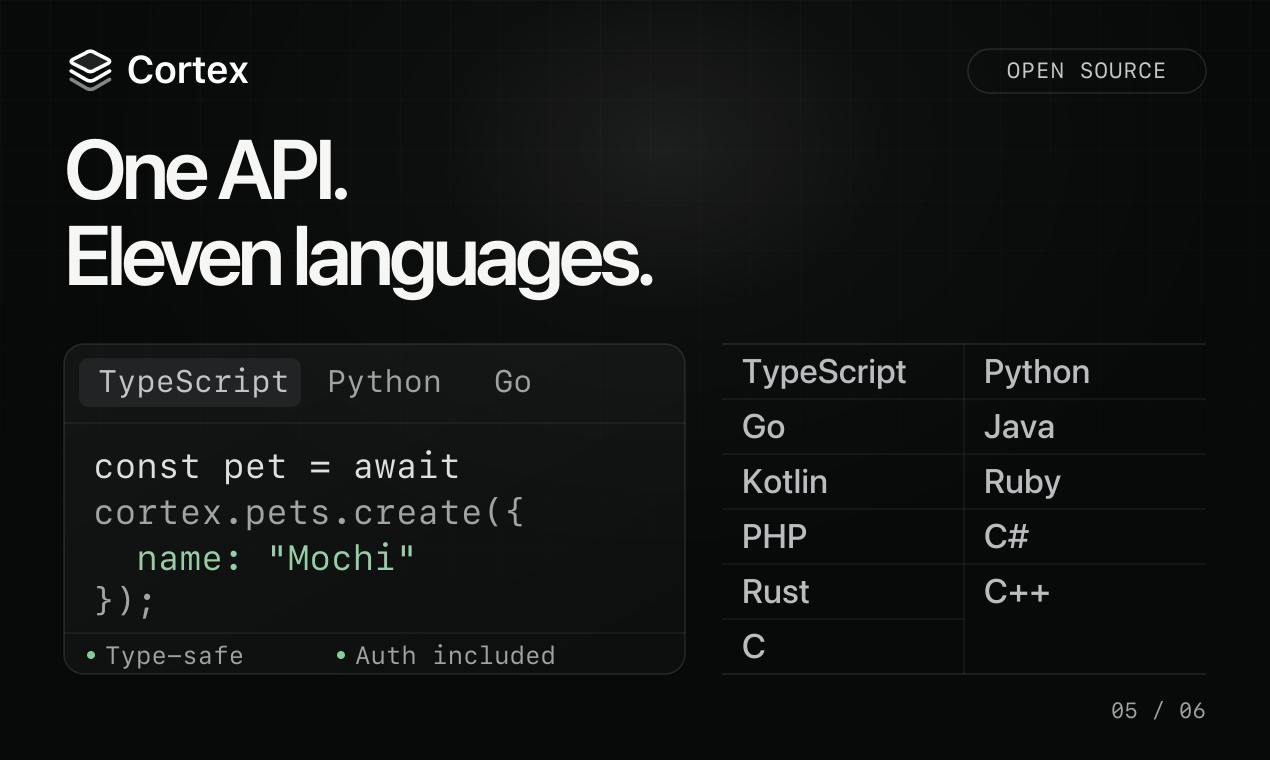
Cortex: Convert API Specs into Docs, SDKs, and MCP Servers in One Click
Cortex is an open-source tool that converts OpenAPI, GraphQL, gRPC and more into interactive docs, typed SDKs in 11 languages, and MCP servers for AI agents.
ABrush: An AI Studio Built for Digital Artists
ABrush is an AI studio for digital artists, ranked #4 on Product Hunt. It embeds leading AI models into existing workflows to remove repetitive tasks, speed up iteration, and keep artists in control.