Sega Pulls Total War: Shogun 2 Remaster After AI Upscaling Disaster Sparks Brutal Backlash

Sega pulls the Total War: Shogun 2 remaster after AI visuals and bugs spark disaster.
Sega pulled Total War: Shogun 2 - Complete Edition from digital stores just one day after launch due to overwhelming negative feedback. Players criticized numerous bugs and what appeared to be crudely AI-processed visual upgrades — smeared textures and illogical assets that broke the original's art style. The incident highlights the industry's reckless use of AI enhancement without human oversight, and while Sega's quick delisting may limit damage, the hit to brand trust lingers.
Sega has urgently pulled Total War: Shogun 2 - Complete Edition from major digital storefronts after a launch day that can only be described as catastrophic. The remastered version of the classic strategy game originally released in 2011 was met with a flood of negative player feedback on day one, with criticism centered squarely on a slew of technical bugs and what appeared to be AI-processed visual upgrades.
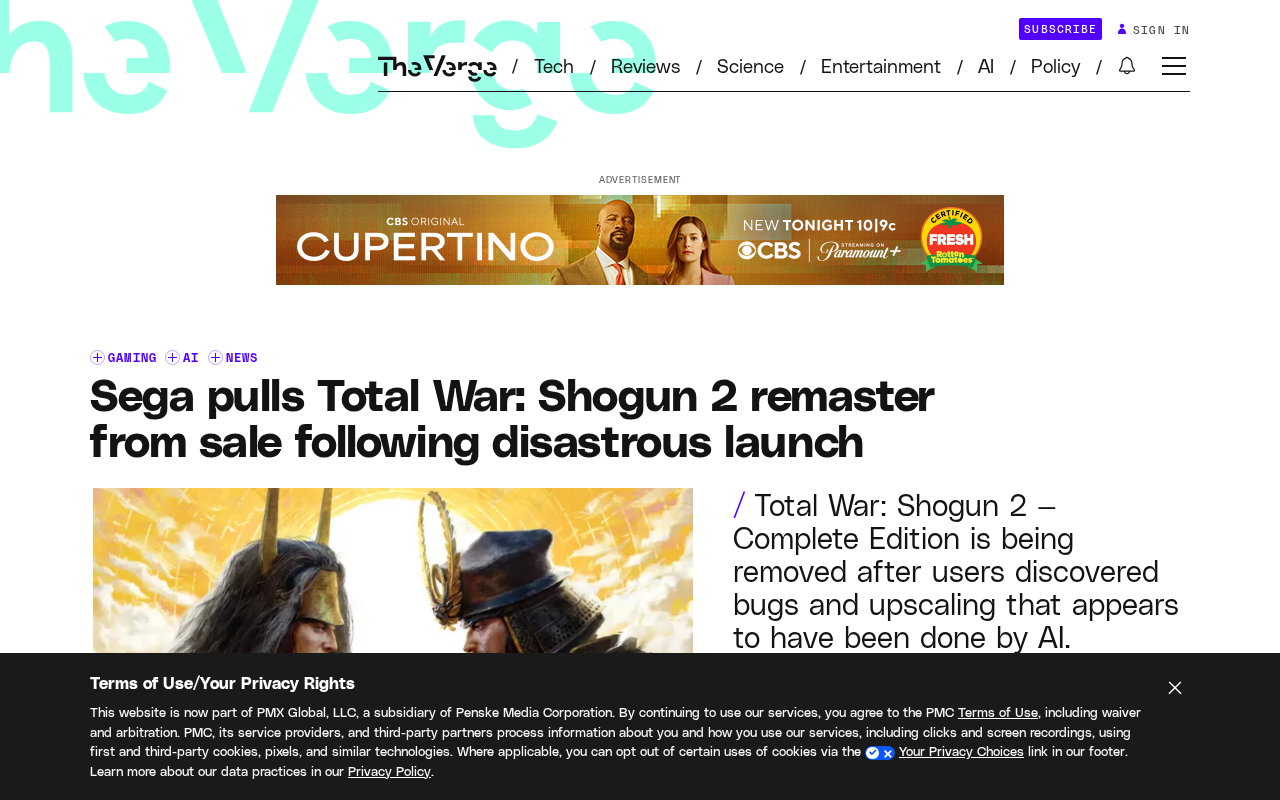
A Disastrous Launch: Bugs and AI Visuals Deliver a Double Blow
According to RSS feed reports, this "Complete Edition" remaster bundles the base game along with all DLC content, and was intended as a goodwill offering to reward longtime fans and attract newcomers. However, just one day after release, the situation took a sharp turn for the worse. The player community was quickly inundated with reports of various technical issues, with the harshest criticism aimed at the game's visual upgrades.
Many players pointed out that the game's textures, unit models, and environmental details exhibited clear signs of "AI generation" — including severe smearing, illogical texture patterns, and unnatural smoothing and distortion in certain assets. This visual treatment, mockingly dubbed an "AI filter" by players, not only fell short of what a modern remaster should deliver, but actually undermined the original game's signature art style, leaving many series veterans deeply disappointed.
The Legacy of Total War: Shogun 2
Total War: Shogun 2 was developed by Creative Assembly and released in 2011, and stands as one of the highest-rated entries in the Total War series. Set during 16th-century Japan's Sengoku period, the game earned widespread acclaim from both players and critics for its refined blend of turn-based strategy and real-time tactics, its rich Japanese-inspired art design, and its deep internal affairs and diplomacy systems. Its standalone expansion, Fall of the Samurai, was equally well-received. This is precisely why the title holds a special nostalgic value among series fans, and any remaster would inevitably be held to extremely high expectations and rigorous scrutiny. This also explains why the visual issues in this "Complete Edition" provoked such a fierce backlash — players' emotional investment in this IP far exceeds that of an average title.
Why AI Visual Upgrades Keep Failing
This Shogun 2 remaster debacle has once again thrust the gaming industry's reckless use of AI visual enhancement technology into the spotlight.
From a technical standpoint, AI super-resolution (such as NVIDIA DLSS or AMD FSR) or AI texture enhancement tools should be powerful assets for improving the visual fidelity of older games. But when developers apply AI algorithms directly to source assets without human intervention, the results often backfire. When AI models "hallucinate" details, they lack an understanding of the game's original artistic intent, easily producing images that look high-definition but are in fact distorted.
In this case, players' greatest frustration was not with the concept of a "remaster" itself, but with its sincerity and quality. When a classic title that carries players' memories is rushed out with "automated AI processing" and riddled with bugs, it amounts to a serious drain on brand credibility.
The Technical Principles Behind AI Super-Resolution and Texture Enhancement
Current mainstream AI visual enhancement technologies fall into two categories: runtime super-resolution, such as NVIDIA DLSS, AMD FSR, and Intel XeSS, which upscale low-resolution frames in real time during gameplay, relying on GPU AI acceleration units or temporal information to fill in details; and offline texture enhancement, where developers use generative adversarial network (GAN) models like ESRGAN to batch-upscale and generate details for original low-resolution textures. The latter is precisely the method commonly used in remastered games.
The problem is that these AI models are essentially "probabilistic generators" — they "guess" missing pixels based on statistical patterns in their training data, rather than genuinely reconstructing details that don't exist in the source material. When the training data doesn't match the target game's art style, the model produces artifacts such as texture smearing, distorted edges, and chaotic material logic. More critically, AI models cannot understand artistic intent — they don't know which details should be preserved and which can be omitted, so they often lose the original's carefully designed visual language while "sharpening." This is the fundamental reason why many remasters, without frame-by-frame human correction, end up looking more "fake" than the originals.
Sega's Emergency Damage Control and an Industry Warning
Faced with an avalanche of negative reviews, Sega chose the most direct form of damage control: pulling the game. Total War: Shogun 2 - Complete Edition has now disappeared from major PC storefront pages. While this move can temporarily contain the spread of negative sentiment, the brand damage already done will be difficult to repair quickly.
This incident serves as a wake-up call for the entire gaming industry. In an era where generative AI technology is increasingly widespread, how to responsibly use AI tools for content remastering and upgrades has become an issue developers must confront. AI can boost efficiency, but it must never replace human artistic oversight and quality assurance. For remastered games, players expect not just higher resolution, but respect for the original's spirit and a thoughtful modernization.
Sega's swift delisting may quell the immediate storm, but the doubts lingering in players' minds about "AI remasters" will likely require many genuinely high-quality titles to dispel.
One-line Summary
Sega urgently pulls the Total War: Shogun 2 remaster after AI visual failures and a flood of bugs.
Paragraph Summary
Sega pulled Total War: Shogun 2 - Complete Edition from major digital stores just one day after launch, following an overwhelming wave of negative player feedback. Criticism focused on two fronts: numerous technical bugs and what appeared to be crudely AI-processed visual upgrades. Players noted severe texture smearing and illogical asset patterns — hallmarks of an "AI filter" — that undermined the original's signature art style. The incident once again exposed the gaming industry's reckless use of AI visual enhancement: when AI super-resolution or texture tools lack human oversight, models fail to grasp original artistic intent, producing images that look sharp but are actually distorted. Sega's swift delisting may limit the damage, but the blow to brand credibility is hard to undo — a warning for the entire industry.
Related articles

Cursor AI Programming in Practice: Build a Student Management System from Scratch in 30 Minutes
A Bilibili creator demonstrates Cursor AI programming: generating a student management system in 30 minutes with natural language. Details on Agent mode, Claude selection, prompt techniques, and thresholds.

Top 20 AI Coding Tools Ranking: From Rock-Solid to Lackluster, a Scored Matrix
Bilibili creator releases top 20 AI coding tools ranking, tiered T0–T4 from rock-solid to lackluster, with Claude Code and Codex tied at T0. This article details the scoring dimensions (capability, reliability, robustness, durability, cost, domestic availability) and tool performances to help developers choose the right AI coding assistant.

Vibe Coding Systematic Tutorial: Master AI-Assisted Programming from Zero
A three-month Vibe Coding tutorial from a Bilibili creator covering Codex, ClaudeCode, and Cursor, from core logic to commercial project practice for beginners.