Semantica: Building Auditable AI Decision Infrastructure for Enterprises with Knowledge Graphs

Semantica wraps LLMs with a knowledge graph layer to make every AI decision fully auditable and traceable for regulated industries.
In heavily regulated sectors like finance and healthcare, enterprise AI faces a core compliance challenge: being unable to clearly explain AI decisions to regulators. Semantica is open-source infrastructure that sidesteps the unrealistic goal of explaining LLM internals, instead building "system-level explainability" around the model — recording what data entered the model, which policies applied, and the full execution path. Its core component is the Context Graph, which replaces traditional vector RAG with a knowledge graph that actively detects data conflicts and attaches W3C PROV-O provenance traces to every fact. Every AI reasoning step is preserved as causally linked nodes, supporting bitemporal point-in-time replay and regulation-ready export formats. Fully open-source with native Snowflake and Databricks integration, data never leaves enterprise boundaries — and performance reaches 6,000x faster node search.
When Regulators Ask "Why Did Your AI Do That" — Can You Answer?
Deploying AI agents in highly regulated sectors like finance, healthcare, and government comes with one unavoidable question: when your AI suddenly rejects a loan application or flags a sensitive medical record, can you explain the complete causal chain behind that decision?
For most enterprises, the honest answer is: no. And in high-stakes scenarios, being unable to explain is more than just embarrassing — it's a massive compliance risk and legal liability. Semantica, an open-source infrastructure project, was built to solve exactly this problem, widely considered the "biggest compliance nightmare" in enterprise AI: transforming traditionally opaque, chaotic AI decision-making into clear, traceable, and fully auditable records.
System-Level Explainability, Not Model-Level Explainability
The first key to understanding Semantica is distinguishing between "system-level explainability" and "foundation model explainability" — a distinction most people conflate.
Sematica doesn't try to peer inside a large language model's reasoning process. The neural network's "chain of thought" remains a black box — and Semantica doesn't touch that. Instead, it completely wraps around the model from the outside, explaining which data was fed into the model, which policies were applied, and the full execution trace. In other words, it records what the system actually did, rather than attempting to "psychoanalyze" the model itself.
This design is both pragmatic and clever. Under current technical conditions, forcibly explaining LLM internal weights is neither realistic nor sufficient for audit requirements. What regulators actually need is a complete record of external data flows and execution chains.
The Fundamental Flaw of Vector RAG: Similarity ≠ Relationship
Why is this kind of "wrapper" even necessary? The root cause lies in how mainstream AI agents are built today — they operate on embedding vectors, not true semantics.
Traditional RAG (Retrieval-Augmented Generation) relies entirely on flat similarity scores. It can only find data that looks mathematically "roughly similar" to a prompt, but provides no structure, no relationships, and no way to trace how a conclusion was actually reached. For rigorous auditors, that's nowhere near enough.

Worse, in standard vector databases and RAG pipelines, conflicting facts get silently overwritten, and the entire decision history disappears — with zero provenance.
RAG (Retrieval-Augmented Generation) is the most prevalent architectural pattern in enterprise AI today: before querying an LLM, relevant snippets are retrieved from an external knowledge base and inserted into the context, enabling the model to answer questions beyond its training data. The retrieval step in traditional RAG relies on embeddings — converting text into high-dimensional numeric vectors and using metrics like cosine similarity to find document chunks "closest" to the query vector. This approach is fundamentally statistical "shape similarity," not semantic relevance. A classic failure scenario: if two documents contain contradictory descriptions of a risk from the same company, vector retrieval may pull both into context (or silently pick one), the model has no way to perceive the conflict, and no audit record is left noting "data contradiction exists here." For financial compliance reviews, this kind of silent failure is more dangerous than an obvious error.
The Core Weapon: Context Graph
Sematica's solution is the Context Graph — think of it as a deterministic, hard-logic semantic layer sitting beneath the LLM. It transforms fragmented enterprise data into a fully queryable structured knowledge graph.
Rather than "guessing that two documents are mathematically similar," the Context Graph knows exactly how and why they connect, mapping precise semantic relationships between them. The contrast between the two paradigms is stark:
- Vector RAG: Flat similarity, silent conflict overwriting, lost decision history, zero provenance
- Context Graph: Graph traversal retrieval, active conflict detection and resolution, W3C PROV-O provenance traces attached to every fact
As the project emphasizes: every fact is not just an asset — it's a receipt. You always know exactly where a piece of information came from.
A Four-Step Pipeline: From Raw Data to Accountable Graph
Sematica transforms messy enterprise data into a clean, accountable graph through a deterministic four-step pipeline:
- Ingest: Connect directly from multiple data sources
- Extract: Carefully preserve entity boundaries during chunking to prevent information from being "cut in half," while mapping relationships between entities
- Conflict Detection: Identify and flag contradictions across different datasets
- Build: Generate a deduplicated knowledge graph
The entire pipeline runs independently of the LLM, making it highly robust.
For platform engineers, the practical value lies in native enterprise integration. Semantica connects directly to data sources like Databricks Unity Catalog, Snowflake, and SAP OData, while being compatible with agent frameworks like LangChain, Agno, and CrewAI. Critically, you never need to export sensitive data to a third-party SaaS — data stays within enterprise boundaries and is transformed into a governed graph in place.
Making AI Decisions First-Class Auditable Citizens
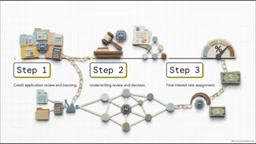
One of the system's most powerful capabilities is turning ephemeral AI reasoning into permanent, queryable records.
Take a loan approval workflow: step one is the initial credit application, where AI reviews income and liabilities; step two is underwriting review; step three is determining the final interest rate. In a typical system, once the AI delivers a rate, it essentially "forgets" how it got there. In Semantica, every step is recorded as a causally linked node on the graph — the final rate explicitly links back to the underwriting review, which links back to the specifics of the credit application.
This builds a bulletproof audit trail. Any export immediately generates a regulation-ready audit record in formats including W3C PROV, JSON, and CSV. You can hand a single file to regulators that clearly shows the exact reasoning behind any AI decision.
Even more powerful is bitemporal facts: tracking both "when something was true in the real world" and "when it was recorded in the system." This enables point-in-time graph snapshots — like rewinding a tape — to see the AI's "brain state" at any past date, letting you confidently defend historical decisions.
Accountability Doesn't Mean Slow: A 6,000x Performance Leap
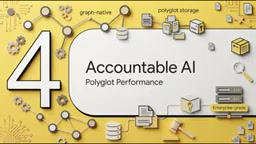
A legitimate concern: does wrapping this thick a layer of governance, provenance, and causal logic around AI drag the system to a crawl?
The data answers that question. In the 0.6.8 update, Semantica significantly optimized candidate generation and caching mechanisms. The result: on a production-scale graph with 118,000 nodes, node search speed improved by an astonishing 6,000x compared to baseline, and embedding cache throughput improved by 10x. Accountable AI doesn't have to be slow AI.
Additionally, the entire system is fully open-source and designed for polyglot persistence: it supports RDF triple stores like Blazegraph, labeled property graphs like Neo4j and AWS Neptune, and vector stores like FAISS and pgvector. This means as your enterprise scales, you can swap storage backends at any time without touching a single line of application code, completely eliminating vendor lock-in.
Polyglot Persistence is an architectural strategy that uses multiple storage engines within the same application system based on data characteristics, rather than forcing everything into a single database. The three storage backend types Semantica supports each serve distinct roles: RDF triple stores (like Blazegraph) excel at precisely expressing logical relationships between entities per W3C Semantic Web standards — the "academic orthodox" for knowledge graphs; labeled property graphs (like Neo4j, AWS Neptune) offer more flexibility for graph traversal queries and engineering practicality, suited for complex business relationship modeling; vector stores (like FAISS, pgvector) retain semantic similarity retrieval capability as a complement to graph-based retrieval. The key value of multi-backend support: as enterprise data scale and query patterns evolve, the storage layer can be migrated smoothly while the agent logic and audit record structure above it remain unchanged — avoiding systemic refactoring due to poor storage choices.
Final Thought: Can Your AI Stack Defend Its Own Decisions?
A pointed question to leave you with: if a regulator walked into your office tomorrow morning, could your current AI stack truly justify its decisions?
If it runs on nothing but flat embeddings and opaque foundation models, the answer is almost certainly "no." What Semantica provides is the infrastructure to turn that "no" into a fully auditable, deterministic "yes." For any team deploying AI agents in heavily regulated domains, the Context Graph approach is a technical path worth serious investigation.
Supplementary Background
Bitemporal Data Model is a mature concept in database theory, but it's especially critical in AI audit contexts. It distinguishes two independent time axes: Valid Time — the period during which a fact is actually true in the real world; and Transaction Time — the point at which that fact was recorded in the system. Separating these two axes means that even if data is later corrected or overwritten, the system can still reconstruct "what the world looked like from the system's perspective at any historical moment." In a loan approval scenario, this means being able to precisely answer: which version of the credit score was the AI relying on when this loan was rejected? Were there subsequent updates that hadn't yet been ingested at the time of the decision? This is critical for responding to regulatory investigations and legal proceedings — you're not just proving the conclusion, but presenting a complete information snapshot of the decision moment.
W3C PROV-O (Provenance Ontology) is a provenance standard published by the World Wide Web Consortium, defining a common vocabulary for describing "who produced an entity, when, and through what process." It is widely used in scientific data and government open data contexts. Semantica's adoption of this international standard means its generated audit records are interoperable across systems, independent of proprietary formats, and can be directly read and verified by regulators using standard tooling.
Related articles

DeepCell: One-Click AI Generation of Documents, Spreadsheets, and Slides
DeepCell tops Product Hunt with one-click generation of documents, spreadsheets, and slides, using the .deepcell format for linked updates, designed for System 2 tasks like modeling and sales reviews.

Doneas: 15-Minute Daily Accountability Calls That Keep Indie Developers From Procrastinating
Doneas is a daily accountability tool for indie developers: plan tasks on Monday, join a 15-minute call with five builders each day, and log deliveries on a public progress page. This article analyzes its core mechanics, effectiveness, and potential issues around retention and matching.

Fastlane 2.0: Fully Automated AI Ad Campaigns, From Creative to Optimization
Fastlane 2.0 is an AI ad automation tool: enter your website and it learns your brand, generates video and image ads, and runs and optimizes them on Meta, TikTok, Instagram, and YouTube.