Sentrint: A Security Scanner Built Specifically for AI-Generated Code
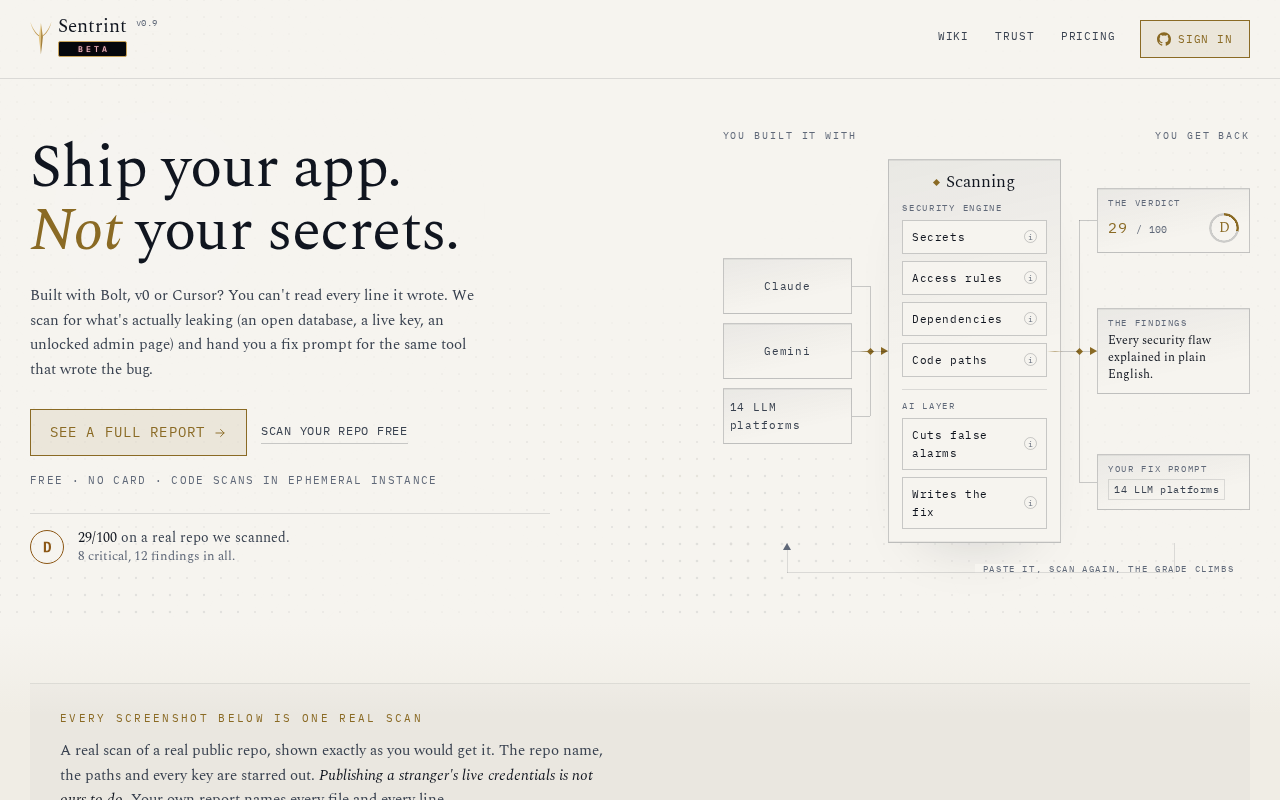
Sentrint is a security scanner purpose-built to catch vulnerabilities unique to AI-generated code.
Sentrint is a new security tool targeting projects built with LLM-generated code. It addresses AI-specific risks like hallucinated dependencies, hardcoded secrets, outdated security patterns, and incomplete input validation that traditional SAST tools often miss. As AI coding tools proliferate and "vibe coding" compresses security reviews, dedicated AI code scanners are becoming essential in modern development workflows.
When LLMs Start Writing Code, Who's Responsible for Security?
With the widespread adoption of AI programming tools like GitHub Copilot, Cursor, and Claude Code, an increasing amount of project code is being assisted or even primarily generated by large language models (LLMs). While this paradigm dramatically improves development efficiency, it also introduces a long-underestimated problem: How secure is AI-generated code, really?
Recently, a project called Sentrint appeared on Hacker News' Show HN section. Its positioning is clear — a security scanner specifically designed for "projects built using LLMs." Although the discussion hasn't gained much traction yet (4 points, 2 comments), the pain point it addresses is an increasingly unavoidable issue in the current wave of AI-assisted development.
Security Risks in LLM-Generated Code
Why Does AI Code Need a Dedicated Security Scanner?
Traditional static application security testing (SAST) tools like SonarQube and Semgrep have been around for years. These tools discover vulnerabilities by analyzing source code or bytecode without executing it — SonarQube uses rule engines and data flow analysis to track how variables propagate from inputs (sources) to dangerous operations (sinks); Semgrep takes a lightweight pattern-matching approach, allowing developers to write detection rules using code-like syntax. However, these tools are built on the core assumption that code is written by humans and follows predictable patterns and context. LLM-generated code is often fragmented — pieced together without project context. Traditional tools' data flow analysis can fail due to broken context, and certain AI-specific problem patterns simply aren't covered by traditional rule databases.
It's precisely because of this uniqueness that tools like Sentrint aim to fill the following gaps:
- Subtle bugs hidden behind apparent correctness: LLM-generated code often has perfect syntax and strong readability, but may conceal subtle logic vulnerabilities or outdated security practices. Human reviewers can easily be lulled into a false sense of security by its "professional appearance."
- Temporal limitations of training data: A model's knowledge is frozen at a certain point in time. It may recommend deprecated encryption algorithms, dependency versions with known CVEs, or outdated security patterns. CVE (Common Vulnerabilities and Exposures) is the globally used vulnerability numbering system maintained by MITRE. After an LLM's training data cutoff, newly discovered CVEs simply "don't exist" to the model. More subtly, certain cryptographic algorithms (like SHA-1 for security signatures or MD5 for password hashing) technically "work" but have been explicitly flagged as insecure by the security community — yet models may continue recommending these outdated practices due to the abundance of historical code in their training data.
- Hallucinated Dependencies: LLMs sometimes "invent" software package names that don't exist. Attackers can register these package names to conduct "dependency confusion" or "slopsquatting" attacks. A 2024 study from New York University found that approximately 5.2% of package references in GPT-4-generated code point to non-existent packages. Attackers can register these frequently "hallucinated" package names on public registries like PyPI and npm, embedding malicious code. Unlike traditional dependency confusion attacks, slopsquatting doesn't require guessing internal package names — it leverages the predictable output patterns of AI models to map the attack surface, making these attacks significantly more scalable.
- Incomplete boundary handling: AI tends to generate code that runs through the happy path, but often provides insufficient coverage for input validation, authorization checks, injection prevention, and other edge-case security scenarios.
From "Efficiency First" to "Security Safety Net"
In AI programming practice, developers tend to quickly accept AI suggestions and move on to the next step. This "vibe coding" approach, while efficient, significantly compresses the security review process.
The term "Vibe Coding" was coined by Andrej Karpathy — former OpenAI researcher and Tesla AI lead — in early 2024. It describes a programming style where developers rely entirely on AI-generated code, accept output based on intuition, and don't deeply understand implementation details. Karpathy himself described it as "not really programming — it's seeing stuff, saying stuff, running stuff, copy-pasting stuff." This pattern is particularly popular in prototyping and personal projects, dramatically lowering the barrier to programming, but it also means a large number of developers lacking security awareness are producing deployable code. Stack Overflow's 2024 Developer Survey showed that 76% of developers are using or plan to use AI coding tools, but fewer than 20% conduct systematic security reviews of AI output.
Sentrint's emergence essentially adds an automated security gate at the end of this rapid pipeline.
Sentrint's Core Features and Positioning
Security Scanning Tailored for AI Development Workflows
From its positioning, Sentrint isn't trying to replace traditional SAST tools — rather, it's adapted for AI-dominated development workflows. Its value proposition can be summarized as: when you rely on LLMs to generate large volumes of code, it provides a dedicated security detection layer that identifies the issues AI is particularly prone to introducing.
These tools typically focus on the following dimensions:
- Secret and credential leak detection: AI-generated example code frequently inlines hardcoded API keys, tokens, or database passwords.
- Dependency security auditing: Detecting whether third-party libraries have known vulnerabilities, and whether suspicious "hallucinated packages" are present.
- Common vulnerability pattern recognition: SQL injection, XSS, path traversal, insecure deserialization, and other classic OWASP risks. OWASP (Open Web Application Security Project) is the world's most influential application security organization, and its Top 10 list is the industry-recognized reference benchmark for web security risks. LLM-generated code is particularly prone to triggering injection attacks (because AI often generates string-concatenated SQL), using components with known vulnerabilities (due to training data staleness), and security misconfiguration (AI tends to generate "good enough to run" configurations rather than hardened ones).
- Configuration error detection: Overly permissive CORS settings, exposed debug interfaces, default credentials, etc.
The Significance of Show HN and the Project's Early Stage
As a Show HN project, Sentrint is still in its early stages. Low engagement on Hacker News doesn't mean the direction is wrong — quite the opposite, security tools often need time to build trust and reputation. For independent developers or small teams, a tool that can scan AI-generated code with one click holds considerable practical value.
The AI Code Security Tool Space Is Heating Up
A Market Need Being Validated
Sentrint isn't alone. As AI programming penetration rates rapidly increase, a tool ecosystem around "AI code security" is forming. From enterprise solutions like GitHub Advanced Security, to AI code scanning capabilities from vendors like Snyk and Semgrep, to independent newcomers like Sentrint — all are competing for the same exploding demand scenario.
An emerging industry consensus is: AI has increased the speed of writing code, but hasn't proportionally improved code security. When teams double their code output with AI, potential security debt accumulates in parallel. Automated security scanning is shifting from "nice to have" to "must have."
How Developers Should Address AI Code Security Risks
For teams heavily using AI-assisted programming, here are several practical recommendations:
- Don't treat AI output as trusted input. No matter how well-formatted the code looks, it should undergo security scanning and human review.
- Integrate security scanning into your CI/CD pipeline — let tools like Sentrint run automatically on every commit, rather than retrofitting security after the fact. CI/CD (Continuous Integration/Continuous Deployment) is the core pipeline of modern software delivery. Embedding security scanning into CI/CD means automatically executing checks at every stage as code flows from developer machines to production. Typical practices include running secret detection in Git pre-commit hooks (using tools like Gitleaks or TruffleHog), triggering SAST scans at the Pull Request stage, performing dependency vulnerability analysis (SCA) during the build phase, and executing DAST (Dynamic Application Security Testing) before deployment. The core principle of "Shift Left Security" is to find problems as early as possible — fixing a vulnerability discovered during development costs only 1/100th of what it costs when found in production. For AI-generated code, this automated detection is especially critical because code output velocity has already exceeded the capacity of manual review.
- Focus particularly on dependencies and secrets — these are the two most frequent security issues in AI-generated code.
- Maintain tool diversity — no single scanner can cover all risks. AI-specific scanners should complement traditional SAST/DAST tools.
Conclusion
Although Sentrint is still a nascent project, it precisely targets a real pain point of the AI programming era. As we enjoy the development efficiency gains that LLMs provide, we must also confront the security gaps they leave behind. As more production systems are built with AI participation, security tools specifically designed for AI-generated code will become an indispensable part of the modern development toolchain.
What's worth watching isn't just how far Sentrint itself can go, but how the entire "AI code security" space will reshape our understanding of software supply chain security.
Related articles

Apple HomeView Hands-On Review: Is the $300 Smart Home Hub Worth It?
Apple HomeView hands-on: a $300 smart home hub with facial recognition for quick account switching, but no App Store or voice recognition. Is the wall-mounted version worth it? Should you buy the first generation?

Meta Muse Wonder Launch: What It Means for Meta's Return to the Frontier AI Race
Meta releases Muse Wonder and WonderFull, benchmarks reach the frontier, community feedback is polarized. An in-depth look at Meta's return to the frontier AI race, its personal agent strategy, and Zuckerberg's different path.

Apple Home Smart Home Lineup Leaked: LG and Schneider Team Up, UWB Door Lock on Board
Apple Home ecosystem gains new LG and Schneider devices: UWB smart lock with proximity unlock, 2.5K dual-camera doorbell, privacy indoor camera, and AirPods-like seamless pairing.