Septopert: The Smallest Nopert Polyhedron — A New Take on Geometric Construction

Septopert is the smallest known nopert polyhedron, constrained by combinatorial topology, which sparked a small discussion on Hacker News.
The article introduces nopert polyhedra and Septopert: nopert means deliberately breaking regular or decomposable structures while preserving geometric validity, and Septopert is the smallest known instance in this family, with "sept" hinting at a seven-related element. Its minimality is constrained by combinatorial topology conditions such as face connectivity, vertex degree, and Euler's formula, and may involve non-convex or self-intersecting elements. The Hacker News discussion saw low engagement (16 points, 2 comments), and the lack of specific coordinates or face lists makes Septopert more of a conceptual entity. The article argues the concept has inspirational value for boundary exploration in geometric construction and combinatorial polyhedron research.
What Is a Nopert Polyhedron?
In geometry, polyhedra are often classified based on symmetry, face count, and vertex configuration. Nopert polyhedra are a special class of constructions whose name derives from negating the concept of "pert" — where pert typically refers to some regular or decomposable structure, and nopert means deliberately breaking that regularity while preserving geometric validity. Septopert is the smallest known instance in this family; the "sept" in its name hints at a seven-related element, though the specific face or vertex counts were not elaborated in the original discussion.
This concept sparked a small discussion on Hacker News, garnering 16 points and 2 comments. Although the discussion was modest, Septopert's status as the smallest nopert polyhedron offers an interesting case study for exploring the boundaries of geometric construction.
Structural Characteristics of Septopert
According to analysis from the Hacker News community, Septopert is called "smallest" because it reaches the theoretical lower bound under the constraints of nopert polyhedra. Constructing such polyhedra requires simultaneously satisfying basic requirements such as face connectivity, vertex degree, and Euler's formula, while the nopert condition further restricts the possibility of symmetry operations or face merging.
One commenter noted that Septopert's construction may involve non-convex or self-intersecting geometric elements, but the original discussion did not provide specific coordinates or face lists. This lack of information makes Septopert more of a conceptual entity than a directly visualizable model. For geometry enthusiasts, understanding its minimality requires approaching it from the perspective of combinatorial topology rather than relying on intuitive diagrams.
Euler's formula is the cornerstone of polyhedral combinatorial topology. For any convex polyhedron (or one homeomorphic to a sphere), we have (V - E + F = 2), where (V) is the number of vertices, (E) the number of edges, and (F) the number of faces. This relationship strictly constrains the degrees of freedom among polyhedral parameters: given any two quantities, the third is determined. For non-convex or self-intersecting generalized polyhedra, Euler's formula may require a genus correction term (e.g., (V - E + F = 2 - 2g)), which is also a boundary condition that needs special attention in nopert polyhedron construction. Understanding this formula helps grasp the mathematical meaning of Septopert's "minimality": under nopert constraints, face count, vertex count, and connectivity must simultaneously satisfy the Euler relation, thereby compressing feasible constructions into a very narrow parameter range.
Combinatorial topology studies properties of geometric objects that remain invariant under continuous deformation — such as connectivity, genus, and vertex degree sequences — without depending on specific coordinates or metrics. For polyhedra like Septopert that lack explicit coordinates, combinatorial topology provides the most natural analytical framework: one can determine whether it satisfies the nopert condition through the incidence structure between faces and vertices (i.e., abstract polyhedra or cell complexes). For example, vertex degree sequences and face adjacency graphs can encode the degree of "regularity" of a construction, and the nopert condition corresponds precisely to breaking these regular patterns. Therefore, even without a visualizable model, Septopert's minimality can be rigorously discussed from the perspective of combinatorial topology.
Community Reaction and Information Gaps
The Hacker News discussion had only two comments, and the original content did not provide a detailed definition or diagrams of Septopert. This makes the information available on the topic relatively limited. One comment may have questioned the criterion for determining "smallest," while another may have explored the relationship between nopert polyhedra and other irregular polyhedra. Due to the lack of multi-source cross-validation, this article's discussion is based mainly on the title and point information, and cannot make deeper assertions about Septopert's mathematical properties.
This information gap also suggests to readers that truly understanding Septopert may require consulting original papers or specialized literature on geometric construction. The Hacker News discussion serves more as an introduction than a complete source of knowledge.
Significance for Geometric Construction Exploration
Despite limited details, the proposal of Septopert as the smallest nopert polyhedron remains thought-provoking. It reminds us that in geometric construction, "smallest" is often not equivalent to "simplest" — the nopert condition may force constructors to make trade-offs among face count, vertex count, or symmetry. Such trade-offs have potential applications in computational geometry, polyhedral combinatorics, and 3D modeling.
For readers in AI and technology fields, the Septopert case also demonstrates how a niche mathematical concept can spark thinking about constructive proofs and boundary conditions. Although 16 points on Hacker News is unremarkable, such discussions often attract developers and researchers with deep interest in fundamental theory.
One-line Summary
Septopert is the smallest known nopert polyhedron, whose construction is constrained by combinatorial topology and which sparked a small discussion on Hacker News.
Paragraph Summary
The article introduces the concepts of nopert polyhedra and Septopert: nopert refers to deliberately breaking regular or decomposable structures while preserving geometric validity, and Septopert is the smallest known instance in this family, with the "sept" in its name hinting at a seven-related element. Septopert's minimality is constrained by combinatorial topological conditions such as face connectivity, vertex degree, and Euler's formula, and may involve non-convex or self-intersecting elements. The Hacker News discussion received low engagement (16 points, 2 comments), and the original information lacked specific coordinates or face lists, making Septopert more of a conceptual entity. The article argues that this concept has inspirational significance for exploring the boundaries of geometric construction and for research on combinatorial polyhedra.
Related articles

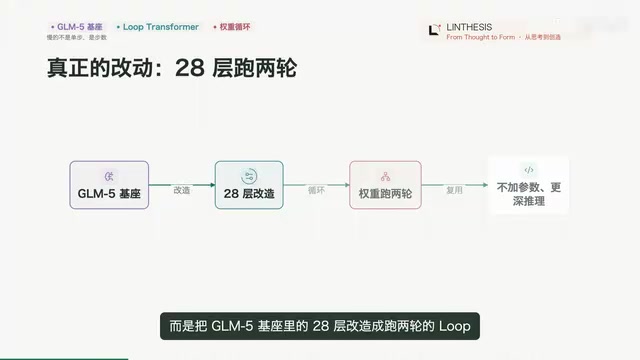
Zhipu GLM-5.4 Released: Loop Transformer Runs 28 Layers Twice
Zhipu releases GLM-5.4, the first Loop Transformer flagship: 28 layers run twice for 2-3T-equivalent intelligence, plus video and image input. API and open weights not yet released.
GLM-5.4 Coding Test 4.6x Slower? Unpacking the Loop Transformer Architecture
GLM-5.4 coding test took 431 minutes vs. competitor's 109, 4.6x more steps. We analyze its Loop Transformer architecture, KingBench4 score of 55.3, Max tier's 1.04M token cost, and tier selection advice.

Zhipu GLM-5.4 Quietly Released: A Debut for Loop Transformer Architecture
Zhipu GLM-5.4 quietly lands in coding plans: first Loop Transformer flagship with 750B params, 1M token context, AIM math up from 19.2 to 30.4, and native vision for coding from screenshots.