SGLang Integrates DSpark: How Confidence-Driven Speculative Decoding Cracks the High-Concurrency Failure Problem

SGLang integrates DSpark, using confidence-driven variable-length verification to fix speculative decoding failure at scale.
SGLang has officially integrated DSpark, which uses a confidence-driven, variable-length verification mechanism to solve speculative decoding's failure under high concurrency. By only verifying tokens the draft model is confident about, DSpark maintains acceleration gains across batch sizes 1 to 256, reaching 383.7 tok/s on B300 and supporting Qwen3 and DeepSeek-V4.
Article
Speculative Decoding, one of the core techniques for accelerating large model inference, has long faced a critical bottleneck: its acceleration effect degrades significantly under high-concurrency, large-batch scenarios. Recently, the high-performance inference engine SGLang announced the official integration of DSpark, which attempts to fundamentally solve this problem through a "confidence-driven, variable-length verification" mechanism. This update not only delivers considerable throughput improvements but also offers new insights for deploying speculative decoding in production environments.
The Old Problem with Speculative Decoding: It Breaks Down at Scale
The basic principle of speculative decoding is to use a lightweight "draft model" to quickly generate multiple candidate tokens, which are then verified all at once by the main model for correctness. When the draft hit rate is high, a single forward pass of the main model can confirm multiple tokens, thereby achieving acceleration.
This technique was first systematically proposed by Google Brain in the 2023 paper Accelerating Large Language Model Decoding with Speculative Sampling. Its design motivation stems from the fundamental bottleneck of autoregressive language model inference: large models can only generate one token at a time, and the entire process is limited by memory bandwidth rather than compute. Draft models are typically 10 to 100 times smaller than the main model and can quickly generate multiple candidate sequences at very low cost. The main model's parallel verification fully leverages its batch processing capability, and the two working together can achieve significant acceleration.
However, this mechanism has a hidden weakness in practice: it performs verification on every single draft token. Understanding this problem requires attention to the relationship between batch size and GPU compute utilization. At single-request scale (batch size = 1), GPU compute is largely idle (utilization may be below 10%), and verifying draft tokens is almost "free." But as concurrent requests increase, the GPU gradually enters a compute-bound state, and the additional verification operations begin to compete for the compute resources of actual requests. Speculative decoding shifts from being a "net gain" to a "net loss," with acceleration benefits shrinking rapidly or even turning negative.
This is precisely the root cause of why many speculative decoding solutions "perform excellently in the lab but fail once deployed." The core of DSpark's design is to keep the acceleration effect stable even as batch size scales up.
DSpark's Core Idea: Only Verify the Parts You're Confident About
DSpark's proposed solution is to introduce confidence-driven, variable-length verification. The key insight is that the draft model's confidence in different tokens varies. For positions where the draft model is highly confident, the prediction is very likely correct and worth investing compute to verify. But for positions where the draft model itself is uncertain, the expected return on verification is low, and it's better to skip them directly.
The theoretical basis for this strategy comes from the concept of entropy in information theory. The lower the entropy of the probability distribution output by the draft model, the more certain the model is about that position's prediction, the higher the verification success rate, and the greater the expected return. Conversely, high-entropy positions offer less return. By setting a dynamic threshold, DSpark concentrates verification resources on high-confidence positions—essentially a confidence-based resource scheduling optimization.
In other words, DSpark no longer mechanically verifies every draft token, but instead only verifies where the draft model is confident. This brings two direct benefits:
- It reduces compute waste from ineffective verification;
- It allows verification length to vary dynamically with the scenario, maintaining acceleration gains even as batch size scales up.
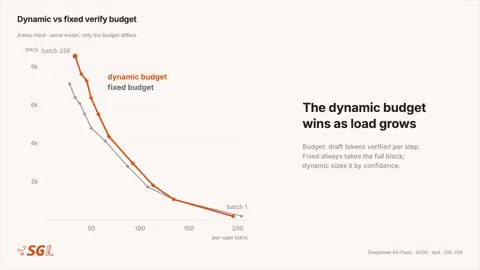
This "variable-length verification" approach essentially replaces a fixed verification budget with an adaptive strategy that dynamically adjusts based on load and confidence, solving the problem of speculative decoding failure under high concurrency at the mechanism level.
SGLang's Engineering Optimizations: Making a Good Algorithm Actually Run Fast
Turning an algorithmic idea into real performance gains often depends on the depth of the engineering implementation. The SGLang team made extensive optimizations at the framework level for variable-length verification.
Throughput Gains from Dynamic Scheduling
In high-concurrency scenarios, DSpark adopts dynamic scheduling instead of the traditional fixed-budget strategy. According to official data, compared to fixed-budget approaches, dynamic scheduling can deliver up to approximately 20% throughput improvement, while maintaining high verification quality across various workloads. This is particularly critical—inference acceleration must not come at the cost of output quality.
Fused Kernels and Zero-Overhead Scheduling
At the underlying implementation level, SGLang combines fused kernels with zero-overhead scheduling. Fused kernels are an important GPU programming optimization technique that merges multiple independent CUDA kernels into a single kernel for execution, substantially reducing kernel launch overhead, memory read/write operations, and data movement costs. In speculative decoding scenarios, steps such as draft generation, confidence computation, and verification decisions would incur significant synchronization waits if executed separately; after fusion, they can be completed within a single kernel, significantly reducing end-to-end latency. Zero-overhead scheduling ensures that the dynamic decision-making itself introduces no perceptible system overhead, so the gains at the algorithm level are not eaten up by engineering losses.
The final results are quite impressive: on B300 hardware, DeepSeek-V4-Pro achieved a generation speed of 383.7 tok/s at batch size = 1.
Performance Across the Full Batch Range
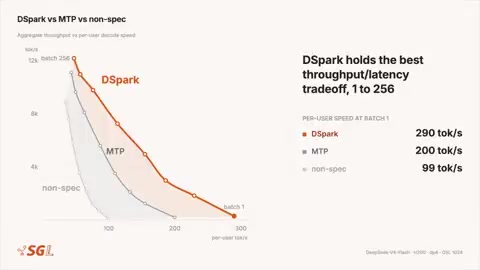
The most noteworthy aspect of DSpark is that it demonstrates sustained advantages across the entire batch range from 1 to 256.
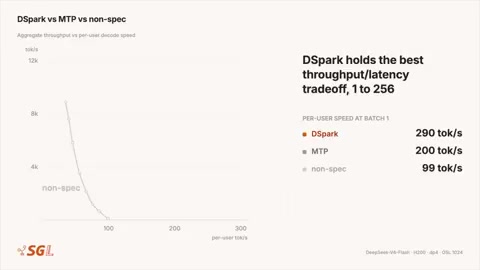
According to official tests on DeepSeek-V4-Flash, DSpark provides the best throughput/latency tradeoff across the entire batch range, outperforming two control groups:
- MTP (Multi-Token Prediction);
- Non-speculative decoding (non-spec) conventional inference.
Notably, MTP represents another class of inference acceleration approach: it achieves acceleration by having the model predict multiple future tokens simultaneously during the training phase, without requiring a separate draft model, but it requires dedicated design in model architecture and training pipeline (DeepSeek has already built this mechanism into its models). As a pure inference-phase optimization, DSpark surpasses MTP's acceleration effect without modifying the model architecture, meaning it offers greater deployment flexibility and can be applied directly to existing models.
This means DSpark is not merely a "nice-to-have" that works only in specific scenarios, but a general-purpose solution that holds its ground at both the single-request and high-concurrency ends. For engineering teams that need to balance latency and throughput in production environments, the "robust across all batch sizes" characteristic is particularly valuable.
Ecosystem Support and the Significance of Open Source
DSpark is now officially available in SGLang and supports two major mainstream model families: Qwen3 and DeepSeek-V4. The SGLang team also specifically thanked DeepSeek for open-sourcing the related work—once again demonstrating the virtuous synergy between open-source models and open-source inference frameworks: the model side opens up technical details, while the framework side engineers them and brings them to a wider user base.
For developers, the integration of such capabilities significantly lowers the barrier to entry. In the past, confidence-driven speculative decoding often remained at the paper level, difficult for ordinary teams to reproduce. Now that it is integrated into a mainstream inference engine, complete with official technical blogs and run commands, any team using SGLang can directly enjoy this acceleration benefit.
Summary
The value of DSpark lies not in proposing a brand-new concept, but in precisely hitting the core pain point of speculative decoding under real workloads—blind full verification causing failure under high concurrency—and offering a solution that is both theoretically grounded and deeply engineered.
The shift from "verify everything" to "only verify what you're confident about" allows acceleration gains to persist as batch size scales up. Combined with SGLang's fused kernels and dynamic scheduling, DSpark achieves leading cost-performance across the full range from single requests to 256 concurrent requests. With official support for Qwen3 and DeepSeek-V4 now in place, DSpark is poised to become another trustworthy and practical option in the large model inference acceleration toolbox.
Key Takeaways
Related articles
PGP-Clinical-TimeKAN: A Detailed Guide to the Multivariate Physiological Indicator Joint Prediction Framework
An in-depth analysis of the PGP-Clinical-TimeKAN framework for joint probabilistic prediction of multivariate physiological indicators, covering trajectory-first paradigm, KAN message passing, MIMIC-IV validation, and ablation studies.
CriticGen: A New Framework That Transforms AI Evaluation into Actionable Improvement Feedback
CriticGen proposes a generation-aware evaluation framework that transforms AI assessment from passive scoring to an active optimization loop, achieving 73.17% answer improvement and 93.28% non-degradation rate.
Vercel AI SDK workflow-harness Update Analysis
Deep analysis of Vercel AI SDK workflow-harness 1.0.107 update: architecture design, engineering practices, and developer value for building reliable AI apps.