SGLang Router v0.1.0 Officially Released: Unified Release Pipeline and Router Component Goes Independent
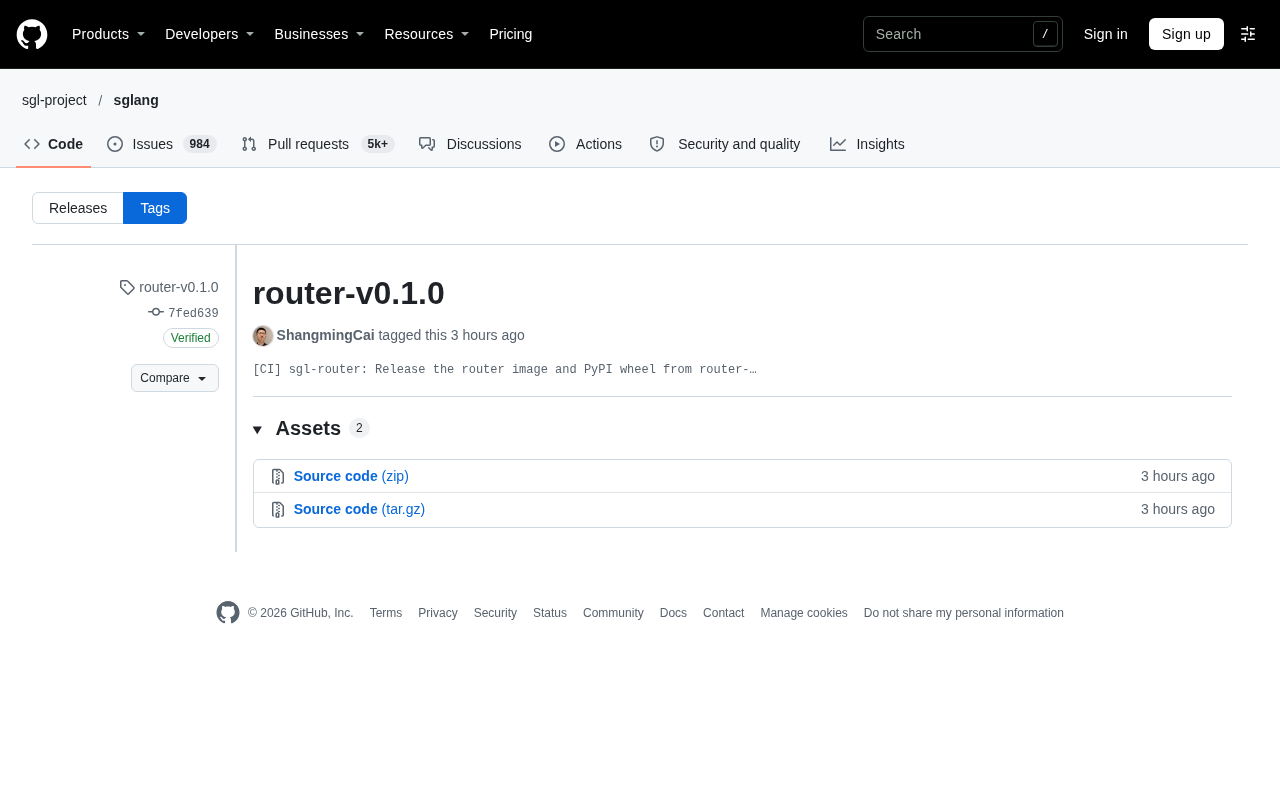
SGLang's router component router-v0.1.0 is released independently, producing both an image and a PyPI wheel.
SGLang's sgl-router component completes its first independent release with the router-v0.1.0 tag, corresponding to commit 7fed639; the commit message indicates the change focuses on the CI release pipeline, delivering both a container image and a PyPI wheel. The article argues that the significance of an initial version like 0.1.0 lies not in features but in the module being split out from the main project and treated as an independent product. Independent distribution brings three benefits—decoupled upgrades, flexible deployment, and converged dependency boundaries—and aligns with the trend of inference frameworks evolving from monolithic repositories toward "core engine + independently deliverable components." Since initial versions typically don't promise API stability, the article suggests platform teams, MLOps engineers, and library-integration developers can do preliminary research first, while production environments should wait for a clear compatibility policy before deeply committing.
The Engineering Signal Behind a Minor Version Bump
A tag named router-v0.1.0 quietly appeared on GitHub. Judging from the commit message, this version was tagged by developer ShangmingCai, corresponding to commit 7fed639, with the commit message [CI] sgl-router: Release the router image and PyPI wheel from router-…. There isn't much information, but the direction is clear: SGLang's router component (sgl-router) is following an independent release path—producing both a container image and a PyPI distribution package.
For developers following large-model inference infrastructure, initial releases like this "0.1.0" are often more noteworthy than the version number itself. It usually means that a module originally embedded in the main project is beginning to be treated as an independent product, and its release cadence, dependency boundaries, and delivery formats will all change accordingly.
Interpreting the Release: Dual Channels of Image and PyPI Wheel
The most critical phrase in the commit message is "Release the router image and PyPI wheel." This reveals two delivery channels:
- Container image: Aimed at users who want quick deployment or who run the routing service via container orchestration such as Kubernetes. Image releases mean the router component can be upgraded independently of the main repository's build process.
- PyPI wheel: Aimed at developers who integrate routing capabilities as part of a Python project. Installing via pip gives you the component without having to compile the entire SGLang repository from source.
Both channels being wired up in a single CI commit shows that the core work of this release is not in algorithms or features, but in release engineering itself—streamlining the build, signing, and upload pipeline. The commit carries a GitHub-verified signature (GPG key ID: B5690EEEBB952194), which also conforms to proper release process standards.
Why Independent Releases Matter
SGLang is known in the large-model inference space for its high-performance scheduling, and its routing layer handles request dispatching, load balancing, and related responsibilities. Splitting the router into an independent distribution package yields concrete benefits in several areas:
- Decoupled upgrades: Iterations on routing strategy no longer need to follow the main project's release cadence, so fixes and tuning can reach users faster.
- Flexible deployment: The image form lets the router component scale independently, suitable for multi-replica, multi-machine deployments.
- Converged dependencies: The PyPI wheel clarifies the component's dependency boundaries, reducing the burden of "pulling in an entire inference framework just to use one routing feature."
These judgments are based on the engineering implications of the commit message itself, not explicit commitments in official documentation, but the direction aligns with the current evolution trend of inference infrastructure toward "componentization and independent deployability."
The difference between wheel and sdist: A PyPI wheel (.whl) is a pre-compiled binary distribution package that requires no local compilation during installation—it's faster and has fewer build toolchain dependencies; sdist (source distribution) requires users to perform the build locally. For inference components that include C/C++/CUDA extensions, the value of a wheel is especially pronounced—it can encapsulate environment differences such as compiler versions and CUDA toolchains on the release side, lowering the installation barrier for users. But wheels also bring platform compatibility issues: they need to be built separately for different Python versions (e.g., cp310/cp311), operating systems (manylinux/macOS/Windows), and even CPU architectures, which is also a major source of increased release engineering complexity.
The Positioning of Version 0.1.0 and Its Target Audience
Initial versions typically do not promise API stability. A reasonable expectation for router-v0.1.0 is that the core release pipeline has been proven out, but interface details may still be adjusted in subsequent minor versions.
Who should pay attention now:
- Platform teams building multi-model, multi-replica inference services that need an independent routing layer;
- Ops and MLOps engineers who want to quickly validate SGLang routing capabilities via containers;
- Application developers who need to integrate request dispatching as a library in Python projects.
If you're pursuing long-term stability for production environments, it's generally advisable to wait for subsequent versions to clarify their compatibility policy before deeply committing; if you're doing technical research or prototype validation, 0.1.0 is a good window to observe its design direction.
The Componentization Trend in Inference Infrastructure, as Seen from This Release
A single 0.1.0 tag isn't enough to draw industry-wide conclusions, but it is an observable sample. Inference frameworks are evolving from "monolithic large repositories" toward "core engine + independently deliverable peripheral components": model serving engines, routing layers, caching layers, and observability components each have their own release cadence, composed into a complete system through standardized artifacts (images, wheels).
This split is good for the ecosystem. Once component boundaries are clear, the barrier to third-party integration and secondary development drops, and relatively independent capabilities like the routing layer become easier to reuse by other inference stacks. The cost is a more complex version compatibility matrix—users need to more carefully verify the version correspondence between components and the main project.
router-v0.1.0 currently only provides a starting point. Signals worth tracking going forward include: whether release frequency is stable, whether the wheel's dependency declarations converge, whether the image offers multi-architecture support, and how the routing API evolves during the 0.x phase. These say more about whether this component will be maintained long-term than the version number itself.
What multi-architecture image support means: A container image's "multi-architecture" support usually means providing images for architectures such as amd64 and arm64 simultaneously via a manifest list, with the runtime automatically selecting the matching version during docker pull. For inference infrastructure, the importance of arm64 support has risen notably in recent years—ARM servers such as AWS Graviton and Ampere are widely used in cost-sensitive inference scenarios. To judge whether an image is truly usable, you can check whether its manifest includes multiple architecture entries and whether it is built separately on hardware-related base images such as CUDA.
FAQ
Does this version include new features? Judging from the commit message, this tag mainly corresponds to changes in the CI release pipeline, with the focus on producing the image and PyPI wheel; no feature-level descriptions are present.
How do I get it? Based on the commit message, the router image can be obtained from a container image registry, or the corresponding wheel package can be installed via PyPI. The specific package name and image address should be based on what the repository actually publishes.
Can it be used in production? 0.1.0 is an initial version, and interface stability is typically limited; it's advisable to validate in a small-scale environment first.
Related articles

Gemini 4 Neon Review: Benchmark Scores Rival Carbon, API Pricing and Quota Breakdown
Google Gemini 4 Neon is now live, benchmark scores closely tracking Carbon, API pricing 3/15 at twice Hydrogen's rate. This article compiles Bilibili creator testing: Neon can replace 90% of Carbon scenarios, AntiGravity quota consumption is only one-third of Carbon, plus subscription channel restrictions and 2API ban risks.

Gemini 4 Helium Coming Soon? Signals of Google Loosening Subscription Restrictions
Google team member hints releases will continue; community speculates Gemini 4 Helium (Flash Lite) may be next. Subscription ban controversy gets a response as product lead says "Soon," suggesting restrictions may be lifted. This article covers Gemini developments, OpenAI Coding Agent and risk management, Doubao real-time audio-video API, and compute business dynamics.

AI-Assisted React Development in Practice: Optimizing a Video App and Handling Errors
A 14-year veteran developer demonstrates AI-assisted React video app optimization: compressing video from 80MB to 5MB (~94%) via ImageKit, plus reliable error handling and retry mechanisms. Includes planning, code understanding, and verification methods for working with AI.