Shepherd Terminal: A Persistent Terminal for Running Codex and Claude in Parallel

Shepherd Terminal lets developers run and manage multiple AI coding agents in parallel from one persistent interface.
Shepherd Terminal is a persistent terminal tool designed for the multi-agent era of AI programming. It enables developers to run Codex, Claude, and other coding agents side by side across tabs, panes, and remote machines. With session persistence, real-time agent status tracking, and context-aware control, it transforms the terminal into an orchestration workbench — shifting the developer's role from code executor to agent supervisor.
AI Programming Enters the Multi-Agent Era
As coding agents like Codex and Claude Code continue to mature, the way developers work is undergoing a fundamental shift. Coding agents are AI systems capable of autonomously understanding programming tasks, generating code, executing commands, and iteratively correcting based on feedback. Unlike earlier code completion tools (such as GitHub Copilot's inline suggestions), coding agents have a complete task execution loop: they can read project codebases, formulate modification plans, write and run code, parse error messages, and automatically fix issues. OpenAI's Codex agent features asynchronous cloud execution, independently completing coding tasks in sandboxed environments; Anthropic's Claude Code runs as a terminal-based interactive tool, emphasizing deep integration with local development environments. The maturation of these agents marks a new phase in AI programming — from "assisted completion" to "autonomous execution."
We used to type commands one by one in a single terminal. Now, more and more developers are running multiple AI agents in parallel — one refactoring code, another writing tests, and yet another running build tasks on a remote machine.
However, traditional terminals were never designed for this kind of "multi-agent parallel" workflow. Closing the app kills the session; switching between multiple tabs makes it hard to tell at a glance which agent is actively working and which is waiting for feedback. Shepherd Terminal, which recently reached #6 on the Product Hunt Developer Tools leaderboard, targets exactly this pain point.
What Is Shepherd Terminal?
Shepherd Terminal has a crystal-clear positioning — "A persistent terminal for Codex and Claude side by side." Built by developer Junseo (Chato) Ko, it has garnered 91 upvotes and 9 comments on Product Hunt, categorized under Developer Tools, Artificial Intelligence, and Change Management.
Its core idea is to upgrade the terminal from a "disposable command execution window" to a "workbench for agents." Developers can run multiple coding agents across tabs, panes, and even remote machines, orchestrating and monitoring them all from a unified interface.
Three Core Capabilities
Based on the official description, Shepherd Terminal addresses three main categories of problems:
Persistent Sessions. This is where the "persistent" in the product name comes from. Terminal sessions stay alive even after you close the app. The underlying technical principle is worth a brief explanation: traditional terminal sessions are tied to the lifecycle of their host process — when the terminal window closes, all child processes receive a SIGHUP signal and terminate. In the Linux/Unix world, terminal multiplexers like tmux and GNU Screen solve this by maintaining an independent session daemon on the server side; the user's shell and child processes actually attach to a background session server, while the frontend terminal window is merely a client that can connect or disconnect at any time. Shepherd Terminal extends this concept to the AI agent scenario, not only keeping shell processes alive but also maintaining the complete context state of agents — including conversation history, current task progress, file modification records, and more. This is far more complex than traditional terminal persistence, because an agent's "state" is not just a process but a runtime environment containing multi-dimensional information. Long-running agent tasks won't be interrupted by closing a window, and context won't be lost when you reopen it — you can pick up right where the agent left off, at the exact files and changes it was working on.
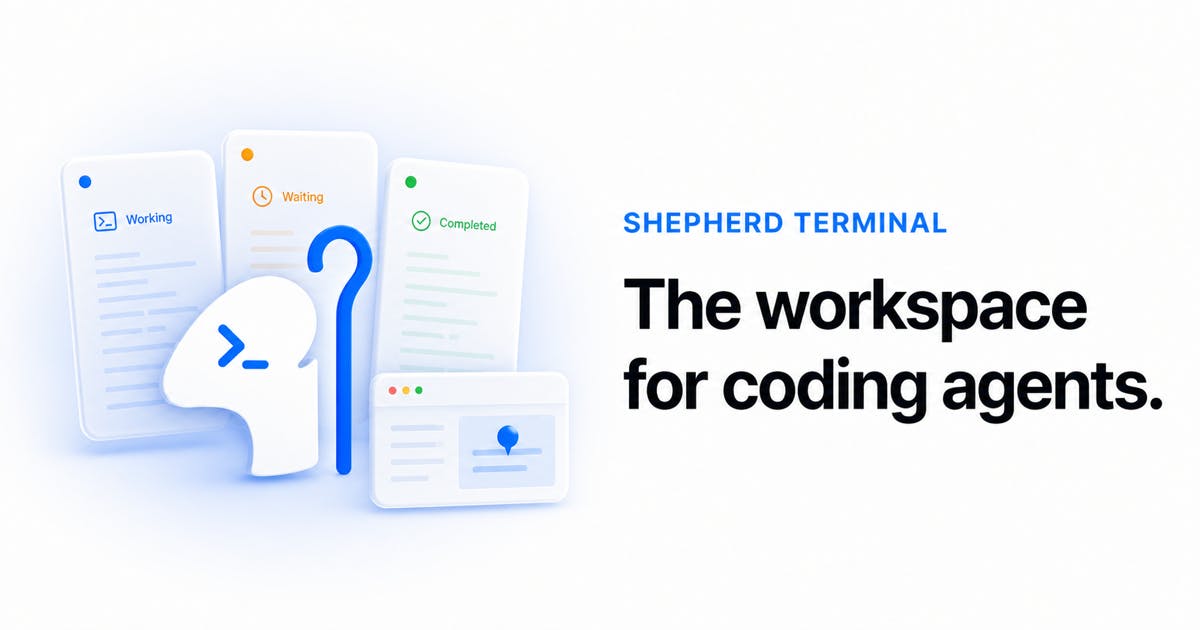
Agent Status Tracking. Shepherd tracks each agent's status in real time: which ones are working and which are waiting for user input or confirmation. For developers managing multiple agents simultaneously, this at-a-glance status panel dramatically reduces the cognitive burden of context switching.
Context-Aware Control. Agents can understand the current Shepherd context and even proactively control tab and pane layouts. More interestingly, they can collect feedback through "browser reviews," providing a more structured interaction channel for human-AI collaboration.
Why This Direction Matters
From "Single Agent" to "Agent Orchestration"
The emergence of Shepherd Terminal reflects a critical evolution in AI programming tools: from single-agent coding assistance to multi-agent orchestration and management. Multi-Agent Orchestration has been one of the most active directions in AI application architecture during 2024–2025. The core idea is to decompose complex tasks among multiple specialized agents, each responsible for a subdomain, achieving overall goals through coordination mechanisms. In software engineering, this means you can have one agent focused on code generation, another on test writing, a third handling code review, and a fourth managing the deployment pipeline. Frameworks like Microsoft's AutoGen, CrewAI, and LangGraph are all exploring multi-agent collaboration paradigms. However, the infrastructure layer for orchestration — how to efficiently launch, monitor, schedule, and intervene with these agents working in parallel — remains an insufficiently solved problem. Shepherd Terminal is precisely targeting this infrastructure gap.
When developers have three to five AI agents working in parallel, "how to efficiently manage these agents" itself becomes an entirely new problem.
This is similar to evolving from "one person writing code" to "a tech lead managing a team." The developer's role is shifting from executor to supervisor and coordinator — and the name "Shepherd" aptly conveys this meaning: you're no longer doing everything yourself, but guiding and monitoring your "flock" of agents like a shepherd. This role shift has deep historical parallels in software engineering. A traditional Tech Lead's core daily work isn't writing every line of code, but decomposing tasks, allocating resources, reviewing output, coordinating progress, and resolving blockers. As AI agents take on a large volume of execution-level coding work, the center of gravity for developer core competencies is shifting toward "problem definition ability" (accurately describing what problem needs to be solved), "quality judgment ability" (evaluating whether agent-produced code meets requirements), and "system architecture ability" (ensuring the work products of multiple agents integrate correctly). This doesn't mean programming skills become less important — quite the opposite. Only developers with deep code understanding can effectively guide and review AI agents' work, just as only technically strong leads can effectively manage a team.
The Practical Value of Persistence and Remote Execution
Session persistence and remote machine support directly address two real bottlenecks in current AI coding workflows.
Coding agent tasks often take a long time — a large-scale code refactoring or a full test suite run can last tens of minutes. If the session is lost when the app closes, developers are either forced to stay glued to the screen or risk task interruption. Persistent sessions allow agents to truly work "asynchronously in the background."
Remote machine support allows developers to offload heavy tasks to more powerful servers while keeping only a unified monitoring and control interface locally. Remote Execution is not a new concept in developer tools — VS Code Remote Development, JetBrains Gateway, GitHub Codespaces, and other products have long accustomed developers to the "edit locally, execute remotely" paradigm. But in multi-agent scenarios, the significance of remote execution is amplified further: multiple agents running simultaneously consume substantial CPU, memory, and API call resources, often more than a single laptop can handle. Distributing agent processes across cloud servers or high-performance workstations while keeping only a lightweight monitoring panel locally can significantly reduce the load on local devices. Additionally, remote execution brings the advantage of environment consistency — agents run in standardized server environments, avoiding the "it works on my machine" problem caused by local environment differences. This is especially practical for scenarios requiring heavy computation, such as compilation, model training, or integration testing.
Challenges and Considerations
As an early-stage product, Shepherd Terminal faces several issues worth watching.
Ecosystem Compatibility. Currently, Shepherd explicitly targets the Codex and Claude coding agents. Whether it can expand to support more agents in the future — such as various open-source models or custom agent frameworks — will directly determine its applicability and market potential. The AI coding agent ecosystem is rapidly diversifying. Beyond Codex and Claude Code, Google's Jules, various coding agents built on open-source models (like DeepSeekAd, Qwen), and custom agents built internally using LangChain or proprietary frameworks are all emerging. A truly universal agent terminal needs to provide standardized integration protocols rather than hardcoded adaptations for each agent.
Balancing Automation and Control. While "agents autonomously controlling tabs and panes" increases automation, it also requires finding the right balance between permission management and user intervenability, to avoid developers losing their sense of control over the workflow.
Effectiveness of Feedback Mechanisms. The specific form and interaction experience of "browser reviews for collecting feedback" — and whether it can seamlessly integrate into existing code review workflows — remains to be validated through actual usage.
Conclusion
Shepherd Terminal represents a typical case of AI programming tools evolving from "assisting individual tasks" to "orchestrating multi-agent collaboration." It redefines the terminal as a persistent workbench for agents, using three core capabilities — session persistence, status tracking, and context awareness — to make "managing multiple AI agents" as intuitive as monitoring a development team.
For power users who are already accustomed to running Codex and Claude in parallel, infrastructure tools specifically designed for multi-agent scenarios may be the key missing piece for the next leap in productivity. Its ultimate value will depend on whether it can strike the right balance between automation efficiency and human control.
Related articles

Uber Deploys ChatGPT Work Company-Wide: AI in the Workplace Enters the Scaled Implementation Phase
Uber deploys ChatGPT Work to 30,000+ employees, extending it from engineering to all roles. We analyze its expert-engineer pairing, end-to-end automation, and questions of AI control and power concentration—insights for scaling AI in the workplace.

Shift at Midnight Hands-On: When "ID Verification" Becomes Alien Hunting
Shift at Midnight blends ID verification with horror survival in a four-player co-op game. We break down its inspection mechanics and chaotic humor.

Zelensky Recounts the Outbreak of War: I Need Ammunition, Not a Ride
Zelensky recalls the first day of war in a YouTube interview: farewell to family, rejecting Biden's evacuation offer with "I need ammunition, not a ride," and how Bucha shaped his stance on compromise and peace talks.