Should RAG Systems Trust Official Documentation or Community Practice?

RAG systems should build multi-dimensional credibility and conflict-handling mechanisms between official documentation and community practice, rather than blindly trusting a single source.
Starting from a Reddit discussion, the article analyzes the knowledge-authority dilemma RAG systems face between official documentation and community practice. Official documentation represents ideal standards, while community content reflects real usage. When they conflict, assigning fixed weights by source type is unwise, because official documentation may be outdated while highly upvoted community answers may better reflect current behavior. The author proposes multi-dimensional credibility signals such as timeliness, community interaction data, and author authority, and a layered retrieval strategy: first use official documentation to ensure basic facts, then supplement with reputable community content, and explicitly indicate source differences during generation. The article also emphasizes differentiating source priorities by scenario and explicitly designing conflict detection and uncertainty expression in the retrieval pipeline.
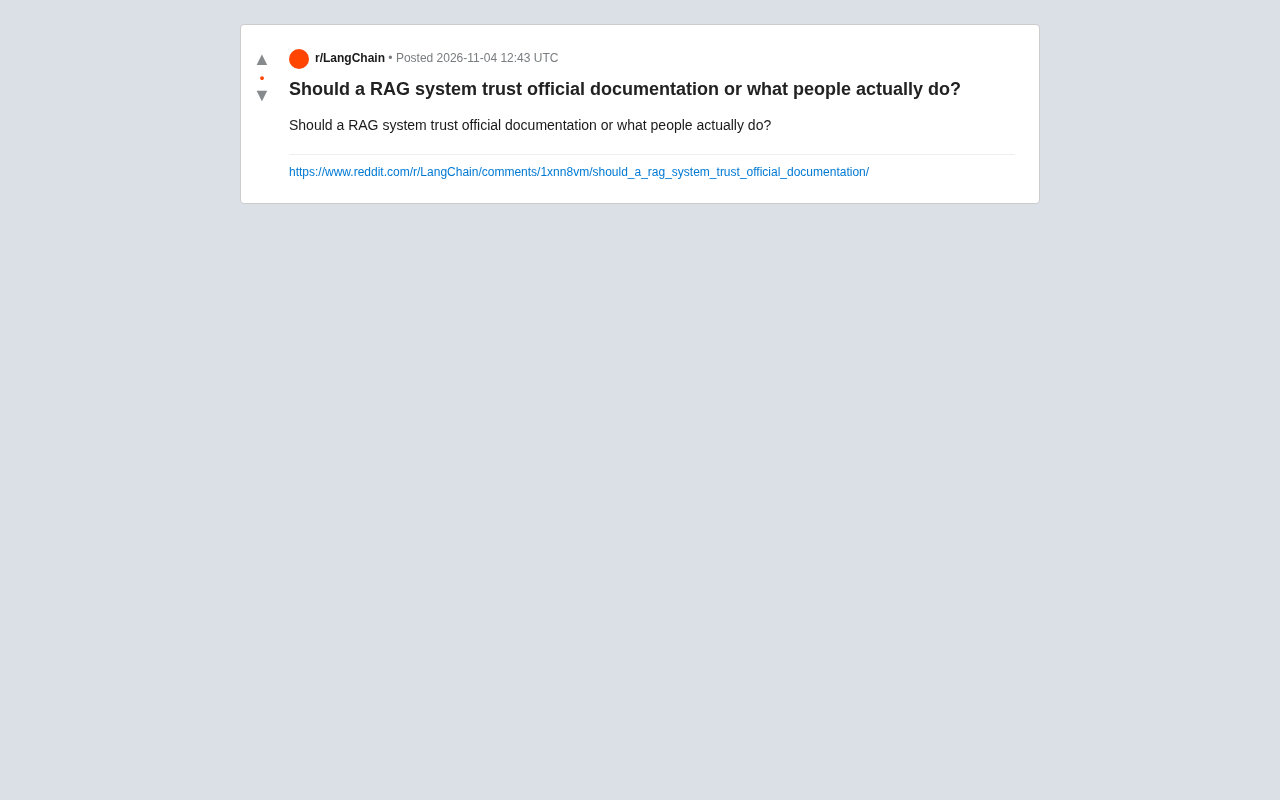
When building RAG (Retrieval-Augmented Generation) systems, a seemingly simple yet highly controversial question emerges: when official documentation and actual community practice diverge, which should the system follow? A recent Reddit discussion struck a chord with many and touched on a core contradiction in the design of knowledge retrieval systems.
The Natural Tension Between Official Documentation and Community Practice
Official documentation often represents the "ideal state"—it describes how the system designers expect it to be used, with standardized syntax, clear interfaces, and well-defined best practices. However, the usage patterns that real developers accumulate on Stack Overflow, GitHub Issues, and technical blogs often deviate from—or even "work around"—official recommendations. These community practices may include temporary patches, non-standard tricks, or workarounds for behavior specific to certain versions.
The core confusion in the Reddit discussion is this: if a RAG system relies only on official documentation, it may give answers that are "correct but useless"; if it relies too heavily on community content, it may introduce outdated, incorrect, or security-risky practices. This is not simply a question of choosing data sources, but a redefinition of "knowledge authority."
The Design Dilemma of Retrieval Weighting in RAG Systems
From a technical implementation perspective, RAG systems typically retrieve document fragments through vector similarity and then hand them to a large model to generate answers. When both official documentation and community posts contain similar keywords, it is difficult for the retriever to automatically determine which piece of information is more trustworthy. A common misconception is to simply assign fixed weights by source type—official documentation always takes priority. But in reality, official documentation may go long periods without updates, while highly upvoted community answers may better reflect the actual behavior of the current version.
A more reasonable approach is to introduce multi-dimensional credibility signals: the timeliness of the document, community interaction data (upvotes, accepted-answer markers), author authority, and the degree of semantic clarity. But these signals themselves also need to be carefully calibrated; otherwise, the system falls into the trap of "what most people say must be right."
Vector similarity retrieval is the core mechanism of RAG systems: it encodes user queries and document fragments into high-dimensional vectors respectively, and finds the semantically closest fragments by calculating metrics such as cosine similarity. The limitation of this approach is that similarity only reflects "semantic closeness," not "information credibility." As long as official documentation and community posts discuss the same topic, their vector distances may be very close, and the retriever cannot distinguish between them based on similarity alone. Therefore, credibility judgment must be introduced as an independent step after retrieval and before generation—for example, using a reranking model or a rule engine to score candidate fragments by source, timeliness, interaction data, and other dimensions, rather than hoping that vector retrieval itself will solve the authority problem.
Practical Approaches to Multi-Source Fusion
Faced with this contradiction, some RAG practitioners suggest adopting a layered retrieval strategy: the first layer prioritizes official documentation to ensure the accuracy of basic facts; the second layer introduces highly reputable community content as a supplement, especially when official documentation is missing or clearly outdated. In the generation stage, the model can be asked to explicitly indicate differences in information sources—for example, "official documentation recommends X, but Y is commonly seen in community practice."
Some views in the Reddit discussion also point out that the key lies in distinguishing scenarios: for domains with high compliance requirements (such as security configuration and API authentication), official documentation must be strictly followed; for development-efficiency issues (such as debugging techniques and environment setup), community experience may be more valuable as a reference. RAG systems need some degree of scenario awareness rather than trusting one type of source across the board.
Layered retrieval strategies usually correspond in engineering to a "multi-route recall + fusion ranking" architecture: different retrievers first recall candidate fragments from the official documentation repository and the community content repository respectively, and then merge the multiple results through reciprocal rank fusion (RRF) or weighted scoring. Compared with a single index, this architecture allows separate configuration of embedding models, chunking strategies, and filtering rules for each source repository, and also makes it easier to inject source priorities during the fusion stage. In practice, it is also important to note that official documentation is often well structured with clear chunk boundaries, while community posts mix code, comments, and irrelevant conversation; differences in chunking quality directly affect recall performance. Therefore, cleaning community content and performing paragraph-level segmentation is a prerequisite for implementing layered retrieval.
Implications for RAG Developers
This discussion reveals a dimension that is easily overlooked in RAG system design: governance strategies for knowledge sources. Simply expanding the retrieval scope does not equal improving answer quality; the conflict-handling mechanism between sources is the key to determining system credibility. Developers need to explicitly design source priorities, conflict detection, and uncertainty expression in the retrieval pipeline, rather than pushing all judgment responsibility onto the large model.
Ultimately, RAG systems should not blindly trust any single source. A mature system should be like an experienced engineer: it respects official specifications, understands practical workarounds, and honestly presents this tension in its answers.
One-line Summary
RAG systems should establish multi-dimensional credibility and conflict-handling mechanisms between official documentation and community practice, rather than blindly trusting a single source.
Paragraph Summary
Starting from a Reddit discussion, this article analyzes the knowledge-authority dilemma that RAG systems face between official documentation and community practice. Official documentation represents ideal standards, while community content reflects real usage. When the two conflict, it is not advisable to simply assign fixed weights by source type, because official documentation may be outdated, while highly upvoted community answers may better reflect current version behavior. The author proposes introducing multi-dimensional credibility signals such as timeliness, community interaction data, and author authority, and adopting a layered retrieval strategy: first use official documentation to ensure basic facts, then supplement with highly reputable community content, and explicitly indicate source differences during generation. The article also emphasizes the need to differentiate source priorities by scenario and to explicitly design conflict detection and uncertainty expression in the retrieval pipeline.
Related articles

9 AI Subscription Plans Compared: The Real Cost Per 100M Tokens Revealed
Bilibili creator tests 9 AI subscription plans from Volcano, Alibaba, Tencent, Baidu, Zhipu, Xiaomi, MiniMax and more, converting them all to real cost per 100M tokens, breaking down fixed-quota vs. three-tier coefficient billing and how caching, time-of-day discounts, and window limits affect actual quota.

Vibe Coding for Beginners: Expressing Intent Instead of Handwriting Code
What is Vibe Coding? A 137-episode Bilibili course defines it: the core is expressing intent, not writing code. This article analyzes Vibe Coding's productivity logic, target audience, and entry expectations to help beginners decide if it's worth learning.

LangChain Beginner's Guide: An Agent Development Roadmap from LangGraph to Deep Agents
Clarify the encapsulation relationship among LangChain, LangGraph, and Deep Agents, and master the learning path and selection logic for agent development frameworks—suitable for beginners in large model development.