Should Vercel Fork and Maintain Deno? Developer Community Debates
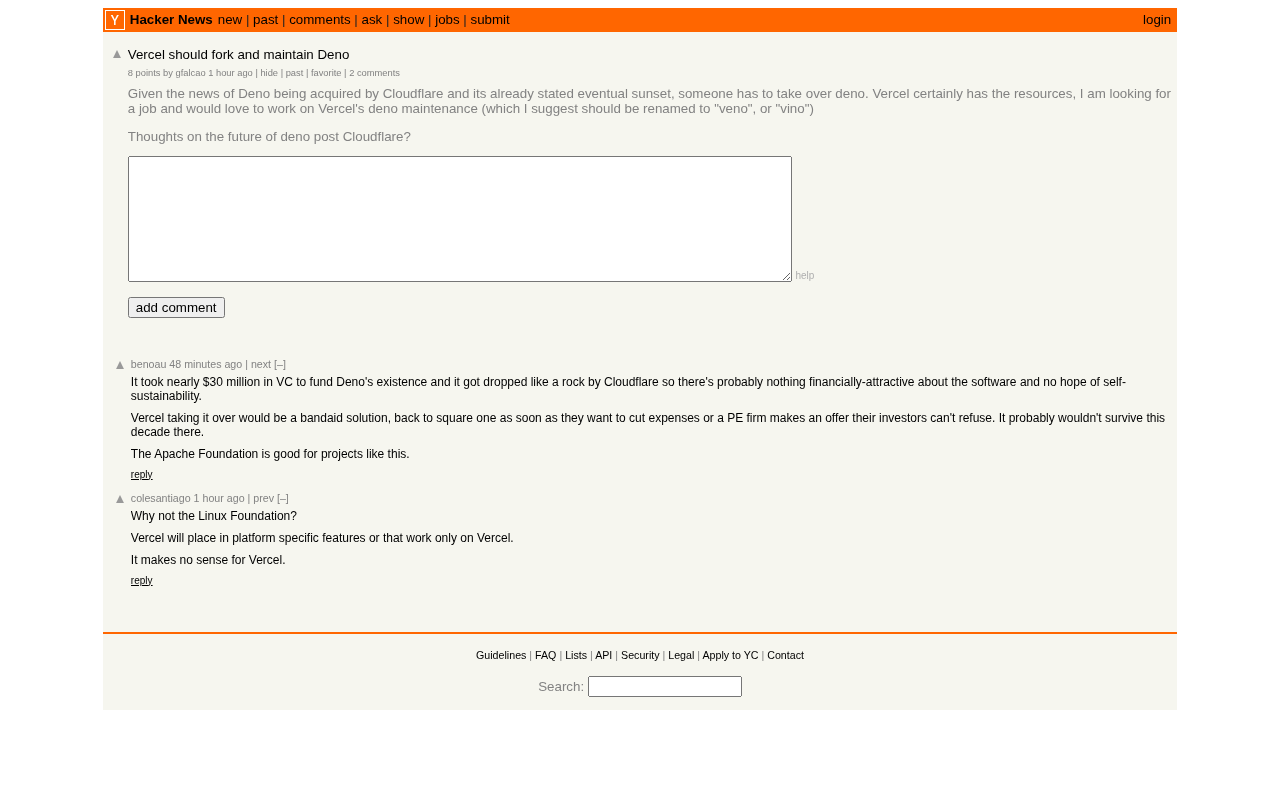
Hacker News discusses whether Vercel should fork and maintain Deno, reflecting the sustainability dilemma of open-source runtimes.
The article analyzes the brief claim on Hacker News that "Vercel should fork and maintain Deno." Deno, initiated by Node.js creator Ryan Dahl, focuses on security by default and native TypeScript, but under Node.js's mainstream dominance and Bun's rapid rise, its commercialization path has never been clear, raising questions about the sustainability of its long-term maintenance. Supporters argue Vercel has the engineering resources and commercial incentives to take over Deno and strengthen its edge computing capabilities; opponents worry that commercial leadership would lead to ecosystem fragmentation and platform lock-in. The article further weighs the pros and cons of forking: resource injection and predictable support are benefits, while community division and duplicated efforts are costs. Finally, it suggests developers keep their tech stack portable to cope with the ongoing reshuffling of runtimes.
A Provocative Proposal: Vercel Should Fork and Maintain Deno
On Hacker News, a post titled Vercel should fork and maintain Deno caught developers' attention. The poster put forward a rather controversial suggestion: Vercel should fork the Deno project and take over its long-term maintenance. Though brief, this proposal touches on several key tensions in the current JavaScript runtime ecosystem — the governance relationship between commercial companies and open-source projects, the competitive landscape among runtimes, and developers' concerns about infrastructure sustainability.
The original post was just a headline-style call with no elaborated argument, but judging from the community discussion context, the suggestion points to the uncertainty surrounding Deno as an independent open-source runtime in terms of resources and direction, and the role Vercel — a giant in frontend and edge computing infrastructure — might play.
Why Deno, Why Vercel
Deno's Positioning and Predicament
Deno was initiated by Ryan Dahl, the creator of Node.js, and focuses on security by default, native TypeScript support, and modern standards compatibility. It is seen as an attempt to correct Node.js's design flaws and enjoys a good reputation in the developer community. However, the runtime market is extremely competitive: Node.js still holds absolute dominance, Bun is rising rapidly with performance and an integrated toolchain, and Deno has never found a sufficiently clear path to commercialization.
When an open-source project requires continuous heavy engineering investment but struggles to monetize directly, the sustainability of its long-term maintenance becomes a focal point for the community. Forking and handing maintenance to a company with commercial incentives is a common "handover" approach in the open-source world.
On "forks" and open-source governance
In the open-source context, a fork refers to developers creating an independent project based on an existing code copy of a project, after which the two projects evolve separately without interfering with each other. Forking is a freedom explicitly granted by open-source licenses (such as MIT, Apache 2.0) and is a common response by communities when facing governance disagreements, commercialization conflicts, or maintenance stagnation. History has seen successful forks — such as LibreOffice splitting from OpenOffice, and MariaDB from MySQL — as well as numerous cases that gradually faded due to lack of ecosystem and maintainers. The core cost of forking is not code duplication but the repeated investment in talent, documentation, security response, and ecosystem building afterward, so a fork led by a company with commercial incentives is often seen as a viable path for "resource handover."
On Deno's commercialization predicament
Deno was released by Ryan Dahl in 2018, and in 2021 the company Deno Land was founded with hosted services like Deno Deploy, attempting to monetize through a cloud platform. But its commercialization scale remains limited compared to the size of the Node.js ecosystem, and continuous runtime development requires long-term investment (standards compatibility, performance optimization, security fixes). More critically, Deno's early separation from the npm ecosystem increased migration costs, and compatibility only gradually improved later. This structure of "heavy engineering investment, slow commercial returns" is precisely the root of community concerns about the sustainability of its long-term maintenance, and the practical background for the suggestion to "hand it over to a company with commercial incentives like Vercel."
Speculation on Vercel's Motives
Vercel's core business revolves around frontend deployment and edge functions, and its runtime environment has long relied on the Node.js ecosystem. If Vercel could lead a modern runtime, theoretically it could gain greater control over edge computing, cold start performance, and security models. Supporters argue that Vercel has sufficient engineering resources and commercial incentives to bear Deno's maintenance costs and integrate its capabilities into its own platform.
Opponents worry that a commercial company leading an open-source runtime would lead to ecosystem fragmentation, or even a "lock-in" effect — where the runtime's evolution direction would prioritize Vercel's platform strategy rather than the diverse needs of the entire community.
Edge computing and runtime control
Vercel's edge functions run in a lightweight environment based on V8 isolates rather than a full Node.js process, which makes cold starts faster but also brings API compatibility limitations. Deno is also based on V8 and built with Rust, and its security model, native TypeScript support, and adherence to Web standards are highly aligned with edge runtime requirements. If Vercel led Deno, theoretically it could achieve deeper vertical integration in isolation models, permission control, and edge deployment pipelines, reducing dependence on external ecosystems (especially the evolution direction of the Node.js runtime). This is the technical basis for supporters' view that "commercial incentives are sufficient."
Pros and Cons of Forking an Open-Source Project
What Forks Can Solve
The most direct value of a fork is resource injection. A runtime backed by a commercial entity can gain stable full-time maintainers, faster security responses, and a clearer roadmap. For teams relying on Deno, this means more predictable long-term support.
Moreover, a fork does not necessarily mean the original project dies. Open-source licenses usually allow parallel development; the forked version can focus on specific scenarios (such as edge computing), while the original project continues exploring the general-purpose runtime direction.
Risks and Costs of Forking
The costs of forking are equally obvious. Community division leads to scattered contributors and duplicated documentation and toolchain building, ultimately possibly making neither side big enough. Many forked projects in history have gradually become marginalized due to lack of sufficient ecosystem support. More subtly, when the forking party is a platform company, developers instinctively question its neutrality.
Judging from the atmosphere of the Hacker News discussion, this proposal is more of a thought experiment to spark discussion than a plan with a concrete execution path. The post itself had limited engagement, indicating it has not yet formed broad consensus, but the questions it raises deserve serious consideration.
Practical Impact on Developers
For ordinary developers, the direction of the runtime battle will directly affect technology choices. If Deno gains more stable commercial support, the risk of adopting it will decrease; if the ecosystem further fragments, teams will need to more carefully evaluate migration costs and long-term maintenance commitments when choosing non-Node.js runtimes.
A pragmatic suggestion is: pay attention to the degree of standardization and cross-platform compatibility of runtimes, and try to keep business code loosely coupled to any specific runtime. Whether or not Vercel actually forks Deno, the runtime market will continue to reshuffle for some time to come, and keeping the tech stack portable is the safest strategy.
Conclusion
The value of the proposal Vercel should fork and maintain Deno lies not in whether it will be adopted, but in putting the sustainability of open-source runtimes on the table. The triangular relationship among commercial companies, open-source communities, and developers is particularly sensitive in the JavaScript ecosystem. This discussion reminds us: choosing a runtime is not just choosing a set of APIs, but also choosing the governance structure and long-term commitment behind it.
Related articles

AI Teams Up with Mathematicians to Attack the Riemann Hypothesis: 17 Million Lines of Code Tear Open a 167-Year Gap
In November 2026, Anthropic mathematicians and Claude claimed to have discovered a proof of the Riemann Hypothesis, publishing 17 million lines of Lean formalized code that passed machine verification. This article analyzes the event's impact on mathematics and cryptography, and the deeper questions raised by the separation of discovery and understanding.

AI Claims Formal Proof of the Riemann Hypothesis — But Machine Verification Isn't a Mathematical Proof
In Nov 2026, Anthropic's Levent Alpöğe released a Riemann Hypothesis proof of 175,000 code files that passed machine formal verification. But machine verification isn't a mathematical proof: the kernel can't confirm the proposition is the Riemann Hypothesis humans understand, and there's no human-readable paper. This article breaks down how ζ function zeros determine prime-count deviation, and the core of the controversy.

Anthropic Raises Over $80 Billion in IPO, DeepSeek Secures $100 Billion in Funding: AI Weekly Roundup
This week in AI: Anthropic's Nasdaq IPO raises $93.5B in the largest ever, DeepSeek closes ~100B yuan round, AI claims formal Riemann proof, MiniMax breaks crypto candidates in seconds.