Show HN: Trail — A Logic Puzzle Game That Redefines the Rules

Indie developer brings Trail, a new path-based logic puzzle game, to Hacker News Show HN.
Trail is a logic game released on Hacker News Show HN, positioned by its developer as a "new kind of logic game" with mechanics that differ from classics like Sudoku and flow puzzles — likely centered on path planning and constraint satisfaction. Logic games are naturally indie-friendly: low art overhead, high replayability, and a clever mechanic can drive viral reach, as Wordle proved. Show HN gives early projects access to high-quality, mechanism-focused feedback from engineers. Trail's traction is limited so far, but the "small-team gameplay experiment" it represents is well worth watching.
A Logic Game That Made It to Hacker News
A logic game called Trail quietly appeared on Hacker News's Show HN section. Its developer positions it as a "new kind of logic game" — an attempt to carve out a different path in puzzle design beyond established classics like Sudoku, flow puzzles, and pathfinding games.
While the project hasn't generated massive discussion yet (6 upvotes, 1 comment), Trail represents a quintessential example of the "solo developer + gameplay innovation" archetype that Show HN is known for — and its design philosophy is worth examining.
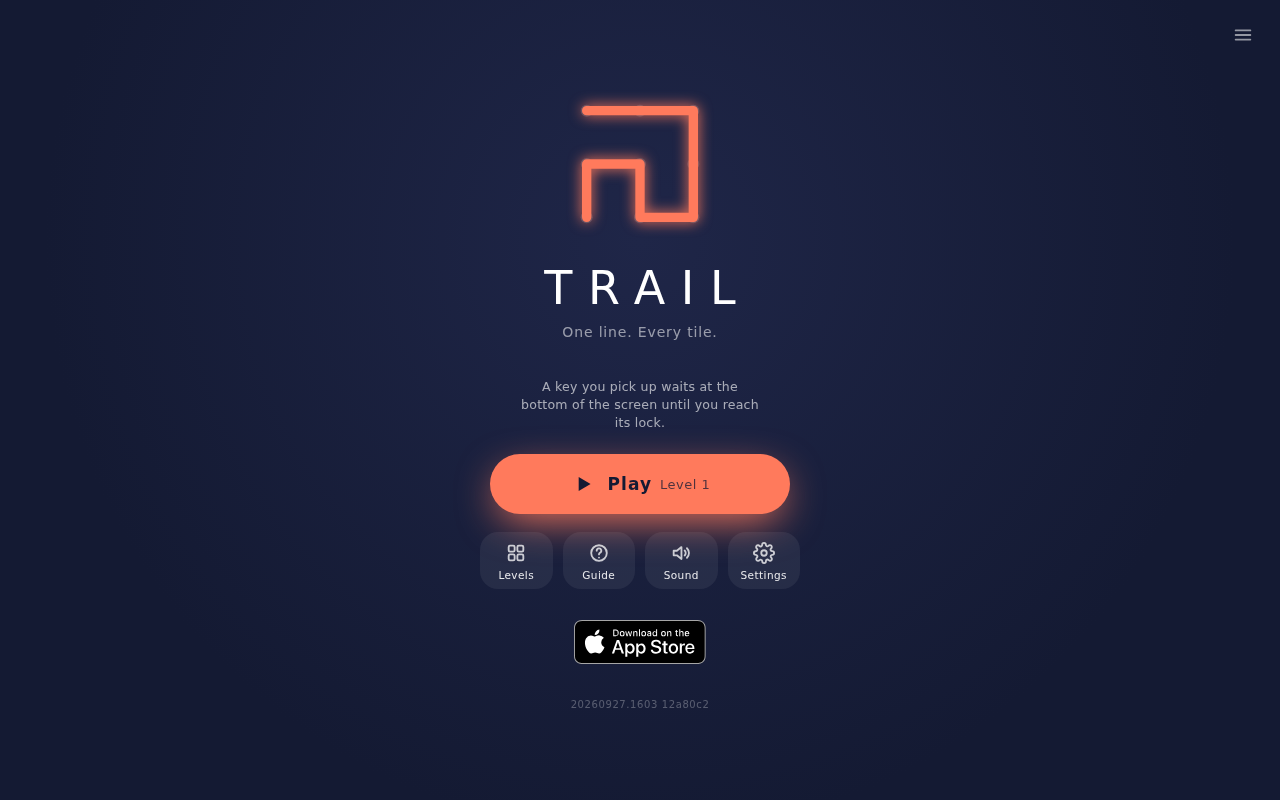
What Does "New Kind of Logic Game" Actually Mean?
Logic games are a highly mature genre. From Sudoku and Nonograms to the viral phenomenon of Wordle, the core of all these games revolves around deduction and constraint satisfaction within a finite ruleset. The developer's choice of the phrase "new kind" signals that Trail isn't recycling an existing template — it introduces something mechanically distinct.
Games with "Trail" (path/trace) in their name typically involve building a continuous path between nodes or across a grid, where the player must plan a route that satisfies specific constraints. This design preserves the rigor of logical deduction while layering in spatial intuition — a direction that has proven popular among independent puzzle game developers in recent years.
Why Independent Developers Love Logic Games
Logic games have a natural appeal for indie developers: the rules can be implemented with minimal code, they require no complex art assets, and yet they offer nearly infinite level combinations and replay value. A clever core mechanic can go viral far more effectively than polished visuals — Wordle's meteoric rise is the clearest proof of this.
Constraint Satisfaction Problems (CSPs) form the mathematical foundation of logic games. Sudoku requires that no digit repeat in any row, column, or box; Nonograms require that consecutive block lengths match the given clues — both are, at their core, searches for assignments that satisfy all constraints within a finite variable domain. Path-based games add topological constraints on top of this: a path must be continuous, non-self-intersecting, or must pass through specific nodes. This makes the search space's pruning logic more intuitive and makes it far easier to design puzzles with a unique solution. It's precisely this mathematical elegance that allows designers to generate a large variety of puzzles at different difficulty levels from very few rules.
The Value of the Show HN Ecosystem
Hacker News's Show HN section is one of the most important windows for developers worldwide to showcase their own work. It attracts a community that's highly attuned to technical detail and willing to give direct, candid feedback. For an early-stage project like Trail, the significance of appearing on Show HN isn't just exposure — it's access to first-hand experience and critique from a technically sophisticated audience.
From a product iteration standpoint, the core goal at this stage is to validate whether the core gameplay holds up, whether the rules are clear, and whether the onboarding difficulty is reasonable. A low comment count reflects limited initial traction, but for an indie project, simply making it onto Show HN and getting a public showcase is itself a valuable open beta.
Show HN isn't a typical product launch platform — it has a distinct set of community norms. Post titles must begin with "Show HN:", authors are expected to actively respond to feedback in the comments, and posts are briefly featured on the front page for initial visibility. Hacker News's user base skews heavily toward engineers, founders, and technical researchers who tend to focus on implementation details, scalability, and design decisions rather than visual polish. This means feedback from Show HN typically zeroes in on foundational questions like "Is the mechanic internally consistent?" and "Are the rules ambiguous?" — precisely the kind of high-quality feedback that matters most for a logic game in early iteration, and often more valuable than feedback from a general gaming community.
Closing Thoughts: Small, Sharp Puzzle Experiments
Trail is a classic example of an indie developer exploring new gameplay territory. Attempting to define "new logic" beyond established genres like Sudoku and flow puzzles requires finding the right balance between novelty and comprehensibility — rules that are too alien will push players away, while rules that are too familiar undermine the point of innovating.
Since public information is still limited, Trail's specific rules, level design, and actual experience can only be judged by playing it. For fans of logic puzzles and deduction games, niche experimental projects like this — born from the developer community — often contain surprisingly clever ideas. This one is worth trying.
Related articles

Free Unlimited Claude Code Solution: Agnes AI + CC Switch Setup Guide
No paid subscription needed — pair the free AI platform Agnes AI with the open-source tool CC Switch to provide a backend for Claude Code, enabling unlimited free calls to text, image, and video models. This guide covers the full setup, test results, and usage boundaries.

A Complete Zero-Cost Guide to Getting Started with Claude Code for Beginners in China
A beginner's guide to Claude Code for users in China: two installation methods (command line and IDE plugin), full configuration steps for replacing the official API with the free domestic LongCat model, and a hands-on demo of building a small tool with natural language, plus tips.

When the NSA Gets Involved: The AI Supply Chain Crisis Behind Open-Source CVEs and API Key Hijacking
Multiple open-source projects disclosed severe CVEs in one day, PHP flaws alarmed the FBI, and Railway and OpenCode were breached with API keys stolen. This article breaks down the vulnerability window, AI-accelerated exploitation, and the AI supply chain crisis behind the API key black market, with a developer defense checklist.