ShunCode In-Depth Review: Local Agent Execution + Bridge Mode Turns ChatGPT into Your Programming Brain

ShunCode uses Bridge Mode to make ChatGPT a local Agent brain inside VS Code, with full Diff approval and MCP tool support.
ShunCode is a VS Code-based AI programming editor built around a local Agent execution system. Its standout Bridge Mode lets powerful models like ChatGPT act as the "thinking" layer while ShunCode handles all local execution — reading files, editing code, and running tests. With Diff-based approval, customizable models, MCP tool integration, and a Skills/Rules/Memory framework, it offers both cost efficiency and developer control.
An Editor That Redefines AI Programming Tools
As AI programming tools continue to proliferate, most products face the same dilemma: either pay steep monthly subscription fees, or hand your code over to a closed cloud platform. ShunCode aims to break this pattern — it's an AI-powered code editor built deeply on VS Code, with a core philosophy of giving developers access to powerful models without sacrificing cost control or local ownership.
About the VS Code Ecosystem: VS Code (Visual Studio Code) is an open-source code editor released by Microsoft in 2015, and it now boasts one of the largest developer user bases in the world. Its success is rooted in an extremely open extension ecosystem — anyone can add functionality via the Extension API. ShunCode being built on top of VS Code means it inherits VS Code's full editor capabilities (syntax highlighting, intelligent code completion, debugger, version control integration, etc.), while layering an Agent execution system on top. This "don't reinvent the wheel" approach means developers don't need to migrate their workflow — they can access AI capabilities directly within a familiar interface.
Unlike the typical "chat window" programming assistants on the market, ShunCode is fundamentally a complete local Agent execution system. It can read projects, search code, modify files, run terminal commands, inspect diagnostic information, call MCP (Model Context Protocol) tools, and display each step clearly to the user. This means it's not just "completing a few lines of code" — it's a complete closed loop that genuinely understands a project, executes tasks, and validates results.
What Is a Local Agent Execution System: An Agent (intelligent agent) is one of the core concepts in AI, referring to an AI system capable of perceiving its environment, planning autonomously, and executing multi-step tasks — fundamentally different from traditional one-shot Q&A AI assistants. A complete Agent execution system typically includes: a perception layer (reading files, retrieving diagnostics), a planning layer (the large model generates task steps), an execution layer (calling tools, running commands), and a feedback layer (validating results, correcting errors). ShunCode brings all four layers into the local environment rather than hosting them on cloud servers, which means code and context information never leave the developer's machine — especially important for projects involving trade secrets or sensitive data.
What Is the MCP Protocol: MCP (Model Context Protocol) is a standardized protocol proposed and open-sourced by Anthropic in late 2024, designed to solve the fragmentation problem of integrating AI models with external tools and data sources. Before MCP, every AI tool needed to develop its own custom adapter for each external service, making maintenance extremely costly. MCP defines a unified interface specification that allows models to call tools like file systems, databases, APIs, and code repositories in a standardized way. ShunCode's support for MCP means it can plug into hundreds of tools already in the MCP ecosystem without needing to build separate integration logic for each one — greatly expanding the Agent's capability boundaries.
Bridge Mode: Making ChatGPT Your External Brain
ShunCode's most imaginative design feature is its Bridge Mode. Through this mechanism, you can let powerful models like ChatGPT become the "external brain" of ShunCode.
The division of labor here is clear: the model handles understanding requirements, planning tasks, and making decisions; ShunCode itself handles safe local execution — reading files, modifying code, running tests, and reviewing results, all forming a continuous closed loop.
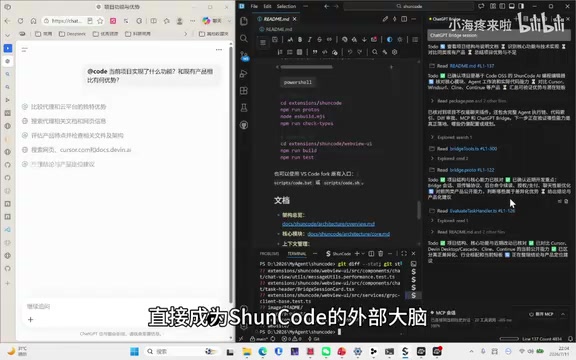
The Technical Principles of Bridge Mode and API Cost Context: The core of Bridge Mode lies in decoupling the model's "thinking" from the tool's "execution." In a traditional API call setup, every interaction with a model consumes tokens (the basic billing unit for large language models, roughly equivalent to 3/4 of an English word). For complex programming tasks, a complete conversation can involve tens or even hundreds of thousands of tokens, causing costs to accumulate rapidly. Take GPT-4o as an example: input tokens cost approximately $2.50 per million and output tokens around $10 per million — a moderately complex programming task could generate several dollars in a single session. Bridge Mode allows ChatGPT and similar front-end interfaces to handle conversational interaction, while ShunCode manages tool calls and execution feedback on the backend. In certain scenarios, this can leverage existing subscription quotas or reduce redundant API round-trips, optimizing the overall cost structure.
The immediate benefit of this architecture is at the cost level: you don't need to repeatedly pay for large numbers of API tokens, nor do you have to give up control over your local editor. For individual developers, this means being able to use powerful models for complex programming tasks at a relatively low cost.
Even when tasks are long or commands take a long time to run, ShunCode can continuously report progress, retain context, and help the model continue completing the task — effectively avoiding the common "context dropout" problem in long-running tasks.

Transparent and Controllable: No More AI Black-Box Operations
One of the biggest concerns with AI programming tools is that model-driven code changes are often a "black box" — you don't know what was changed and have no way to review it. ShunCode offers a clear solution to this.
Every Change Is Traceable
In ShunCode, all code modifications are not black-box operations. Every code change can be reviewed through Diff comparison, and every modification supports accept, reject, or rollback. This approval workflow keeps control firmly in the developer's hands — no matter how capable the model is, the final decision always rests with the human.
The Engineering Significance of Diff Comparison and Code Approval Workflows: Diff (difference comparison) is a foundational concept in software engineering, originating from the Unix
diffcommand, used to compare two file versions line by line and present changes as "added lines (+)" and "deleted lines (-)." In the context of AI programming tools, the Diff view is critical: it allows developers to see exactly what was changed before accepting an AI modification, rather than accepting a new version with no clear origin. This design is highly analogous to Git's Pull Request review process — modern software engineering's quality control relies heavily on Code Review. ShunCode introduces this mechanism into the AI Agent workflow, essentially establishing a critical quality checkpoint between AI automation and human oversight, in line with the "Human-in-the-loop" principle of AI safety design.
This design is especially well-suited for university instructors and educational settings — it's an open platform where the internal workings can be observed, modified, and verified. Students and researchers can truly see how an AI Agent completes tasks step by step.
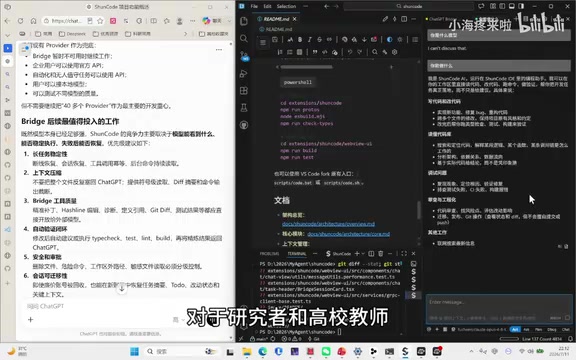
High Flexibility: Build Your Own Professional Agent
Another major highlight of ShunCode is that it doesn't lock your capability ceiling into any single model, any single workflow, or any single subscription plan.
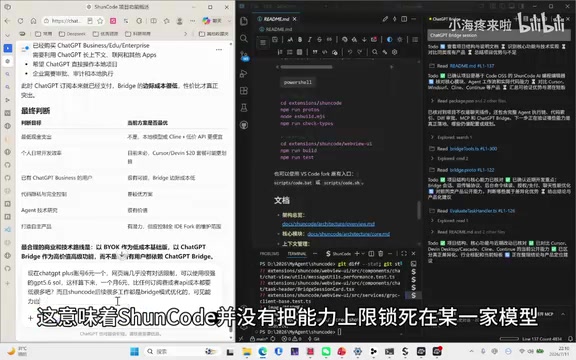
Flexible Model and Tool Selection
Users can freely choose from different AI models, including locally deployed private models; customize system prompts to define how the Agent works; and connect their own tools to databases, project platforms, internal APIs, or automation workflows.
Going further, ShunCode uses four mechanisms — Skills, Rules, Memory, and MCP — to allow developers to shape it into a professional Agent that truly fits their own needs.
The Technical Substance of the Four Mechanisms: These four mechanisms together form the technical foundation of ShunCode's customizable Agent framework. Skills typically refer to predefined task templates or tool-call sequences, enabling the Agent to perform specific types of work in a reusable way. Rules are a constraint layer on Agent behavior — for example, "never delete a file directly; always back it up first" or "confirm before all database operations" — encoding team standards or security policies into Agent behavior. Memory addresses the inherent context window limitations of large language models: through vector databases or structured storage, the Agent can retain project knowledge, user preferences, and historical decisions across sessions. Combined, these four elements effectively build a domain-specialized Agent runtime on top of a general-purpose large model, transforming it from a generic tool into a professional assistant deeply tailored to a specific work context.
The underlying logic is clear and compelling: the base model provides intelligence, ShunCode provides the execution framework, and what it ultimately grows into as a tool is up to you.
Who Is ShunCode Best Suited For?
Overall, ShunCode is primarily aimed at two types of users:
- Individual developers: Can significantly reduce the cost of using powerful models for complex programming tasks, while organically integrating local code approval workflows, tool permissions, and model capabilities.
- University instructors and researchers: Can use it as a transparent, verifiable open platform for AI Agent teaching demonstrations and mechanism research.
Conclusion: Make Models More Powerful, Make Tools More Free
ShunCode represents a vision for what AI programming tools should look like in the future — not just completing code for you, but genuinely understanding projects, executing tasks, validating results, and always remaining under developer control.
By connecting to powerful AI models while maintaining ownership of local execution, ShunCode attempts to find a balance between "strong model capabilities" and "developer autonomy." As a relatively new tool, it still needs time to prove itself in areas like ecosystem maturity and long-task stability, and the real-world performance of Bridge Mode warrants further follow-up. But the direction it proposes — letting every developer build their own local Agent — is undoubtedly worth keeping a close eye on.
Key Takeaways
Related articles

Apple HomeView Hands-On Review: Is the $300 Smart Home Hub Worth It?
Apple HomeView hands-on: a $300 smart home hub with facial recognition for quick account switching, but no App Store or voice recognition. Is the wall-mounted version worth it? Should you buy the first generation?

Meta Muse Wonder Launch: What It Means for Meta's Return to the Frontier AI Race
Meta releases Muse Wonder and WonderFull, benchmarks reach the frontier, community feedback is polarized. An in-depth look at Meta's return to the frontier AI race, its personal agent strategy, and Zuckerberg's different path.

Apple Home Smart Home Lineup Leaked: LG and Schneider Team Up, UWB Door Lock on Board
Apple Home ecosystem gains new LG and Schneider devices: UWB smart lock with proximity unlock, 2.5K dual-camera doorbell, privacy indoor camera, and AirPods-like seamless pairing.