Sider Code: The AI Browser Extension That Lets You Reshape Any Webpage with Natural Language
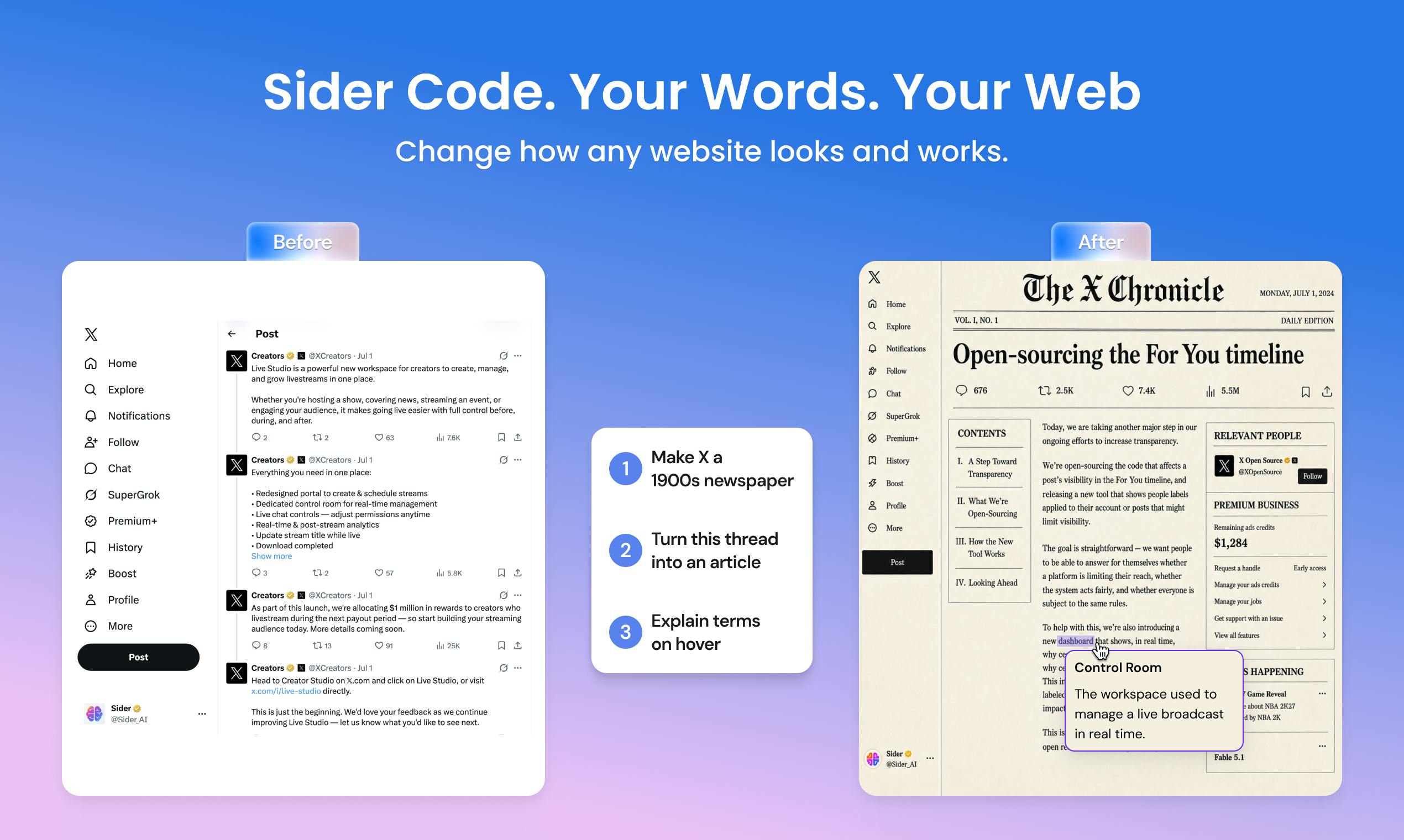
Sider Code lets anyone customize any webpage using plain natural language instructions powered by AI.
Sider Code is a Chrome extension that empowers users to modify any website using natural language commands. The AI parses the page's DOM structure, generates the appropriate code, and applies changes in real time—no programming skills required. Users can save customizations as persistent patches. Part of the broader Sider AI ecosystem, it represents a shift from passive browsing to active web reshaping, though security and compatibility challenges remain.
When You Define the Rules of the Web
For the past three decades, the logic of the internet has been dictated unilaterally by website developers: where buttons go, how information is laid out, whether features exist—users could only passively accept it all. Sider Code, a Chrome extension that climbed to #5 on Product Hunt, aims to fundamentally rewrite this power dynamic.
Its core proposition is simple yet novel: use a single plain-language sentence to reshape any website you rely on daily. You simply tell the Sider extension how a page should work, and it understands the page structure, automatically writes the code, and applies the changes in real time. After launch, the product quickly garnered 115 upvotes and 33 comments, categorized under Chrome Extensions, Productivity Tools, and Artificial Intelligence.
From Passive Acceptance to Active Reshaping: The Pain Points Sider Code Solves
Everyone has a mental "complaint list" about certain websites: a shopping site buries its price sorting option, a news site's ads are too intrusive, or a backend tool lacks a batch operation button. Traditional solutions either require installing specialized browser scripts (which demands coding knowledge) or hunting for existing plugins (which rarely offer an exact match).
Before Sider Code, the most common way for ordinary users to customize web pages was through userscript managers like Tampermonkey or Greasemonkey. These tools allow users to install community-written JavaScript scripts for ad removal, auto-pagination, UI beautification, and more. Platforms like Greasy Fork have accumulated tens of thousands of ready-made scripts. However, this ecosystem has a clear barrier to entry: if no existing script precisely meets your needs, you have to write or modify JavaScript code yourself—something nearly impossible for non-technical users.
Sider Code's value lies in reducing that barrier to zero. It transforms "webpage customization"—a task that traditionally belonged to developers—into a single natural language instruction. The AI behind it performs three key steps:
-
Understanding the page — It parses the current webpage's DOM structure and content semantics. The DOM (Document Object Model) is a tree-like structural representation generated by the browser after parsing an HTML document. Every HTML tag—from the outermost
<html>to specific buttons, paragraphs, and images—becomes a node in this tree. Traditional web modification tools require familiarity with DOM query methods (likedocument.querySelector), but Sider Code's breakthrough is letting AI handle this step automatically: the large language model can not only recognize DOM hierarchies but also infer each element's functional meaning based on visible page text—for example, determining that a particular<div>is an ad container rather than a content area—thereby generating precise operation instructions. -
Writing code — It generates the appropriate scripts or style modifications based on your request.
-
Executing changes — It applies the effects directly on the page in a WYSIWYG fashion.
More importantly, users can save and manage these custom features, making changes persistent rather than disappearing after a page refresh. This means you can build up your own set of "enhancement patches" for frequently used websites.
AI Code Generation Comes to the Browser
LLM-Powered Web Automation
At its core, Sider Code represents a scenario-specific implementation of "AI code generation" capabilities on the browser side. Unlike GitHub Copilot, Cursor, and other programming assistants designed for professional developers, Sider Code targets everyday internet users, pursuing a zero-code, instant-results experience.
This product form is made possible by the deep understanding that current mainstream large language models (such as GPT-4, Claude, etc.) have of front-end code. These models were trained on massive amounts of open-source front-end code from GitHub, giving them a remarkably high proficiency in HTML, CSS, and JavaScript. Multiple benchmarks show that these models can correctly generate code snippets involving DOM manipulation, CSS selector authoring, event listener binding, and similar tasks, with accuracy rates exceeding 80% in common scenarios. More crucially, large language models possess a "semantic bridging" capability that maps natural language intent to specific front-end operations—for example, translating "highlight all prices in red" into applying a CSS color property to elements with a specific class. The maturity of this capability is precisely the technical prerequisite that makes products like Sider Code viable.
This product form reflects a clear trend: as large language models improve their understanding of web structure and front-end code, the "natural language as interface" interaction paradigm is moving from concept to practical application. "Natural Language as Interface" is one of the most closely watched paradigm shifts in human-computer interaction in recent years. Its core idea is that users no longer need to learn specific GUI operations or programming syntax—instead, they express intent through everyday language, and the AI system handles the conversion from intent to action. Early forms of this paradigm can be traced back to Siri, Alexa, and other voice assistants, but they were limited by fixed command sets and narrow execution capabilities. The emergence of large language models has been transformative—models can understand complex open-domain instructions and convert them into executable code or API calls. In the browser context, this means saying "hide the sidebar on this page" is equivalent to writing a CSS display:none rule, reducing interaction cost from minutes to seconds. Users no longer need to learn regular expressions, CSS selectors, or JavaScript to gain webpage customization capabilities that were previously exclusive to programmers.
Convenience and Security Risks Coexist
Of course, directly injecting AI-generated code into the web pages users browse raises noteworthy concerns. First is security—injected scripts may conflict with a website's existing logic or introduce risks on sensitive pages (such as online banking or payment portals).
From a technical standpoint, Chrome extensions' script injection mechanism is based on the Content Scripts system under the Manifest V3 architecture. Extensions can inject JavaScript and CSS into matching web pages, and these scripts run in an "isolated world" that is separate from the page's own JavaScript, theoretically unable to directly access the page's JavaScript variables. However, through DOM manipulation, injected scripts can still read all visible content on the page, including sensitive data in forms. For high-risk pages like online banking and payment portals, if injected scripts modify form submission logic or hijack click events, serious security consequences could result. Additionally, AI-generated code itself may contain logical vulnerabilities—such as inadvertent XSS (cross-site scripting) risks or data leakage paths—requiring such products to establish rigorous code review and sandbox execution mechanisms.
Second is compatibility—once a website's front end is redesigned, previously generated custom features may break and require readjustment. Furthermore, page content parsing also touches on privacy boundaries, and users need to understand what data the extension can access.
These are all challenges that natural language programming tools must address on their path to maturity. Sider Code's emphasis on users having "save and control" rights over their features can be seen as an initial attempt to strike a balance between convenience and controllability.
Sider's Broader Ecosystem: From Reading Assistance to Web Rewriting
You may not have noticed, but Sider Code is not a standalone product—it's part of the broader Sider AI assistant brand ecosystem. Sider itself is already a well-known browser AI sidebar tool, covering features like web summarization, translation, and writing assistance. The launch of the Code feature effectively extends AI capabilities from "understanding web pages and assisting reading" to "rewriting web pages and restructuring interactions."
AI browser sidebar tools have been one of the fastest-growing Chrome extension categories since 2023. Beyond Sider, notable products in this space include Monica, Merlin, MaxAI, and others, which typically integrate multiple large language models (GPT-4, Claude, Gemini, etc.) to provide users with web summarization, translation, conversational Q&A, writing assistance, and more. Sider's differentiation lies in its early establishment of a multi-model switching and multi-function integration product framework, with a user base already in the millions. The leap from information comprehension (summarization, translation) to functional manipulation (code injection, interface rewriting) marks the evolution of AI sidebar tools from "passive information assistance" to "active environment transformation"—and this is the core battlefield for the next phase of competition in this space.
From a product strategy perspective, this represents a clear capability upgrade path: first master understanding and generation at the information layer, then move to manipulation and customization at the functional layer. For a browser extension that has already built a user base, this kind of feature stacking both increases user stickiness and expands differentiated competitive space.
Conclusion: Web Sovereignty Is Shifting to Users
The significance of Sider Code may extend beyond just being a handy utility. It represents a shift in philosophy—the final form of a webpage is no longer entirely determined by developers; users are beginning to gain the power to shape their own digital environment.
Of course, there's still a long road between a recently launched Product Hunt product and actually changing people's browsing habits: the accuracy of AI-generated code, cross-site stability, and the definition of security boundaries will all determine whether it can achieve mass adoption. But at the very least, it clearly outlines a direction: with AI empowerment, ordinary people are gradually reclaiming the right to define the internet's interface.
Related articles

AI-Powered SRC Vulnerability Hunting: A Hands-On Guide to Building the Hermes Agent Workbench
Based on a hands-on Bilibili video: how to build an AI-powered SRC vulnerability hunting workbench—three-step method, four report elements, Agent mode vs web chat, and tool selection.

CLI-Anything Complete Beginner's Guide: How AI Operates Software — Principles and Practice
A complete beginner's guide to CLI-Anything: how AI Agents operate professional software via the command line, covering the three-layer architecture, CLI Hub installation, DrawIO practice, generator principles, and limits.

Carbon-X: A 14.8B Open-Source Model That Handles DNA and Text Simultaneously
Carbon-X is a 14.8B open-source multimodal model on Hugging Face where DNA and text share a token stream. 6-mer tokenization, 302B token mid-training, deployable on a single 80GB GPU, 66.7% average on five DNA benchmarks, Apache 2.0 license.