Siemens TIA Portal AI Agent in Practice: A New Paradigm for Intelligent Industrial PLC Programming

How AI Agents combine RAG and automated workflows to enable intelligent PLC programming in Siemens TIA Portal.
This article explores a new paradigm for industrial PLC programming: combining AI Agents with local knowledge bases in Siemens TIA Portal. Through project decomposition agents, RAG-based knowledge retrieval, and an automated 'generate-compile-detect-repair' error-fixing loop, the solution greatly lowers the barrier to industrial automation programming and exemplifies AI Agents landing in vertical industries.
When Industrial Programming Meets AI Agents
In the field of industrial automation, PLC program development has always been a task heavily dependent on engineers' experience. The PLC (Programmable Logic Controller) is the core device of industrial automation. Since its birth in the 1960s, it has become the nervous system of manufacturing, widely used to control production lines, robotic arms, temperature control systems, and virtually anything requiring precise logic control. Siemens TIA Portal (Totally Integrated Automation Portal), as a mainstream industrial programming platform, is a fully integrated automation engineering software launched by Siemens. It supports unified programming and configuration of S7-series PLCs, HMI human-machine interfaces, variable frequency drives, and other devices. TIA Portal programming involves multiple programming languages such as Ladder Diagram (LAD), Function Block Diagram (FBD), and Structured Text (ST). Engineers also need to be familiar with the IEC 61131-3 international standard and industrial communication protocols like PROFINET. Its programming logic is complex and involves a great deal of industry-specific expertise, making the barrier to entry for developers quite high.
As AI Agent technology continues to mature, a brand-new automation programming paradigm is quietly taking root in this traditional field. AI Agents are fundamentally different from the conventional "question-and-answer" interaction with large models—they possess capabilities for autonomous planning, tool invocation, and feedback iteration. They can chain together multiple tools to form a self-operating workflow, rather than waiting for manual intervention after a single generation. This "perceive-plan-act-feedback" loop mechanism is precisely the core value that distinguishes an Agent from an ordinary chatbot.
Based on the hands-on content from Bilibili creator "Mingjing and Diandian," this article explores how to combine AI Agents with local knowledge bases to achieve intelligent programming within the Siemens TIA Portal environment. The core idea of this solution is: to let AI do more than simply generate code, but to build a complete automation loop covering everything from requirement analysis and code writing to error repair.
Analysis of the Three Core Modules
This AI programming solution is not a single code generator, but rather composed of multiple collaborating modules, mainly including the project decomposition agent, the automatic program error repair mechanism, and local knowledge base support.
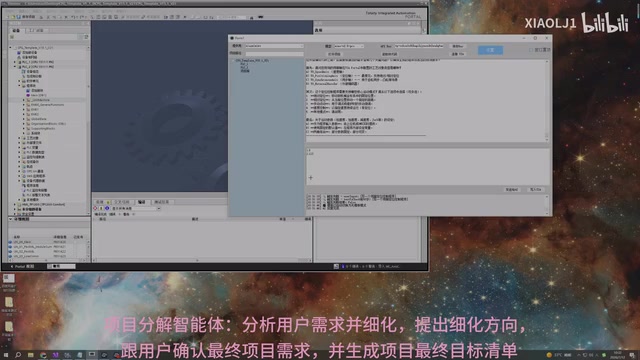
Project Decomposition Agent: From Vague Requirements to a Clear Checklist
A major pain point in industrial projects is that the requirements proposed by users are often vague and colloquial. Handing them directly to an AI for code generation can easily lead to deviations. This is exactly where the value of the project decomposition agent lies—it first analyzes the user's original requirements and proactively proposes several refined directions for the user to select and confirm.
After repeated confirmation with the user, the agent ultimately generates a clear "project objectives checklist." This process essentially simulates how a senior engineer clarifies requirements when taking on a project: breaking down a statement like "I want to build a temperature control system" into specific, executable subtasks such as sensor data acquisition, logic judgment, actuator control, and alarm mechanisms. This structured decomposition is a key prerequisite for ensuring the quality of the subsequent code. In the Agent architecture, this stage corresponds to the Task Decomposition capability of the "planning layer," which recursively breaks down complex goals into executable atomic steps, thereby significantly reducing the probability of errors in each generation step.
Local Knowledge Base: RAG Technology Solving the Domain-Expertise Challenge
The biggest weakness of general-purpose large models when handling industrial programming is the lack of industry-specific expertise and precise parameter configuration capabilities. The video specifically mentions that when encountering situations of "parameter uncertainty," the system calls upon a local domain knowledge base for support.

This design has significant engineering practicality. Behind it lies RAG (Retrieval-Augmented Generation) technology—currently the mainstream solution for addressing large models' "hallucination" problem and their limitations in private knowledge. The working principle of RAG is: enterprise-private documents (equipment manuals, technical specifications, historical project experience, etc.) are chunked and vectorized, then stored in a vector database. When the AI needs a certain type of parameter, the system first retrieves the document fragments most semantically relevant to the question, then injects these fragments as context into the large model's reasoning process, guiding the model to generate answers based on real materials. Compared with directly fine-tuning a model, the advantages of RAG are: the knowledge base can be updated at any time without retraining, answers are traceable and verifiable, and computational costs are low. Parameters, specifications, and equipment model information on the industrial floor are highly proprietary. Siemens PLCs' specific instruction sets, sensor measurement ranges, internal enterprise programming standards, and the like are precisely the scenarios where RAG technology delivers the most value.

For industrial enterprises, this means they can distill their accumulated technical documents, project experience, and equipment manuals into a knowledge base, allowing the AI to genuinely "understand" their business rather than speak in generalities.
Automatic Program Generation and Error Repair
Visualized Generation Process
Unlike black-box code generation, this solution provides complete visualization of the program generation process. Users can not only see the final generated program but also trace the entire reasoning chain—that is, the decision basis of the Agent at each stage of planning, retrieval, and generation.

This transparency is crucial in industrial scenarios. Industrial programs directly control physical equipment, and any hidden logical error could cause safety accidents or production losses. Being able to view the generation process means engineers can review, verify, and intervene in the AI's decisions, rather than blindly trusting the output. This also aligns with the fundamental requirement of "Explainability" in the field of industrial safety—especially in scenarios with stringent functional safety standards (such as IEC 61508), where the traceability of the reasoning process is itself part of the safety system.
The Automatic Error Repair Loop
The solution introduces automatic program error repair capabilities. In traditional development, after code is written, it requires manual debugging, compilation, and troubleshooting, with repeated iterations that are time-consuming and laborious. An AI Agent, however, can automatically analyze error messages after a compilation failure, locate the problem, and attempt to fix it, forming an automated loop of "generate—compile—detect—repair."
Technically, this capability relies on the "Reflexion Agent" mechanism: the error logs returned by the compiler (such as data type mismatches, address conflicts, instruction parameter out-of-range errors, etc.) are captured by the Agent and used as new input, triggering the next round of reasoning and correction. It is worth noting that error types in industrial programming are highly structured—compiler error codes are explicit and error locations are precise—which makes the AI's automatic repair success rate far higher than in general open-domain code debugging scenarios. This capability frees engineers from tedious debugging work, allowing them to focus their energy on higher-level solution design and on-site commissioning.
Significance and Outlook
Lowering the Barrier to Industrial Programming
The most direct value of this solution is that it significantly lowers the barrier to entry for industrial automation programming. TIA Portal programming work that used to require years of accumulated experience can now, with the help of AI Agents, be picked up more quickly even by junior engineers or cross-disciplinary personnel. Requirement analysis is assisted by an agent, domain knowledge is supported by a local base, and error repair is handled by an automated mechanism—the entire development pipeline is greatly simplified. This holds important practical significance for the current real-world problem of a talent shortage in industrial automation.
A Representative Example of AI Agents Landing in Vertical Industries
From a more macro perspective, this Siemens TIA Portal case is a representative example of AI Agent technology landing in a vertical industrial domain. It reveals the key path for general-purpose large models to move toward industrial application: general reasoning capability + domain knowledge base + automated workflow.
A large model alone cannot directly solve industrial problems, but when it is packaged into an Agent system with requirement decomposition, knowledge retrieval, and self-repair capabilities, it gains genuine productivity value. The architecture of "large model foundation + local knowledge (RAG) + Agent orchestration" is becoming a universal paradigm for AI empowering all industries—whether in healthcare, law, finance, or industrial manufacturing, this three-layer architecture is repeatedly proving its effectiveness.
Of course, industrial safety places extremely high demands on reliability. Before AI-generated programs actually go into production, they still require rigorous manual review and on-site testing. For deep-seated issues involving the safety logic of physical equipment, it is especially important to guard against situations where "the syntax is fixed, but a logical hazard is buried." Here, AI plays the role of an "intelligent co-pilot" rather than a complete replacement for engineers. But it is foreseeable that as such tools continue to mature, both the efficiency and the very methods of industrial software development will undergo profound transformation.
Key Takeaways
Related articles

Gemini 4 Interprets 500-Page Chemistry Patents: Boosting Drug Discovery Efficiency
Isomorphic Labs researchers used Gemini 4 to process 500-page chemistry patents and academic papers, generating high-quality reports in 10-15 minutes — work that originally took a month was done in an afternoon.

Apple HomeView First Look: The Prototype of a Smart Home Control Hub
First look at Apple HomeView smart home control interface: thermostat and accessory customization, up to nine camera live feeds, iCloud+ and Apple Intelligence video descriptions, and tiered permissions blocking recording access in guest mode.

Gemini 4 Teaches a Humanoid Robot to Play Cornhole: A Breakthrough in Video Learning and Self-Iteration
Google Gemini 4 Argon's experiment shows a humanoid robot learning Cornhole from a human video, iterating via the Mojoku simulator, and making seven consecutive real-world hits.