Silicon Valley AI Security Startup Traceforce Is Hiring a Backend Engineer in Seoul

Silicon Valley AI security startup Traceforce is hiring a backend engineer in Seoul with top 1% pay and an L1 pathway to the US.
Traceforce, a Silicon Valley AI security startup backed by Y Combinator and Antler, is hiring an early-stage backend engineer in Seoul to build endpoint AI agents plus an MCP registry and gateway. The role reports to the CTO, uses Go but allows learning on the job, requires all-English interviews, pays at the top 1% of the Korean market, and offers an L1 visa pathway to San Francisco HQ after one year.
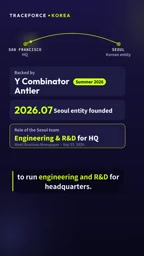
Silicon Valley AI security startup Traceforce is recruiting an early-stage backend engineer in Seoul. The company, backed by Y Combinator and Antler and focused on securing AI Agent data access, has just established a Korean entity in Seoul, placing its core engineering and R&D functions in Korea — and the job posting itself reveals plenty of noteworthy industry signals.
What does the company do?
Traceforce's core product addresses a rapidly expanding new problem: when AI Agents like ChatGPT and Claude access enterprise data through MCP (Model Context Protocol) and Skills, where exactly does the data go, is there any privilege escalation, and is it being misused?
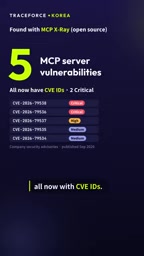
What it does is track every data access path of AI Agents in real time and intercept risks the moment they occur. According to its official information, Traceforce's open-source scanner MCP X-Ray has already discovered five MCP server vulnerabilities, all of which have been assigned CVE numbers.
This detail is worth a closer look. From Anthropic's introduction of MCP to its adoption across numerous toolchains, the ecosystem has expanded far faster than security auditing has kept up. The fact that an early-stage startup can obtain five CVEs through an open-source tool shows, on one hand, that the security baseline of the MCP ecosystem is indeed low, and on the other, that Traceforce has real technical depth in "putting surveillance on AI Agents" rather than just telling a security story.
MCP (Model Context Protocol) is an open protocol proposed by Anthropic at the end of 2024, aiming to establish a standardized way of connecting large language models with external data sources and tools. Previously, every AI application that needed to connect to a database, file system, or SaaS service had to write its own proprietary integration; MCP abstracts these integrations into a unified "server-client" interface, so the model side only needs to call according to the protocol. Its value lies in extending AI Agents' capabilities from "conversation" to "actual operation of enterprise systems," but the cost is that data access paths become highly fragmented and difficult to audit — a single Agent call may chain multiple MCP servers and cross multiple layers of permission boundaries. This is precisely the premise for products like Traceforce: the protocol layer only defines "how to connect," not "whether one should connect," pushing the responsibility for security and compliance down to enterprises themselves.
Skills is a complementary mechanism to MCP, referring to packaging the operational procedures, prompts, and tool calls for specific tasks into reusable capability units for Agents to load on demand. While MCP addresses "what to connect to," Skills focuses more on "how to get things done." When the two are combined, the Agent's execution chain becomes very long, and a permission misjudgment at any link could lead to data leakage — which is why observability of data access is beginning to be treated as an independent infrastructure problem.
CVE (Common Vulnerabilities and Exposures) is a public vulnerability numbering system maintained by MITRE. When a vulnerability receives a CVE number, it means it has been independently confirmed and can be publicly searched and tracked — a relatively solid credibility endorsement in the security industry. For early-stage startups, producing CVEs through open-source scanners is a lower-cost but more persuasive way to demonstrate technical capability.
What the role involves
This is an early-stage backend engineer position for Korea, reporting directly to the CTO. There are two core areas of work: building endpoint AI agents, and building the MCP registry and gateway.
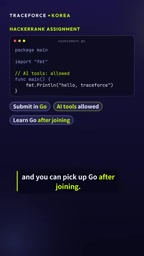
In terms of tech stack, the specified language for the role is Go. But the job posting contains a line that is not very common in traditional backend hiring: AI tools are permitted, and you can learn Go after joining. This means the company's screening criteria lean more toward system design ability, understanding of AI Agent workflows, and the ability to quickly pick up unfamiliar tech stacks — rather than rigid requirements like "has written Go for X years."
For engineers looking for opportunities in the AI infrastructure space, this is a relatively rare entry point — the code you write will run directly on the critical path between AI Agents and data, rather than in peripheral CRUD business logic.
MCP registry and gateway are two key components for implementing this type of product. The registry can be understood as the registration and directory center for MCP servers, recording which MCP services are running within an enterprise, what tools and data sources each exposes, and who is responsible for maintaining them. Without a registry, enterprises often cannot even clearly say "how many MCP servers we have running," let alone govern them. The gateway is the mandatory checkpoint for all Agent data requests, responsible for authentication, rate limiting, data masking, and audit logging before requests actually reach the data source.
Putting these two together with endpoint AI agents in the same job responsibility indicates that this role must handle the entire chain from "Agent initiates request" to "data is returned" — a classic control plane engineering role rather than business logic development. This kind of work typically demands more in terms of system design, concurrency handling, and protocol implementation than in specific language syntax, which also explains why the recruiter is willing to accept candidates who learn Go after joining.
All-English interviews and compensation positioning
An explicit requirement in the hiring process is that all interviews are conducted in English.
For local Korean engineers, this is a threshold that needs to be assessed, but it also reflects the team's way of working — although the Seoul entity is the engineering and R&D base, the working language is consistent with the Silicon Valley headquarters.
On compensation, Traceforce states it is "benchmarked against the top 1% of the Korean market." In a market like Seoul where engineer salary ranges are relatively concentrated, explicitly positioning at "top 1%" usually means it needs to use compensation to offset the uncertainty of a startup, and also needs to compete with local giants (such as Naver, Kakao, Coupang) for the same pool of talent.
The San Francisco pathway after one year
The most distinctive design of this role is that it strings "Seoul" and "San Francisco" into a path: after a year of strong performance, there is an opportunity to transfer to the San Francisco headquarters, with the L1 visa process and fees covered by the company.

L1 is a visa type for intra-company transfers at multinational corporations, requiring the applicant to have worked at an overseas affiliated entity for at least one year. Traceforce establishing an entity in Seoul and explicitly stating this pathway in its hiring indicates that the Korean team is not an outsourcing or satellite office, but a formal branch incorporated into the headquarters' HR system. For engineers who want to enter Silicon Valley but do not want to go the study-abroad or lottery route for now, this kind of "join locally first, then transfer internally" path usually has higher certainty than directly applying for overseas positions.
L1 visa is a non-immigrant work visa designed by the United States for managers or specialized knowledge employees within multinational corporations, divided into L1A (managerial positions) and L1B (specialized technical positions), with a validity period typically of 1 year (new office) or 3 years, renewable, and allowing immigrant intent. Its core prerequisite is that the applicant must have worked continuously for at least one year at an overseas affiliated entity within the three years prior to filing the application.
This requirement precisely explains why Traceforce set up a formal entity in Seoul and publicly disclosed this transfer pathway — the overseas branch must be a legally affiliated company for the Seoul team's work experience to count toward the L1 qualification period. Compared with the uncertainty of the H1B lottery, L1 does not require going through a lottery, and the process is relatively controllable, but it is tied to a specific employer. For engineers, this means that "join in Seoul first, then transfer to San Francisco" is a path with relatively high certainty but also deep binding to the company — leaving mid-way would directly affect visa eligibility.
The other side to face squarely
The job posting itself does not shy away from the pace: this is an early-stage startup, and both intensity and speed are high. Combined with the fact that it is simultaneously working on three product lines — endpoint agent, MCP registry, and gateway — while also maintaining an open-source scanner, the engineering team's workload will not be light.
Another point that requires your own judgment is that the MCP security track is still evolving rapidly. The standard itself is still changing, and customer needs are still taking shape, which means work content may be adjusted frequently rather than progressing along a clear roadmap. People who prefer certainty may not be suited to it, but for those who want to help define a new category, this is precisely where the opportunity lies.
Interested engineers may want to focus on the process and detailed explanations in the job description. Interviews are entirely in English, and preparing in advance with a technical understanding of AI Agent data access paths will be more useful than grinding Go syntax problems.
One-line Summary
Silicon Valley AI security company Traceforce is recruiting a backend engineer in Seoul, using top 1% compensation and an L1 path to the US to compete for AI Agent data security talent.
Paragraph Summary
Traceforce is a Silicon Valley AI security startup backed by Y Combinator and Antler, focused on solving privilege escalation and misuse issues when AI Agents access enterprise data through MCP and Skills. Its open-source scanner MCP X-Ray has discovered five MCP server vulnerabilities with assigned CVE numbers. The company has just established a Korean entity in Seoul, placing its core engineering and R&D functions in Korea, and is recruiting an early-stage backend engineer to report directly to the CTO, responsible for building endpoint AI agents as well as MCP registry and gateway, with Go specified but learning on the job allowed. The hiring process requires all-English interviews, compensation is benchmarked against the top 1% of the Korean market, and after one year of strong performance, candidates can apply to transfer to the San Francisco headquarters, with the L1 visa process and fees covered by the company. The article also notes that the pace of an early-stage startup is intense, the MCP security track's standards are still evolving, and work content may change frequently.
Related articles

Free Unlimited Claude Code Solution: Agnes AI + CC Switch Setup Guide
No paid subscription needed — pair the free AI platform Agnes AI with the open-source tool CC Switch to provide a backend for Claude Code, enabling unlimited free calls to text, image, and video models. This guide covers the full setup, test results, and usage boundaries.

A Complete Zero-Cost Guide to Getting Started with Claude Code for Beginners in China
A beginner's guide to Claude Code for users in China: two installation methods (command line and IDE plugin), full configuration steps for replacing the official API with the free domestic LongCat model, and a hands-on demo of building a small tool with natural language, plus tips.

When the NSA Gets Involved: The AI Supply Chain Crisis Behind Open-Source CVEs and API Key Hijacking
Multiple open-source projects disclosed severe CVEs in one day, PHP flaws alarmed the FBI, and Railway and OpenCode were breached with API keys stolen. This article breaks down the vulnerability window, AI-accelerated exploitation, and the AI supply chain crisis behind the API key black market, with a developer defense checklist.