SimRig: Building a Unified Experimentation Layer for Embodied AI — Stop Reinventing the Wheel
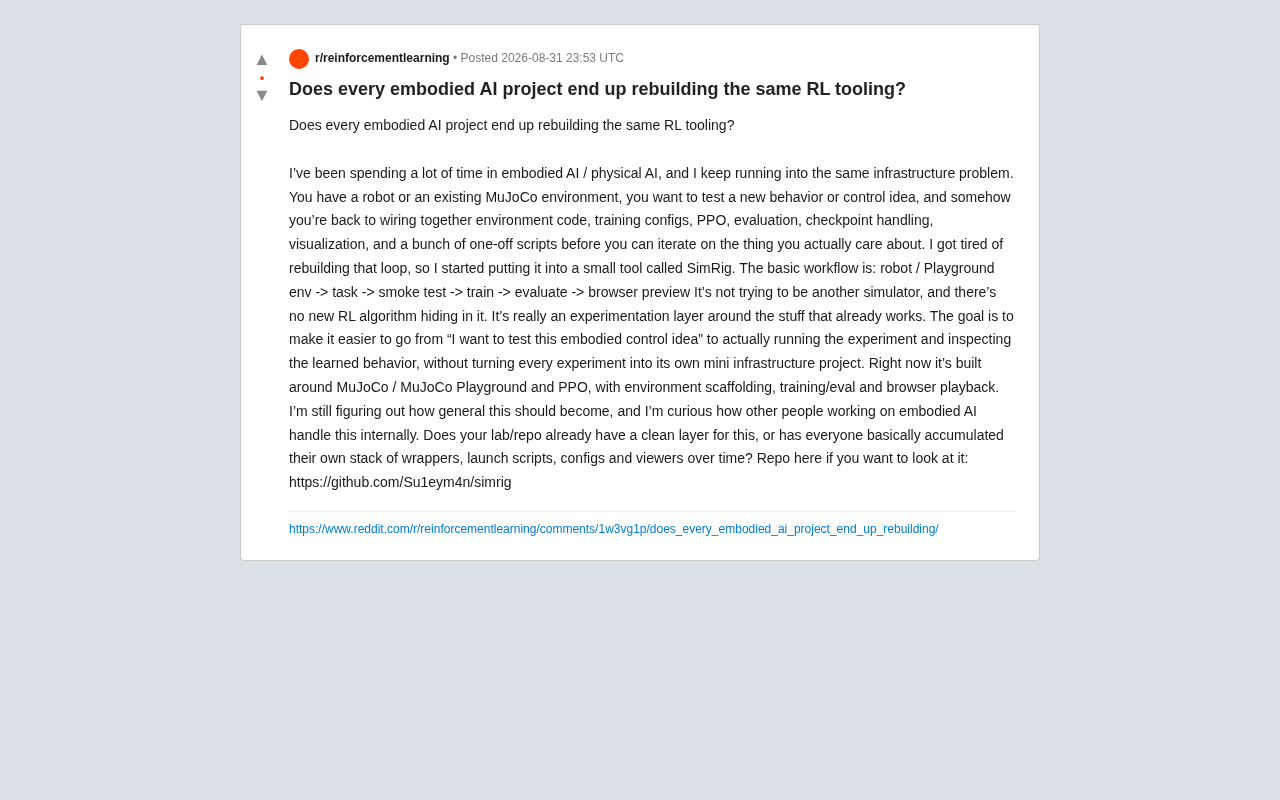
SimRig provides a unified experimentation layer for Embodied AI, eliminating repetitive RL infrastructure work.
Embodied AI developers waste significant time rebuilding RL training infrastructure for every experiment. SimRig addresses this by providing a lightweight experimentation layer built on MuJoCo and PPO, offering a standardized pipeline from environment setup and smoke testing to training, evaluation, and browser preview. By abstracting away repetitive engineering work, it lets researchers focus on what matters — testing control ideas and iterating faster.
The Universal Pain Point for Embodied AI Developers
Developers working in Embodied AI and Physical AI have almost all encountered the same exhausting scenario: you have a robot or an existing MuJoCo environment and simply want to test a new control strategy or behavioral idea, only to find yourself back at square one — stitching together environment code, writing training configs, hooking up PPO, handling evaluation pipelines, managing checkpoints, building visualization interfaces, and dealing with a pile of throwaway scripts.
Embodied AI refers to embedding artificial intelligence into systems with physical form — such as robots, autonomous vehicles, or intelligent drones — enabling them to perceive, understand, and interact with the real physical world. Unlike AI that runs purely in digital environments, Embodied AI must deal with physical constraints like gravity, friction, and collision, which causes research and development complexity to grow exponentially. Physical AI is a concept that NVIDIA CEO Jensen Huang has been championing in recent years, emphasizing that AI systems must understand and obey the laws of physics, autonomously navigating and operating in three-dimensional space. These two concepts are converging rapidly in both academia and industry, becoming one of the most closely watched AI frontiers after large language models.
A Reddit user recently posted about this topic and struck a deep chord with the community. He candidly stated: "I got tired of rebuilding this loop." Before he could even begin iterating on the core problem he actually cared about, a massive amount of time was consumed building infrastructure. This isn't an isolated case — it's a structural problem pervasive across the entire Embodied AI field.
Why Does Every Embodied AI Project Reinvent the Wheel?
RL-driven embodied intelligence experiments inherently involve a relatively fixed pipeline: environment definition, task specification, training, evaluation, and result visualization. In theory, most parts of this pipeline are reusable. In practice, however, due to the lack of a unified experimentation layer, every lab and every repository ends up accumulating its own set of wrappers, launch scripts, configuration files, and viewers.
This fragmentation leads to significant efficiency losses: the cost of validating new ideas is unnecessarily inflated, experiments are difficult to reproduce, and team collaboration is hindered by inconsistent toolchains. The original poster hit the nail on the head — the fundamental problem is that every RL experiment turns into a "mini infrastructure project." This phenomenon is especially pronounced in Embodied AI because, compared to pure computer vision or NLP tasks, embodied intelligence experiments involve more components with tighter coupling: physics simulation engines, sensor modeling, dynamics constraints, reward function design, policy network architectures, training hyperparameters — a change in any one component can trigger a cascade of adjustments, and the lack of a standardized experimentation layer means these adjustments must be handled manually every time.
SimRig: Not Reinventing — Filling the Gap
To address this pain point, the developer built a lightweight Embodied AI experimentation framework called SimRig. It's important to emphasize that SimRig has a very clear positioning: it doesn't try to be yet another simulator, nor does it hide some novel RL algorithm. At its core, it's an experimentation layer built around components that "already work well."
In software engineering, this kind of "experimentation layer" is a middle abstraction layer that sits between low-level infrastructure (like simulation engines and algorithm libraries) and high-level application logic (like specific control strategy design). It manages common workflows across the experiment lifecycle: configuration management, training loop orchestration, checkpoint saving and restoration, metrics logging, result visualization, and more. PyTorch Lightning is a successful example of this philosophy in the deep learning domain — it doesn't replace PyTorch itself but abstracts engineering details like training loops, distributed training, and mixed precision into standardized interfaces, letting researchers focus on model architecture and loss function design. SimRig aims to play a similar role in the Embodied AI space.
Core Workflow
SimRig defines a clean, standardized pipeline:
Robot / Playground Environment → Task → Smoke Test → Training → Evaluation → Browser Preview
The value of this pipeline lies in shifting developers' attention from "how to set up the experiment" back to "whether this embodied control idea actually works." The engineering friction between "I want to test this control concept" and actually running the experiment and inspecting the learned behavior is drastically reduced. The "smoke test" step is particularly noteworthy — before launching a training run that might take hours or even days, a quick short training cycle verifies that the environment configuration, reward signals, and policy network are basically functional. This simple step can save enormous amounts of debugging time in practice.
Technology Stack
SimRig is currently built on mature, industry-proven foundations:
- Simulation Environment: MuJoCo and MuJoCo Playground
- Training Algorithm: PPO (Proximal Policy Optimization)
- Supporting Capabilities: Environment scaffolding, training & evaluation, browser replay
This "standing on the shoulders of giants" approach is a wise one. MuJoCo (Multi-Joint dynamics with Contact) is a high-fidelity physics simulation engine developed by Emanuel Todorov. After being acquired by DeepMind in 2021, it was open-sourced in 2022. With its outstanding contact dynamics simulation, extremely high simulation speed, and numerical stability, it has become the de facto standard in robot reinforcement learning. MuJoCo can accurately simulate complex physical phenomena including rigid bodies, joints, tendons, friction, and collisions, allowing researchers to safely and efficiently train robot control policies in virtual environments before transferring the learned policies to real hardware. MuJoCo Playground is a collection of pre-configured environments built on top of MuJoCo, offering a rich set of benchmark tasks ranging from simple inverted pendulums to complex humanoid robot locomotion.
PPO (Proximal Policy Optimization), proposed by OpenAI's John Schulman in 2017, is a policy gradient reinforcement learning algorithm. Its core innovation uses a clipping objective function to limit the magnitude of each policy update, preventing the training instability caused by excessively large policy update steps. Compared to its predecessor TRPO (Trust Region Policy Optimization), PPO dramatically simplifies implementation complexity while maintaining comparable performance. From OpenAI Five playing Dota 2 to robotic dexterous manipulation, PPO has played a key role in numerous milestone achievements and remains one of the most versatile and reliable baseline algorithms to this day.
SimRig doesn't reinvent these underlying capabilities. Instead, it organizes them into an out-of-the-box experimentation framework, saving developers from tedious glue code.
A Question Worth the Entire Community's Reflection
At the end of the post, the author posed an open-ended question — arguably the most valuable part of the entire discussion: How do other teams working on Embodied AI handle this RL toolchain problem internally?
He asked curiously: Does your lab or codebase already have a clean experimentation layer? Or has everyone essentially just accumulated their own pile of wrappers, launch scripts, configs, and viewers over time?
This question touches on the deeper reality of engineering practices in embodied intelligence. Compared to the rapid advances in algorithm research, the standardization of engineering infrastructure is often a neglected area. When every team is privately rebuilding similar toolchains, the entire field is effectively paying the same cost repeatedly for the same problem. This issue becomes even more prominent in the context of Sim-to-Real Transfer — the ultimate goal of Embodied AI R&D is to deploy policies trained in simulated environments onto real robots, and the success rate of this transfer is closely tied to the quality of the entire toolchain: the physical fidelity of the simulation environment, Domain Randomization configuration, training reproducibility, evaluation metric comprehensiveness — all directly impact the final transfer outcome. When experimental toolchains are fragmented and non-standardized, researchers find it difficult to pinpoint whether a policy failure is caused by algorithmic design issues or engineering implementation problems.
The Value of the Experimentation Layer Is Underestimated
From a broader perspective, the "experimentation layer" philosophy that SimRig represents is one of the hallmarks of machine learning engineering reaching maturity. In other areas of deep learning, we've already seen frameworks like PyTorch Lightning and Hugging Face Transformers dramatically boost researcher productivity by abstracting reusable training and evaluation workflows. PyTorch Lightning standardizes engineering details like training loops, distributed training, and mixed precision into clean interfaces; Hugging Face Transformers provides one-stop management of pre-training, fine-tuning, and inference workflows in the NLP domain. The value of this layered architecture is that underlying components can evolve independently, upper-level experiments can iterate rapidly, and the experimentation layer ensures a stable connection between the two.
The Embodied AI field needs exactly this kind of abstraction layer. It doesn't change the underlying simulator or RL algorithm, but by eliminating repetitive engineering burden, it enables researchers to iterate on ideas faster, reproduce experimental results more easily, and collaborate more smoothly across teams. In fact, Embodied AI may have a more urgent need for a standardized experimentation layer than other AI subfields, because its experimental pipeline involves a longer chain of components, each component has a larger configuration space, and debugging costs are higher — a complete experiment configuration for a humanoid locomotion task might involve combinations of dozens of physical parameters, reward weights, and training hyperparameters. Without a unified management framework, experimental reproducibility is nearly impossible to guarantee.
From Personal Tool to Community Consensus
SimRig is still in its early exploration stage, and the author himself admits he's "still thinking about how general it should be." The project is open-sourced on GitHub (Su1eym4n/simrig), and Embodied AI developers who are interested are welcome to contribute.
Regardless of whether SimRig ultimately becomes the standard experimentation tool for Embodied AI, the question it raises is extremely valuable: when everyone in a field is privately and repeatedly solving the same infrastructure problem, perhaps it's time for the community to come together and build a unified standard. Looking back at the history of technology, almost every mature engineering domain has gone through the evolution from "everyone doing their own thing" to "standardized toolchains" — web development got React and Next.js, ML training got PyTorch Lightning and Weights & Biases, LLM fine-tuning got the Hugging Face ecosystem. The Embodied AI field is standing at a critical juncture in this evolution.
For teams exploring the embodied intelligence track, rather than continuing to accumulate their own "script graveyards," it's worth seriously considering building or adopting a clear experimentation layer — this may be the most underestimated investment for improving robot reinforcement learning R&D efficiency.
Related articles

Bilibili's Hit Dify Tutorial: A Practical Guide to Building 20+ AI Apps from Scratch
A distilled guide to Bilibili's top-rated Dify tutorial: Windows + Docker deployment, MySQL connection, five app types, model integration strategy, and publishing.

Agent Skills Beginner's Guide: From Concepts to Multi-Agent Collaboration in Practice
A comprehensive guide to Agent Skills: core concepts, components, the importance of Description, standardization, beginner learning paths, and multi-agent collaboration.

One Neuron Detects Both Cats and Cars? We Reproduced It and Found a New Explanation
The cat-car neuron reinterpreted: researcher Cammarata argues it distinguishes pointy from round, not cats from cars. We reproduced the experiment and found the new explanation holds on most inputs—but cars are the exception. The interpretability debate continues on language models.