Sincere and Self-Interested at Once: Unpacking the Deep Bond Between Belief and Interest

Sincerity and self-interest coexist by default — people unconsciously bend their beliefs toward their interests.
A social media observation prompts a deeper look at human motivation: we can't fully separate "someone sincerely believes X" from "X happens to serve their interests." Rather than the binary of true believer vs. self-serving calculator, psychology reveals a subtler truth — motivated reasoning causes people to unconsciously align their beliefs with their interests, arriving at genuinely held convictions that are also conveniently self-serving. The practical implication: when evaluating expert opinions, industry advocacy, or tech predictions, neither sincerity nor self-interest alone tells the full story. Accepting that both can coexist is both an honest account of human nature and a more sophisticated starting point for critical thinking.
A Tweet That Got Me Thinking
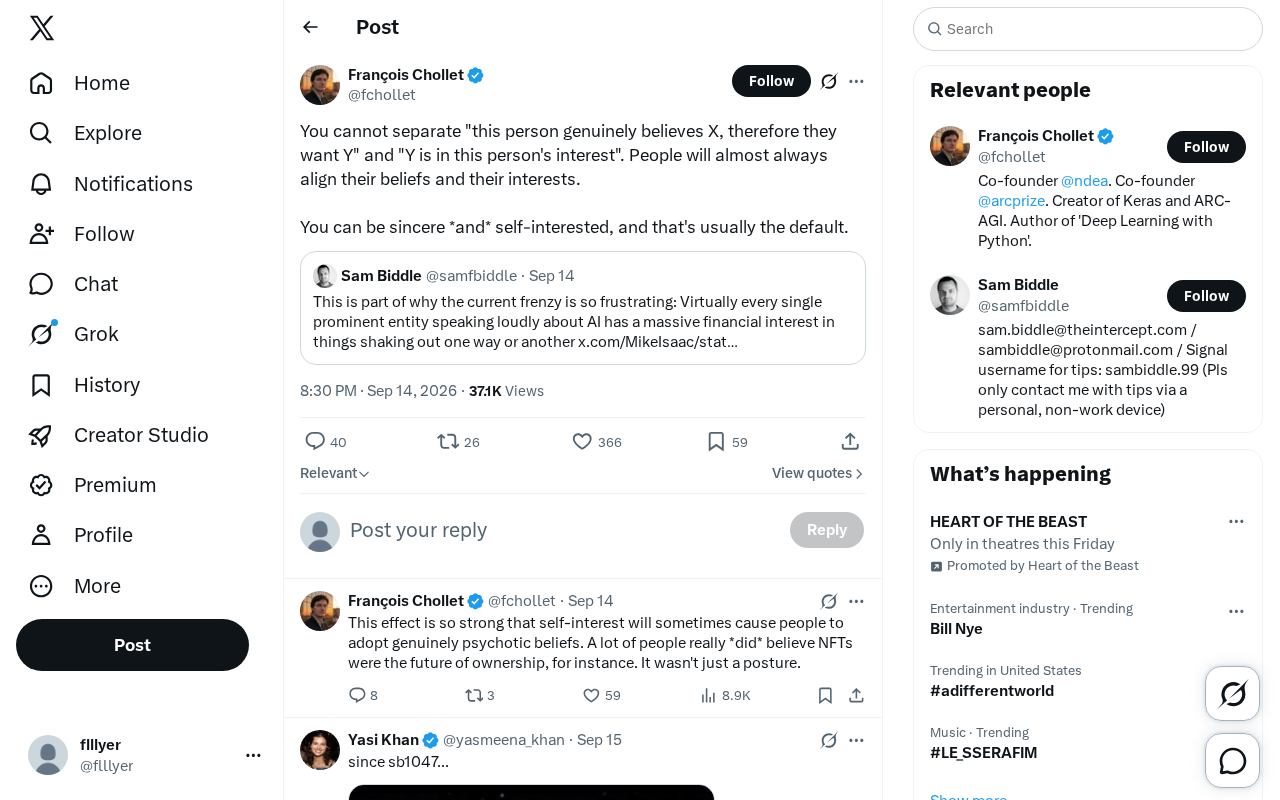
A perspective making the rounds on social media goes something like this: you can't fully separate "this person sincerely believes X, and therefore wants Y" from "Y happens to serve this person's interests." People almost always end up aligning their beliefs with their interests.
This sounds simple, but it touches on a long-overlooked truth about human cognition and motivation: sincerity and self-interest are not opposite poles — they're actually the default state, coexisting more often than not.
Sincere Doesn't Mean Selfless
We tend to view motivation in binary terms: either someone genuinely believes a position, or they're calculating for personal gain. In public discourse, we often use "he's just acting in his own interest" to dismiss someone's sincerity, or "he really means it" to defend someone's self-serving stance.
But the perspective above breaks down this either/or framework. A person can simultaneously hold a sincere belief in what they advocate and have that advocacy happen to serve their own interests. These two things are not only compatible — they're the most common combination in human nature.
The Self-Alignment of Belief and Interest
The key insight lies in the word "align" — people actively, and often unconsciously, bend their beliefs to match their interests. This isn't crude deception; it's a far more subtle psychological process. When a particular position benefits you, your brain tends to search for genuine reasons to support it — and eventually convinces itself. You end up truly believing it.
This maps closely onto what psychologists call motivated reasoning: we don't objectively analyze a situation and then reach a conclusion. We arrive at a preferred conclusion first, then go searching for evidence to support it. The result is that someone can look in the mirror with a clear conscience, because they genuinely believe what they're saying — it just so happens that what they believe is convenient for them.
Motivated reasoning is a foundational concept in behavioral economics and cognitive psychology, systematically articulated by psychologist Ziva Kunda in the 1990s. Its core mechanism: the human brain is not a neutral reasoning machine, but a confirmation system biased toward "the conclusion I want." Specifically, when a conclusion is self-serving, the brain lowers its scrutiny threshold for supporting evidence ("good enough") while raising the bar for counterevidence ("this study has methodological issues"). Neuroscience research suggests this process occurs largely below the level of conscious awareness — the person involved has almost no way of detecting it. That's precisely why motivated reasoning is so hard to self-correct: subjectively, it feels indistinguishable from "objective analysis." The person simply feels like they're thinking carefully about the issue. Related concepts include confirmation bias and conflict of interest, but motivated reasoning more specifically emphasizes the internal process of belief formation rather than external structural relationships.
Why This Matters
Understanding that sincerity and self-interest can coexist has direct practical value for how we evaluate what others say.
When we discover that someone's view aligns with their interests, we don't need to conclude they're lying or performing. Equally, when we confirm that someone truly believes something, we can't take that sincerity as proof that their position is purely objective and free of self-interest.
This is especially critical when assessing expert opinions, industry statements, and policy advocacy. A practitioner who sincerely believes a technology has a bright future — that sincerity is genuine and beyond reproach. But that belief is likely deeply intertwined with their career, investments, or reputation. Acknowledging that both can coexist is what allows us to weigh their perspective with clear eyes.
Implications for AI and Tech Discourse
In a field as laden with competing interests as AI, this lens deserves particular attention. Whether someone is bullish or bearish, their read on the technology's trajectory is often tightly coupled with their personal situation. People holding equity in AI startups tend to sincerely believe AGI is just around the corner; people worried about their jobs being automated tend to sincerely believe AI is overhyped.
Both sides may be entirely sincere. Both sides' beliefs may be aligned with their interests. This doesn't mean their views are worthless — it means that when listening to either side, we should take their sincerity seriously and keep their interests clearly in view.
This binding of belief and interest has a dedicated analytical lens in the venture capital and tech communication ecosystem, sometimes framed through narrative economics (a concept introduced by Nobel laureate Robert Shiller): the grand narrative around a technology has economic value in itself — it drives fundraising, attracts talent, shapes regulation. Those embedded in the ecosystem therefore have powerful structural incentives to believe in and propagate that narrative, and their belief is often completely sincere. A practical self-check is what might be called the revealed interest test: if someone's position were to reverse 180 degrees, what would happen to their economic or social standing? The greater the loss, the more deeply their belief is likely bound to their interest. This doesn't mean their view is wrong — but it does mean seeking corroboration from people positioned at different points in the interest landscape.
Closing: Embracing Human Complexity
The value of that original tweet lies in its refusal to moralize in simple terms. It doesn't divide the world into "sincere good people" and "calculating self-interested ones," but instead acknowledges that most people naturally inhabit the gray zone where the two intertwine.
Accepting this complexity actually makes us more generous toward others and more careful with information. The fact that sincerity and self-interest can coexist is not a condemnation of human nature — it's the most honest description of it.
Related articles

Cursor AI Programming in Practice: Build a Student Management System from Scratch in 30 Minutes
A Bilibili creator demonstrates Cursor AI programming: generating a student management system in 30 minutes with natural language. Details on Agent mode, Claude selection, prompt techniques, and thresholds.

Top 20 AI Coding Tools Ranking: From Rock-Solid to Lackluster, a Scored Matrix
Bilibili creator releases top 20 AI coding tools ranking, tiered T0–T4 from rock-solid to lackluster, with Claude Code and Codex tied at T0. This article details the scoring dimensions (capability, reliability, robustness, durability, cost, domestic availability) and tool performances to help developers choose the right AI coding assistant.

Vibe Coding Systematic Tutorial: Master AI-Assisted Programming from Zero
A three-month Vibe Coding tutorial from a Bilibili creator covering Codex, ClaudeCode, and Cursor, from core logic to commercial project practice for beginners.