Single-Motor Drone DIY: Engineering Ingenuity in Minimalist Design

Maker replaces quad-motor differential speed with single motor plus mechanical transmission, validating a minimalist flight approach.
The article introduces a single-motor drone project posted by a maker on YouTube, gaining 211 points and 39 comments on Hacker News. The single-motor approach uses mechanical transmission, control surface actuation, or thrust vectoring to replace multi-motor differential speed for attitude adjustment, with limited flight stability at the proof-of-concept level. Its core value lies in demonstrating constraint-driven design thinking with lower material costs and lighter structures. The HN community is divided on practicality but acknowledges the hands-on spirit and educational value, reminding creators that mainstream solutions aren't the only answer.
From "Four Motors" to "One Motor": A Counterintuitive Drone Approach
While consumer drones typically come with four motors as standard, a maker posted a video on YouTube titled I built a drone with only one motor, demonstrating a design that achieves flight using just a single motor. The video gained 211 points and 39 comments on Hacker News, drawing attention to minimalist aircraft design.
This isn't about replacing DJI—it's a direct answer to the engineering question: "What's the minimum number of power sources needed for flight?"
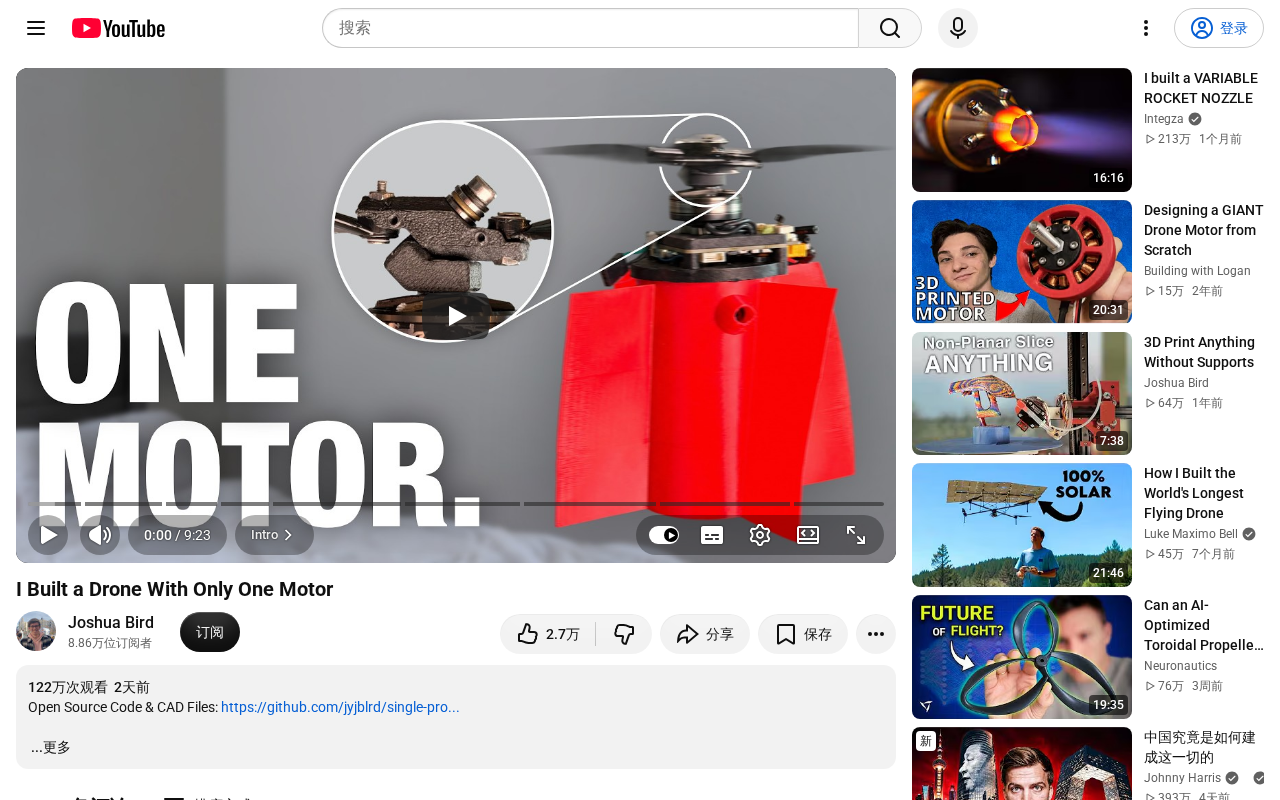
How Does a Single Motor Work? Core Mechanism Analysis
Multi-rotors rely on differential speed across multiple motors for attitude control. Reducing to a single motor means mechanical structures must replace electronic speed control. Based on the video content and HN comment discussions, such designs typically follow these approaches:
Mechanical Transmission and Control Surface Actuation
A single motor drives multiple rotors through gears or belts, with the motor itself providing only constant rotational speed. Attitude adjustment is handled by servo-controlled guide vanes or variable-pitch mechanisms. This resembles the main rotor plus tail rotor logic of helicopters, but eliminates the independent tail motor in favor of mechanical linkage.
Collective pitch is a key mechanical component in helicopters and some single-motor designs: it adjusts lift by changing the blade installation angle without changing motor speed. On multi-rotors, lift is regulated by motor speed differentials; in single-motor designs, the motor can maintain constant speed while servos drive the collective pitch mechanism to uniformly change all blade angles of attack, achieving collective control. Adding cyclic pitch further allows the rotor disc to tilt, generating pitch and roll moments. The trade-off is numerous precision linkages, bearings, and servos—maintenance complexity far exceeds electronic speed control, though control bandwidth and response linearity perform well during hover.
Tilting Rotors and Center of Gravity Shifting
Another common approach uses a single motor to drive a tiltable rotor assembly, achieving pitch and yaw by changing thrust vector direction, while roll relies on center of gravity shifts or auxiliary aerodynamic surfaces. Some HN commenters noted that such designs have lower hover efficiency than quadrotors, but significantly reduce part count and cost.
The flight shown in the video is not smooth—it's at the proof-of-concept level. This is precisely the value of DIY projects: first prove "it can fly," then discuss "flying well."
Thrust vectoring refers to generating control moments by mechanically deflecting thrust direction without changing the aircraft's overall attitude. In single-motor drones, a common approach mounts the motor and rotor on a gimbal that can tilt about two axes, driven by servos. When rotor thrust direction deviates from the vertical line through the center of mass, its horizontal component generates pitch or yaw moments; roll can be achieved through auxiliary aerodynamic surfaces or movable counterweights. The advantage of thrust vectoring is decoupling control moments from thrust, suitable for low-speed hover; the disadvantage is that gimbals and servos add structural weight and backlash, with response speed limited by servo bandwidth.
Why It Matters: The Engineering Value of Minimalism
Quadrotors became mainstream because electronic speed controllers are cheap, control algorithms are mature, and redundancy is high. Single-motor designs go the opposite direction, sacrificing redundancy and control precision for lower bill of materials and lighter structural weight.
Such projects have practical significance for education and rapid prototyping: students can directly observe the coupling between thrust vectoring and attitude rather than delegating the problem to a flight controller black box. According to HN discussions, some commenters compared it to early single-channel RC glider thinking—trading mechanical complexity for electronic complexity.
Of course, single motors also bring obvious shortcomings: no redundancy—any transmission component failure means a crash; mechanical structures increase maintenance costs; control bandwidth is limited by servos. The video author doesn't claim this is a practical solution but treats it as a "can it be done" challenge.
Redundancy in multi-rotor design refers to maintaining flight when individual components fail through excess power units or control channels. Quadrotors typically have some fault tolerance: after losing one motor, some flight controllers can barely manage an emergency landing by adjusting diagonal motor speeds. Single-motor designs have no power redundancy—failure of any gear, belt, or servo in the transmission chain leads to loss of control. Redundancy directly relates to cost and weight, making it one of the core trade-offs in consumer and experimental aircraft design.
Community Reaction from HN Discussions
The 39 comments on Hacker News presented polarization: one side praised the hands-on spirit and clever mechanical design, while the other questioned its practical use, arguing that quadrotor redundancy and mature ecosystems are hard to challenge with single-motor designs. This divergence itself illustrates that the value of minimalist DIY projects lies not in replacing existing products but in expanding design space.
Combining video content with community feedback, the project's core contribution is providing a reproducible single-power flight platform concept rather than a performance breakthrough. For creators in AI and robotics, such "constraint-driven innovation" cases are worth learning from—limitations often force clearer design logic.
Insights for Creators
Single-motor drones won't become consumer products, but they remind us: mainstream solutions are products of engineering compromise, not the only answer. As computing power and sensors become cheaper, sometimes returning to mechanical structures to eliminate electronic components yields lower costs and better explainability. For teams working on AI hardware or robotics prototypes, this reverse thinking deserves a place at the table.
One-line Summary
Maker uses single motor plus mechanical transmission to replace quad-motor differential speed, validating a minimalist flight approach.
Paragraph Summary
The article introduces a single-motor drone project posted by a maker on YouTube, which gained 211 points and 39 comments on Hacker News. The single-motor approach uses mechanical transmission, control surface actuation, or thrust vectoring to replace multi-motor differential speed for attitude adjustment, with limited flight stability at the proof-of-concept level. Its core value lies in demonstrating constraint-driven design thinking with lower material costs and lighter structures, offering reference value for education and rapid prototyping. The HN community is divided on its practicality but acknowledges the hands-on spirit and educational value. The article argues that such minimalist DIY projects expand design space and remind creators that mainstream solutions aren't the only answer.
Related articles

Bilibili's Hit Dify Tutorial: A Practical Guide to Building 20+ AI Apps from Scratch
A distilled guide to Bilibili's top-rated Dify tutorial: Windows + Docker deployment, MySQL connection, five app types, model integration strategy, and publishing.

Agent Skills Beginner's Guide: From Concepts to Multi-Agent Collaboration in Practice
A comprehensive guide to Agent Skills: core concepts, components, the importance of Description, standardization, beginner learning paths, and multi-agent collaboration.

One Neuron Detects Both Cats and Cars? We Reproduced It and Found a New Explanation
The cat-car neuron reinterpreted: researcher Cammarata argues it distinguishes pointy from round, not cats from cars. We reproduced the experiment and found the new explanation holds on most inputs—but cars are the exception. The interpretability debate continues on language models.