Skepia: Boosting Creativity Through Daily Thinking Training

Skepia turns techniques like SCAMPER into daily challenges plus puzzle training, aiming to make creativity a daily exercise like a muscle.
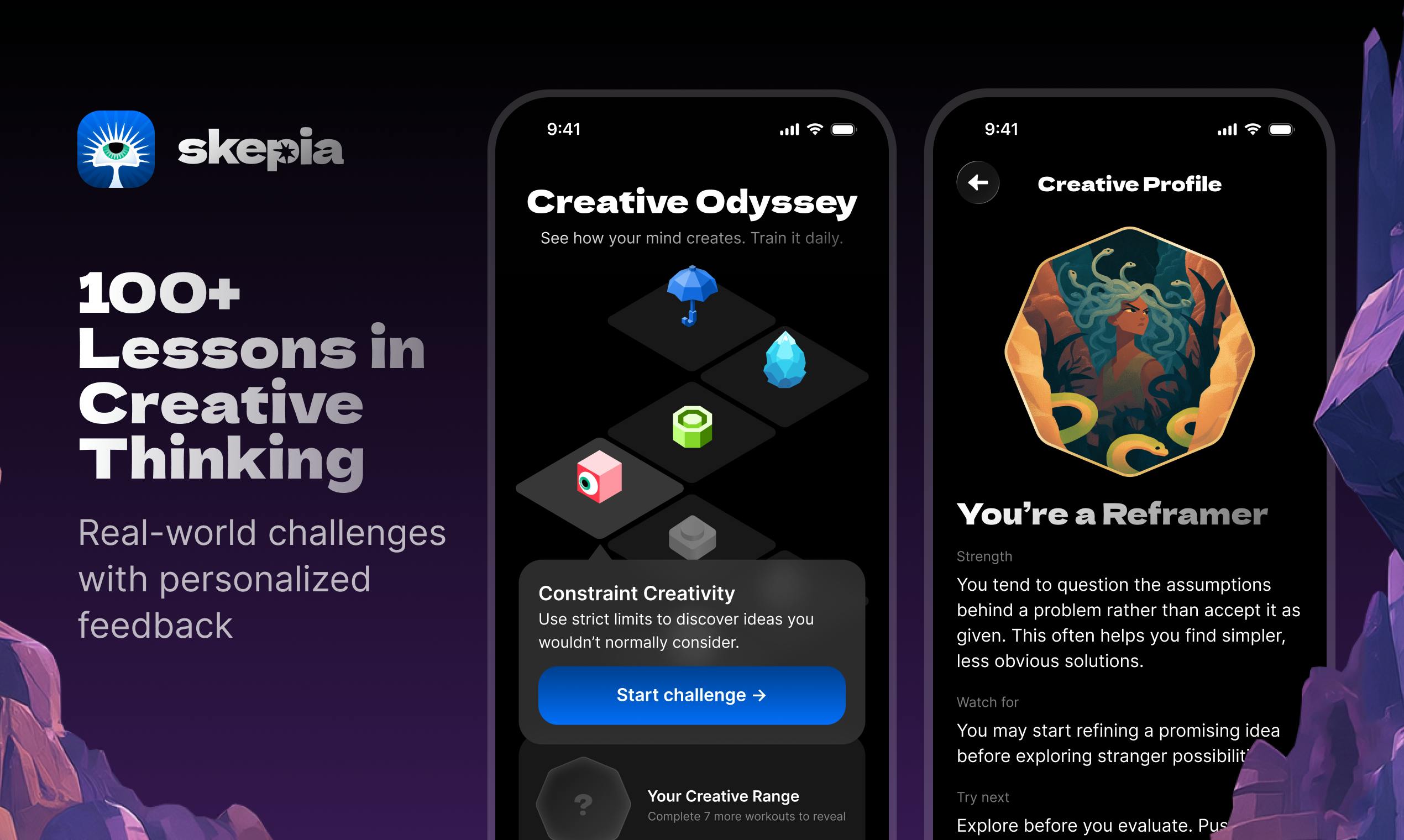
Skepia is a new "design-first mind fitness app" built on two parts: 100+ creative challenges based on SCAMPER and lateral thinking with personalized creativity-profile feedback, and beautifully packaged puzzle-style brain training for low-threshold daily opens. It assumes a clear mind enables creative output. Key concerns include a limited question bank, unclear feedback standards, and a small early Product Hunt sample.
Can creativity be trained like a muscle? Skepia, a new product on Product Hunt, is trying to answer that question. It positions itself as a "design-first mind fitness app," aiming to turn abstract creative thinking training into a lightweight habit users can stick to every day.
From Puzzles to Creative Thinking: Skepia's Product Logic
Skepia's core rests on two pillars. The first is creative challenges: it includes more than 100 prompts built on established creativity techniques such as SCAMPER and lateral thinking, and it gives personalized feedback based on user performance, gradually sketching out a "creativity profile." The second is brain training: it repackages common puzzle mechanics with an emphasis on being "hard enough to make you think, and fun enough to make you want to open it every day."
This combination is not a random mashup. Creative techniques address the methodological question of "how to come up with new ideas," while brain training targets underlying cognitive abilities such as attention and working memory. Skepia's hypothesis is that a clear mind is a prerequisite for creative output, and the two reinforce each other.
On Product Hunt, Skepia received 7 upvotes and 5 comments, ranking 19th for the day, under the tags Productivity, Puzzle Games, and Education. That result is not especially impressive on the highly competitive Product Hunt, but its positioning happens to hit a growing niche: turning mental health and cognitive training tools into everyday, productized experiences.
SCAMPER and Lateral Thinking: A New Vehicle for Old Methods
SCAMPER is a classic checklist for divergent thinking that uses seven angles—Substitute, Combine, Adapt, Modify, Put to other uses, Eliminate, and Reverse/Rearrange—to transform existing things. Lateral thinking emphasizes stepping outside linear reasoning and finding unexpected connections through analogy, random stimuli, and similar techniques. These methods have circulated for a long time in creative workshops and management training, but they have long remained in the form of pen-and-paper exercises or offline courses.
Skepia's value lies in moving these methods onto the phone and completing a daily practice in fragmented time. Personalized feedback is where it tries to differentiate itself from static question banks: users are not just answering questions, but also seeing which thinking dimensions they are stronger in and which patterns they use more often. If the feedback mechanism is nuanced enough, this "creativity profile" can itself become a motivation for continued use.
However, the effectiveness of a methodology does not equal the effectiveness of the product experience. Tools like SCAMPER often require team discussion and external stimuli in real creative scenarios. Whether a standalone app can reproduce that tension is a question Skepia needs to answer.
The seven letters of SCAMPER stand for: Substitute, Combine, Adapt, Modify, Put to other uses, Eliminate, and Reverse/Rearrange. It was organized into a checklist in 1971 by educator Bob Eberle based on Alex Osborn's brainstorming principles. In essence, it breaks divergent thinking into operational question templates, lowering the starting threshold when "you can't come up with ideas." Lateral thinking was proposed by Edward de Bono in 1967. In contrast to vertical thinking, which relies on logical deduction, it advocates actively creating cognitive leaps through random words, analogies, reverse assumptions, and other means, thereby bypassing existing thought patterns. Both are structured creative techniques. When there is no team collision, the value of an app lies in replacing on-the-spot inspiration with a fixed framework.
Design-First: Why a Productivity Tool Emphasizes "Beauty"
Skepia calls itself "design-first," which is uncommon among thinking-training products. Most brain-training apps lean toward data dashboards and progress bars, looking visually more like study tools than daily companions. Skepia's choice to make the puzzle section "beautiful" is clearly aimed at habit formation: the biggest enemy of brain-training products is not a lack of questions, but users not opening the app the next day.
Putting creativity and puzzle games in the same product also implies a user-path design: puzzles handle low-threshold daily opens, while creative challenges handle deeper value delivery. Whether this dual-engine structure can move users from games toward genuine thinking training depends on how naturally the two tracks connect.
Opportunities and Questions in the Creative Thinking Training Market
The brain-training category has experienced a wave of enthusiasm and also scientific skepticism. Skepia's differentiation is that it does not package itself as a tool to "raise IQ," but instead focuses on creativity—a more specific ability that is closer to workplace needs. If the creativity profile and personalized feedback can truly accumulate into a reviewable growth record, it will appeal to designers, product managers, content creators, and similar groups.
The questions are also obvious. A question bank of 100+ challenges is not ample for a product used daily, and the pace of content updates will determine its lifecycle. Whether the evaluation criteria behind personalized feedback are transparent and supported by research is also worth watching. In addition, as a newly launched product, its early traction on Product Hunt is limited, and the sample of community feedback is still small. Whether the product can build word of mouth in real use remains to be seen.
For people who want to try thinking training, Skepia represents a lighter, more beautiful, and more everyday path. Whether it can truly improve creativity will ultimately be determined by subjective experience and actual output after sustained use.
Scientific skepticism about brain training mainly comes from a series of research reviews around 2016. After conducting a meta-analysis of "brain training" products, a team at the University of Melbourne in Australia found that training effects were mostly limited to the tasks themselves and were difficult to transfer to untrained abilities or daily cognitive performance. A joint statement in 2014 by the Stanford Center on Longevity and the Max Planck Institute in Berlin also noted that universal improvement claims for commercial brain games lacked sufficient evidence. Such controversies have created a trust threshold for this category. By narrowing its goal from generalized "IQ improvement" to the specific ability of creativity, Skepia somewhat avoids the burden of proof around "cognitive transfer." But creativity assessment itself also lacks unified standards. If personalized feedback is to be taken seriously, it still needs to explain the source and validity of its evaluation dimensions.
One-line Summary
Skepia turns creative techniques such as SCAMPER into daily challenges plus puzzle training, trying to make creativity something users exercise every day like a muscle.
Paragraph Summary
Skepia is a new product positioned as a "design-first mind fitness app." Its core structure has two parts: first, 100+ creative challenges designed around established creative techniques such as SCAMPER and lateral thinking, with personalized creativity-profile feedback; second, beautifully packaged puzzle-style brain training that handles low-threshold daily opens. The product assumes that a clear mind is a prerequisite for creative output, and that the two reinforce each other. Its "design-first" orientation targets the retention problem common among brain-training products. The article also points out that a limited question bank, insufficient transparency and research support for feedback evaluation criteria, and a small early Product Hunt community sample are the main questions Skepia must face. Its real effect will ultimately depend on subjective experience and actual output after sustained use.
Related articles

No Coding Required: He Shipped an App Store App by 'Cutting Features' and Nitpicking with AI
A game designer with zero frontend/backend skills shipped a dual-platform App Store app with AI—not via one-click generation, but by cutting scope and nitpicking like a demanding client.

What Is Harness Engineering? From Concept Origins to Enterprise-Level Agent Implementation
What is Harness Engineering? This article traces the concept's origins and analyzes enterprise-level Agent requirements for tool call fault tolerance, data security, tenant isolation, and memory gaps.

Coze in Practice: A Three-Tier Agent Classification and a Multi-Agent Collaboration Guide
A Bilibili tutorial breaks down the multi-agent collaboration toolchain into three categories: building platforms like Coze Studio and Dify, Agent software like Claude Code, and development frameworks like LangChain—plus a Coze demo of industry templates, three-platform interoperability, local Agent integration, and the trade-offs of credit consumption.