Slack-to-RAG Incremental Sync Architecture Design: A Production-Ready Approach to Avoiding Duplicate and Stale Vectors

A production architecture for Slack-to-RAG sync that eliminates duplicate and stale vectors.
This article breaks down how to design a production-grade incremental sync pipeline from Slack to a RAG vector database. It covers key architectural decisions including raw data persistence before vectorization, event-driven sync with reconciliation fallback, hash-based change detection to minimize reprocessing, cascading deletions, and idempotent writes—all aimed at maintaining a clean, consistent vector store.
The Problem: Why Slack-to-RAG Sync Is So Hard
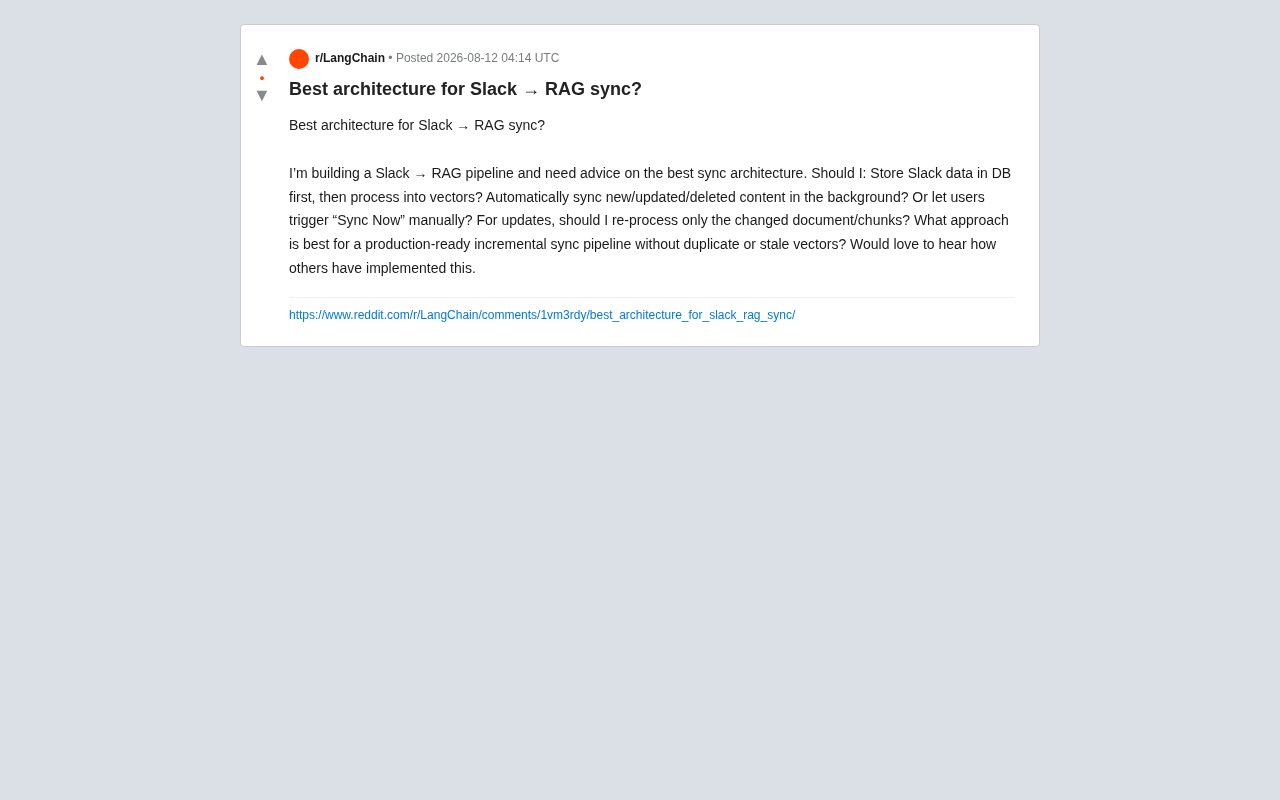
In Reddit's tech community, a developer raised a very specific yet highly representative engineering question: how do you build a production-grade RAG (Retrieval-Augmented Generation) sync pipeline for Slack data?
On the surface, ingesting Slack messages into a vector database seems straightforward—pull messages, chunk them, vectorize, and store. But once you enter production, things get tricky: messages get edited, deleted, and threads keep growing with new replies. If your sync strategy is poorly designed, your vector store will be flooded with duplicate vectors and stale vectors, directly contaminating retrieval quality and making RAG responses unreliable.
This developer raised several core decision points that happen to cover the key tradeoffs in this type of system design—worth a deep dive.
Three Core Architecture Decisions
Decision 1: Should You Persist Raw Data Before Vectorizing?
The original post asks: should you first store Slack data in a database, then process it into vectors?
In production scenarios, the answer is almost always yes—persist to a raw data store (source of truth) first, then vectorize asynchronously. Here's why:
- Rebuildability: Embedding models get upgraded, and chunking strategies get adjusted. If you only keep vectors and discard the original text, you can't reprocess historical data when you want to switch embedding models or adjust chunk sizes.
- Decoupling: Data ingestion and vectorization are processes with different throughput rates and failure modes. Once data is persisted, vectorization can run as an independent background task—retryable on failure without blocking data collection.
- Metadata management: Slack messages carry rich metadata (channel, author, timestamp, thread ID). Storing them in a structured format first makes downstream filtering and permission control much easier.
The typical approach: use a relational database or document store as the raw layer to hold the full Slack message history, with the vector store serving only as a derived retrieval index.
Decision 2: Automatic Background Sync or Manual Trigger?
The original post presents two options: automatically sync new/updated/deleted content in the background, or let users manually click "Sync Now"?
For production systems, automatic background sync is the primary approach, with manual triggers as a supplement.
Slack provides an Events API that lets you subscribe to message, message_changed, message_deleted, and other events for near-real-time incremental capture. This is more efficient and timely than polling. A manual "Sync Now" button is better suited as a fallback—for initial full imports, reconciliation after event loss, or forced refreshes during debugging.
The recommended hybrid sync pattern in practice:
- Initial full sync: Batch-pull historical messages when first connecting.
- Real-time incremental sync: Capture subsequent changes via the Events API.
- Periodic reconciliation: Use low-frequency full scans (e.g., daily) to fix inconsistencies caused by missed events.
The Key to Incremental Updates: Only Process Changed Chunks
The last question in the original post is the most technically demanding: during updates, should you only reprocess the changed documents/chunks?
This is the core of avoiding duplicate and stale vectors. To achieve this, you need a robust content-addressable versioning mechanism.
Stable ID Mapping
Every Slack message has a unique timestamp ID (ts). Use it as the stable document identifier to establish a slack_ts → chunk_ids → vector_ids mapping. This way, when a message is edited, you can precisely locate all its corresponding chunks.
Hash-Based Change Detection
Compute a hash (e.g., SHA-256) for each chunk's text content. When a message is updated:
- Re-chunk the content and compute hashes for the new chunks.
- Compare against old chunk hashes: skip chunks whose content hasn't changed, and only re-vectorize new or modified chunks.
- Delete vectors corresponding to old chunks that no longer exist.
This "content-addressable" strategy minimizes vectorization costs and fundamentally eliminates duplicate vectors.
Cascading Deletion
When you receive a message_deleted event, or discover during reconciliation that a message has disappeared from the raw store, you must cascade-delete all associated vectors in the vector store. This depends on the ID mapping established earlier—without this mapping layer, deletions are nearly impossible to execute precisely, and stale vectors will persist and contaminate search results.
A Production-Ready Reference Architecture
Putting it all together, a production-grade Slack-to-RAG incremental sync pipeline can be organized as follows:
Slack Events API
      ↓
Event Queue (Kafka/SQS)
      ↓
Ingestion Service → Raw Database (source of truth: ts, content, metadata, content hash)
      ↓
Vectorization Worker (async)
   ├─ Change detection (hash comparison)
   ├─ Only process new/changed chunks
   ├─ Upsert to vector store
   └─ Delete stale vectors
      ↓
Vector Database (Pinecone/Weaviate/pgvector, etc.)
Introducing an event queue is a critical design choice—it smooths out bursty Slack events, letting vectorization workers consume at their own pace while naturally supporting failure retries and idempotent processing.
Idempotent Writes Are Non-Negotiable
In distributed systems, the same event may be delivered multiple times. Vector store writes must be idempotent—use a combination of the message ts and chunk hash as the vector ID, paired with upsert semantics. Even if the same event is processed repeatedly, the result stays consistent with no duplicate vectors.
Summary and Recommendations
Returning to the original post's core goal—how to build a production-grade incremental sync pipeline free of duplicate and stale vectors—here are the guiding principles:
- Separate raw data from vectors: Persist original text as the single source of truth; the vector store is merely a rebuildable derived index.
- Event-driven first, reconciliation as fallback: Use Slack's Events API for near-real-time incremental sync, supplemented by periodic full reconciliation to fix missed events.
- Content-addressable incremental updates: Use hash-based detection to only process truly changed chunks, and cascade-delete vectors on removal.
- Async decoupling with idempotent writes: Use queues to decouple ingestion from vectorization, and use stable IDs to guarantee write idempotency.
This pattern isn't limited to Slack—it applies universally to Notion, Confluence, Google Docs, and any other data source that needs continuous sync to RAG. The engineering complexity is never about "getting data in"—it's about "keeping things consistent when data changes." That's the real moat in productionizing RAG.
Related articles

Bilibili's Hit Dify Tutorial: A Practical Guide to Building 20+ AI Apps from Scratch
A distilled guide to Bilibili's top-rated Dify tutorial: Windows + Docker deployment, MySQL connection, five app types, model integration strategy, and publishing.

Agent Skills Beginner's Guide: From Concepts to Multi-Agent Collaboration in Practice
A comprehensive guide to Agent Skills: core concepts, components, the importance of Description, standardization, beginner learning paths, and multi-agent collaboration.

One Neuron Detects Both Cats and Cars? We Reproduced It and Found a New Explanation
The cat-car neuron reinterpreted: researcher Cammarata argues it distinguishes pointy from round, not cats from cars. We reproduced the experiment and found the new explanation holds on most inputs—but cars are the exception. The interpretability debate continues on language models.