Snag by Parallel: Turn AI Conversations into Shopping Price-Comparison Lists
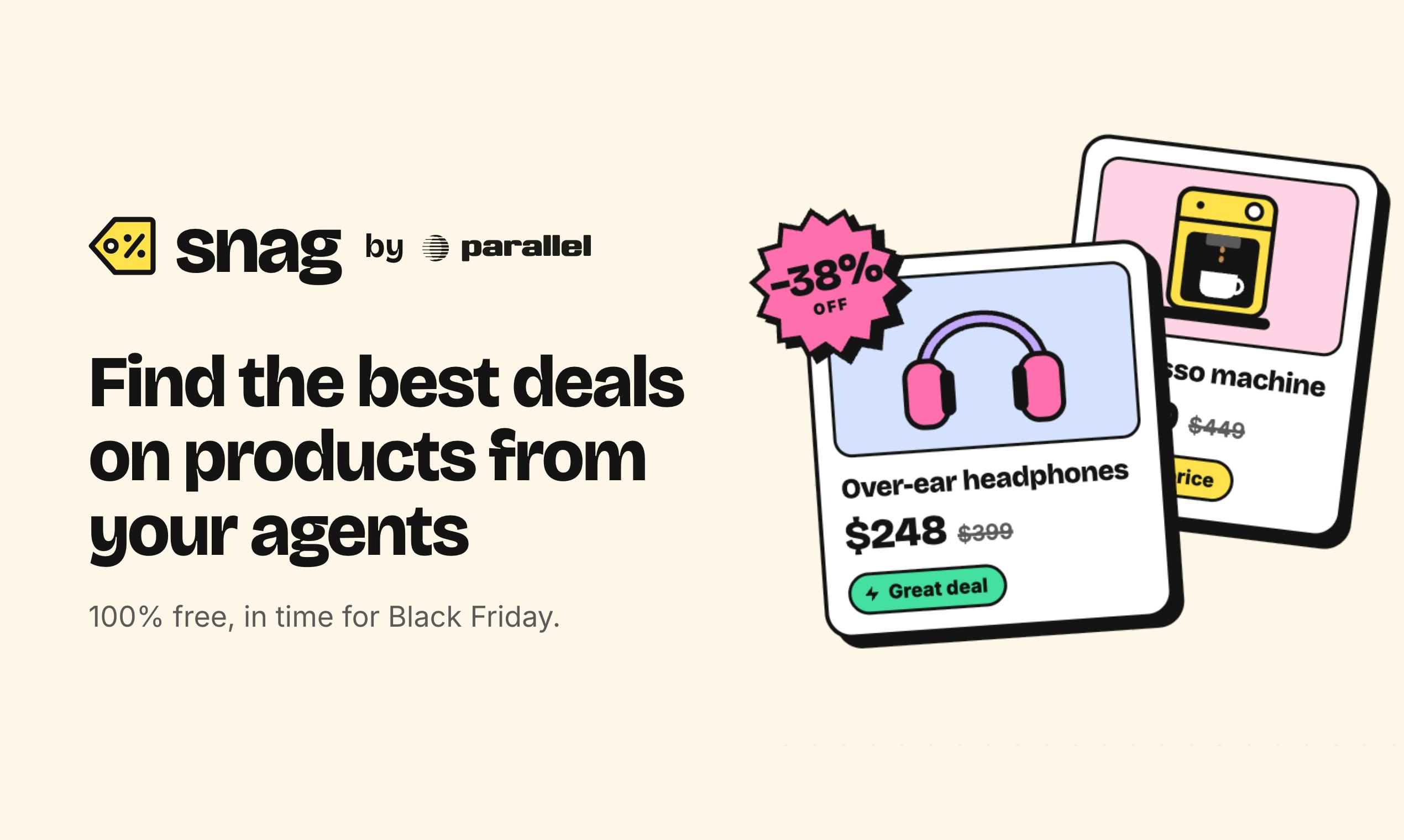
Snag by Parallel turns AI conversations into price-comparison shopping lists, launching free for Black Friday.
Snag by Parallel is a free tool that converts conversations with AI assistants like ChatGPT and Claude into structured shopping lists, automatically matching products and comparing prices across stores. Lists are sorted by best deal, with each price scored against its original price, and can be shared via link. Powered by the Parallel Shopping API and Images API, it launched before Black Friday to target the gap between AI purchase advice and actual buying. Its edge is extracting needs directly from conversation context, but product-matching accuracy, price coverage, and data privacy details remain unclear, and it faces competition from established tools like Google Shopping.
On Product Hunt, a free tool called Snag by Parallel has drawn attention, reaching No. 3 on the day's leaderboard with 105 votes. The product solves an everyday pain point: after you ask ChatGPT, Claude, or another AI assistant for product recommendations, how do you quickly find the best price? Snag's answer is to turn the conversation into a one-click importable shopping list that automatically matches products and compares prices across stores.
From conversation to list: how Snag works
Snag's core idea is straightforward. Conversations with AI often contain specific product names, model numbers, or vague requirements, and Snag extracts this information to generate a structured wishlist. After a one-click import, the system matches each entry to a precise product and checks prices across multiple stores.
According to the Product Hunt page, the list is sorted by "best deal," with each price scored against its original price. Lists can also be shared via link so friends can take a look. The entire tool is 100% free, and it launched just before Black Friday.
Snag's capabilities are powered by the Parallel Shopping API and Parallel Images API. The former handles product matching and price comparison, while the latter may be used for product image recognition or display. These two APIs mean Snag is not a simple scraper but a shopping search tool backed by an underlying data service.
Parallel API is a set of developer interfaces provided by Parallel, designed to connect large language model capabilities with external data and services. The Shopping API focuses on product search, matching, and price comparison, capable of locating specific products across multiple retail channels based on text descriptions and retrieving real-time prices; the Images API may involve image recognition, product image matching, or visual search. Such APIs typically use a pay-per-call business model, but as a free tool, Snag's costs may be subsidized by Parallel itself or serve as an API demo case. For end users, this means Snag's price-comparison capabilities are directly limited by the API's data coverage and update frequency.
Why this tool is worth noting
AI assistants can already help users generate shopping suggestions, but between "suggestion" and "checkout" there remain multiple steps: comparing prices, choosing stores, finding coupons, and more. Snag targets precisely this conversion gap.
Most price-comparison tools on the market today rely on users manually entering product names or on browser extensions triggered on specific e-commerce pages. Snag's difference is that it starts directly from the conversation context, eliminating the step of reorganizing requirements. For users accustomed to using AI for purchasing decisions, this reduces the friction of switching from a chat window to a shopping platform.
However, this model also depends on users being willing to import conversation content. Snag claims to be 100% free, but the Product Hunt page does not explain its specific data privacy practices, such as whether conversation content is stored and how interactions with third-party APIs are handled. This may be something potential users need to look into further.
Browser extension price-comparison tools (such as Honey and CamelCamelCamel) typically work after the user has already entered an e-commerce product page, querying historical prices and applying coupon codes by identifying product information or ASIN codes on the page. Snag's entry point is earlier: it intervenes when a shopping intent arises in a user's AI conversation, converting unstructured conversation text into a structured list. This difference is similar to the distinction between "compare prices after searching" and "compare prices at the moment of decision." However, intervening earlier also means Snag needs to handle vaguer input (such as "a coffee machine suitable for a small apartment"), placing higher demands on the semantic understanding capability of its product-matching algorithm.
Positioning in the Black Friday context
Snag's launch timing clearly points to Black Friday, the most important promotional event of the year in Western retail markets. When a large number of products are discounted simultaneously, comparing prices one by one is very time-consuming. Snag's "sort by best deal" and "price scored against original price" features serve exactly this scenario.
From a product design perspective, Snag's shareable lists also carry a social element. Users can send list links to friends, which to some extent lowers the barrier to sharing. For a free tool, this sharing mechanism may help attract early users.
Black Friday is a promotional season that begins on the fourth Friday of November each year. It originated in the United States and has now become an important event for the retail industry in many countries around the world. During this period, retailers generally offer substantial discounts, but prices fluctuate frequently and inventory changes quickly, leaving consumers facing information overload. The core value of price-comparison tools in this scenario is not only finding the lowest price but also judging whether a discount is genuine (by comparing against historical prices) and checking inventory availability. If Snag's "price scored against original price" feature could be combined with historical price data, it would more effectively help users identify fake discounts, but the article does not clarify whether it has historical price tracking capability.
Potential limitations and points to watch
Currently, public information about Snag is limited. The Product Hunt page has only 3 comments, and its rating and vote count (105 votes) indicate it has gained initial attention but are not enough to judge the long-term user experience. The accuracy of product matching, the range of stores covered for pricing, and the stability of API calls are all key indicators affecting its practicality.
In addition, Snag relies on Parallel's API services. If the underlying API coverage is incomplete or some products cannot be precisely matched, the list's usefulness will be compromised. The product page claims it "matches every entry to a precise product," but in practice this is often affected by factors such as differences in product naming and model variants.
From a competitive standpoint, Snag faces established tools such as Google Shopping, Honey, and CamelCamelCamel. Its advantage lies in integration with AI conversations rather than the price-comparison function itself. Whether this entry point is enough to create differentiation still requires observing user retention.
Conclusion
Snag by Parallel is a small tool with a clear positioning: turning shopping intent in AI conversations into actionable price-comparison lists. It captures a new demand arising from the spread of AI assistants, using a free strategy and the Black Friday time window to attract users. For people who frequently use ChatGPT or Claude to find product recommendations, Snag offers a shortcut from conversation to purchase. However, product-matching accuracy and data privacy details still need to be verified through more user feedback.
One-line Summary
Snag by Parallel turns AI conversations into price-comparison shopping lists, launching free for Black Friday.
Paragraph Summary
Snag by Parallel is a free tool that turns users' conversations with AI assistants such as ChatGPT and Claude into structured shopping lists, automatically matching products and comparing prices across stores. Lists are sorted by best deal, with each price scored against its original price, and can be shared via link. Powered by the Parallel Shopping API and Images API, the tool launched just before Black Friday, targeting the conversion gap between AI purchase advice and actual buying. Its advantage is extracting requirements directly from conversation context, saving the step of manual organization. However, product-matching accuracy, price coverage, and data privacy details remain unclear, and it faces competition from established tools such as Google Shopping.
Related articles

Pure-Code Video Generation Tested: Which AI Model Actually Follows Instructions?
A Bilibili creator tested three AI models' pure-code video generation with unified prompts and three revisions each: Xiaonaomao has a high ceiling but lacks stability, GPT 6.2 Extra models well but only follows half the instructions, and OPAS 5.5 remains the benchmark.

GPT-6 Six-Tier Hands-On Test: Astra Ultra Dominates but Bills Double
GPT-6 six-tier test: Astra Ultra sweeps 3:0 in 3D tasks thanks to sub-agents and runs 14% faster, but hidden backend bills make its real cost 2.6x single-threaded.

GPT-6.2 Astra vs Fable 5.2: Huge Cost-Efficiency Gap Across 12 Real-World Tests
Bilibili creator tests GPT-6.2 Astra vs Fable 5.2 across 12 real tasks: Fable wins 7-5 but costs 7.2x more and takes nearly 5x longer. Token efficiency emerges as the key selection metric.