Snap Pushes Its $2,200 Smart Glasses Again — Can It Convince the Market?
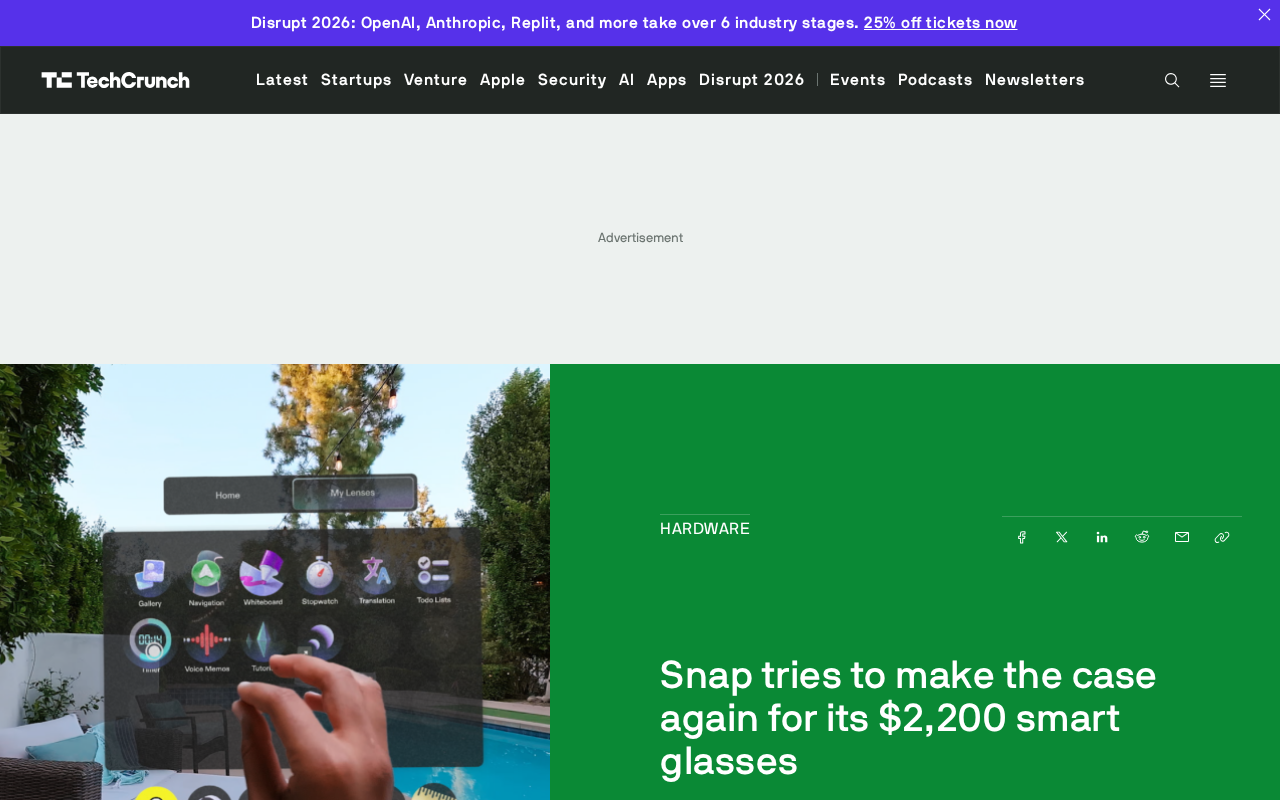
Snap updates its $2,200 AR glasses, betting on the long-term potential of smart eyewear as the next computing platform.
Snap unveiled new features for its $2,200 smart glasses this week, doubling down on the value proposition of its high-end device. The steep price keeps it squarely in developer and early-adopter territory for now. While Meta Ray-Ban targets the mass market at around $300 with camera and audio features, Snap is taking a different route with full AR display capabilities — two very distinct product philosophies. For Snap, the glasses business is ultimately a long-term strategic bet: nurturing a developer ecosystem and building technical expertise to pave the way for a future affordable mass-market version. The move reflects a broader industry conviction that AR glasses could become the next computing platform, with Apple, Meta, and Snap all racing to secure their position in a market that remains nascent but holds enormous potential.
Snap's Smart Glasses Ambitions
Snap unveiled a series of new features for its smart glasses this week, making another attempt to prove that the $2,200 device is worth the attention. As an early player in the consumer AR/smart glasses space, Snap has long sought to extend the AR filters and social experiences it built on Snapchat into wearable hardware.
Yet the $2,200 price tag means this product is currently aimed primarily at developers and early adopters, not everyday consumers. That's well above the mainstream smart glasses products on the market today, which inherently limits its audience.
The Positioning Dilemma Behind the High Price
Competition in the smart glasses space has intensified in recent years. Meta's Ray-Ban line has gained traction with a more accessible price point and features like a camera and audio playback, while Snap is trying to carve out its niche with a more complete AR experience. The core tension is that there's always a gap between AR glasses' practical utility and their cost — high performance means high prices, and consumers are extremely price-sensitive when it comes to wearables.
Snap is betting on continuous feature updates to reinforce its product value proposition — both to retain its existing developer ecosystem and to lay the groundwork for a more affordable mass-market version down the road. For a company still figuring out its hardware monetization model, the glasses business looks more like a long-term strategic bet than a near-term revenue tool.
Meta Ray-Ban smart glasses and Snap glasses represent two fundamentally different product philosophies in today's smart glasses market. The Meta Ray-Ban is priced around $300 and focuses on photography, hands-free calling, and music playback — with no built-in display, it's essentially "earbuds that can take photos." Snap's glasses, by contrast, feature waveguide optical display modules capable of overlaying digital images onto the real world, enabling genuine augmented reality (AR) interaction. Waveguide display technology sits at the heart of the trade-off between form factor and optical performance in AR glasses — it requires coupling light at precise angles into the lens and directing it to the eye, a manufacturing process that is complex, has low yields, and directly drives up hardware costs. This is precisely why any glasses with true AR display capabilities are currently difficult to price below the four-figure range.
An Industry Signal Worth Watching
Regardless of whether the product ultimately succeeds, Snap's persistence reflects the broader tech industry's continued bet on AR glasses as the "next computing platform." From Apple to Meta to Snap, major players are all racing to stake a claim in this market — immature today, but brimming with potential.
For everyday users, the $2,200 Snap glasses aren't a realistic purchase option right now, but the evolution of its features is worth tracking — it may well preview the interaction and AR capabilities that affordable smart glasses will carry in the future.
The concept of a "next computing platform" holds that smart glasses have the potential to replace or supplement smartphones as the primary interface between humans and machines — users wouldn't need to look down at a screen; information would appear directly in their field of view, with voice and gesture completing the interaction. This vision was first tested by Google Glass in 2013, but it failed due to privacy concerns, poor battery life, and high prices. Over the following decade, sustained advances in chip performance, battery energy density, optical displays, and AI rekindled the industry's confidence. The wave of entrants — Apple Vision Pro, the Meta Quest lineup, and a host of AR glasses — are all fundamentally jockeying for position in this time window. Whoever builds a developer ecosystem and establishes user habits first may dominate when the platform matures. Snap's AR filter developer community on Snapchat is one of the few genuinely differentiated assets it brings to this race.
Related articles

The Return of Wind Power: How Cargo Ships Are Embracing Wind Energy to Cut Emissions
Why are cargo ships embracing wind power again? Explore rotor sails, hard wing sails, and other modern wind-assisted technologies driving shipping's emission-cutting comeback.
Scarier Than AI Agents Taking Over the Internet: A CEO Cartel Monopolizing AI
A Hacker News piece argues that a CEO cartel monopolizing AI is scarier than agents taking over the internet. This article examines AI concentration, open source, and governance.

Vercel AI SDK Alibaba Adapter Update: Multi-Turn Conversations Now Preserve Reasoning Chain by Default
Vercel AI SDK's @ai-sdk/alibaba adapter v0.0.28 now preserves reasoning chain by default in multi-turn conversations on supported models, improving coherence.