Sol 6.1 Priced at One-Fifth of Astra, 95% Cache Read Discount

A tweet says Sol 6.1 costs one-fifth of Astra with a 95% cache discount, but capability claims are unverified.
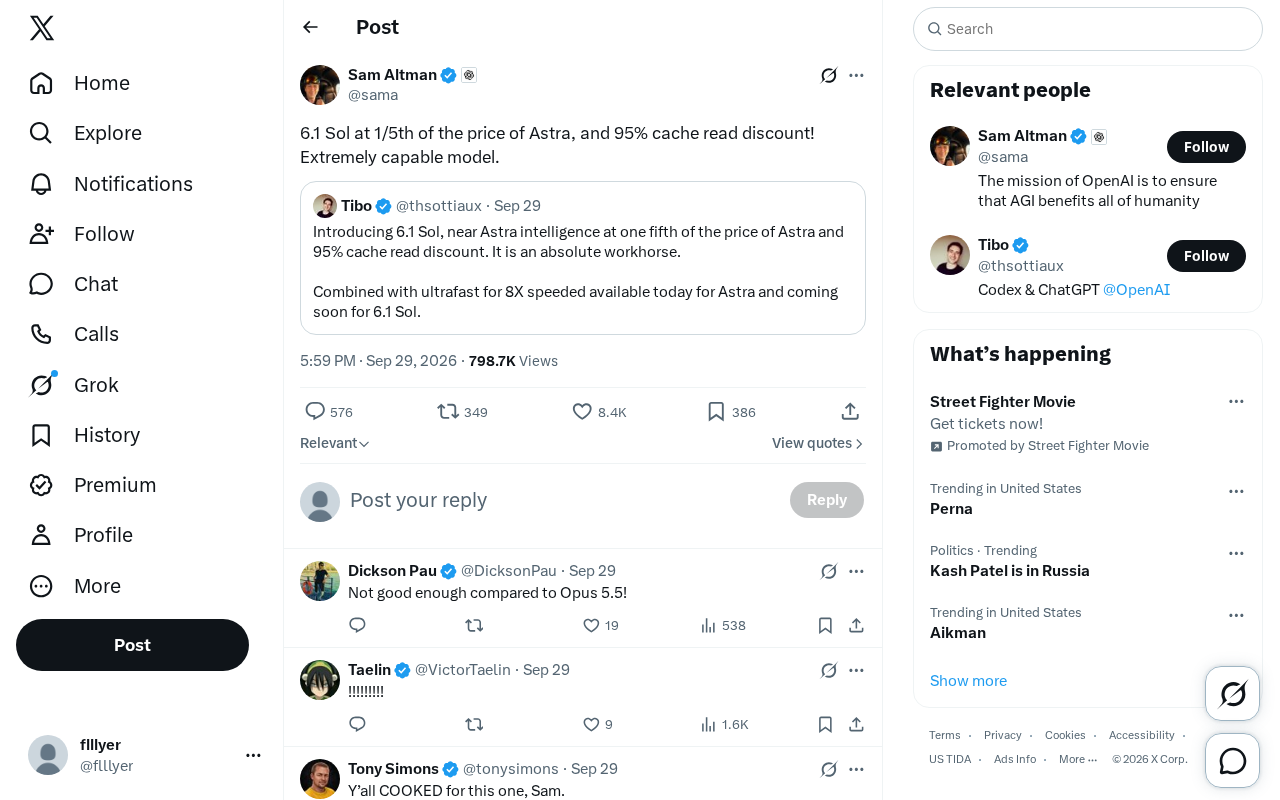
A Twitter tweet claims Sol 6.1 offers a 95% cache read discount at one-fifth of Astra's price and is called an "extremely capable model." The article interprets this in three ways: the price benchmark suggests inference costs could drop to 20%, but input/output and absolute pricing are unspecified; the 95% cache discount may matter more for long-context apps since cache-hit input uses almost no compute; and "extremely capable" lacks benchmark support as a single-source subjective claim. Overall, the information is useful for cost-sensitive and long-context projects but needs official documentation and independent evaluation, as competition shifts from "who is stronger" to "who is stronger and cheaper."
Recently, a short tweet from Twitter caught the attention of the AI developer community: 6.1 Sol is priced at just one-fifth of Astra, while offering up to a 95% cache read discount, with the poster calling it an "extremely capable model."
Though this information amounts to just a single sentence, it condenses three key signals in today's large model API market competition—price wars, cache economics, and word-of-mouth about model capabilities.
Price Benchmarking: What One-Fifth Means
"1/5th of the price" is a striking figure. In the large model API space, pricing is typically calculated per million tokens for input and output separately. If Sol 6.1's pricing really is only 20% of Astra's, that means developers can compress inference costs to one-fifth of the original for the same call volume.
For teams that need to call models at scale, this is a gap large enough to change technology choices. Over the past year, we've seen multiple vendors compete for developer share through aggressive pricing, and a magnitude of "one-fifth" goes beyond routine price adjustments—it looks more like a targeted strike against a specific competitor.
It's worth noting that the tweet doesn't specify whether this price comparison is based on input tokens or output tokens, nor does it give absolute price figures. So this can only be understood as a directional signal; actual costs need to be confirmed against official pricing pages.
Tokens and pricing methods: In large model APIs, a token is the basic unit of text measurement, roughly equivalent to 0.75 English words or 1–2 Chinese characters. Vendors typically price input tokens (prompts and context sent by users) and output tokens (content generated by the model) separately, with output prices often several times those of input. Therefore, when a tweet only says "one-fifth the price" without specifying input or output, the actual cost difference may be significantly amplified or diminished: if the discount applies only to input while output pricing stays flat, then for tasks with a high output ratio, the total cost reduction will be far less than 80%. When evaluating, developers should combine their own load's input/output ratio and compare using weighted effective unit prices rather than directly applying a single discount figure.
95% Cache Read Discount: An Underestimated Cost Lever
Even more noteworthy than the price itself is the 95% cache read discount.
In large model API usage scenarios, many requests carry the same context repeatedly—such as fixed system prompts, long documents, code repository summaries, etc. Caching mechanisms allow the server to reuse this already-computed KV cache, greatly reducing computational overhead. Vendors pass these savings on to users, creating a "cache read discount."
A 95% discount means: if most of the input in a request hits the cache, the actual billing may be only a fraction of the original price. For developers building long-context applications (such as code assistants, document Q&A, and agent workflows), this discount may have an even greater impact than the base price difference.
In other words, Sol 6.1's selling point isn't just "cheap"—it's "extremely cheap under specific workloads."
How KV cache works: When a Transformer model generates each token, it needs to compute the key (Key) and value (Value) vectors for all previous tokens; these tensors together form the KV cache. For multi-turn conversations or long-document Q&A, if the KV for the entire context is recalculated on every request, compute overhead grows quadratically with context length. Caching mechanisms work by identifying identical prefixes across requests (such as fixed system prompts) and directly reusing the already-computed KV cache, skipping redundant computation. Vendors offer discounts on cache-hit portions because these consume almost no additional GPU compute. A 95% discount essentially encourages developers to place stable, reusable context at the front of requests to maximize cache hit rates—which also means the ordering of prompts directly affects the actual bill.
"Extremely capable": Capability Claims Still Need Verification
The tweet uses "extremely capable model" to describe Sol 6.1, but this is a subjective statement with no accompanying benchmark data or specific cases.
When it comes to evaluating model capabilities, a single social media comment has limited reference value. True capability judgments need to rely on standardized evaluation leaderboards, independent third-party comparison tests, and actual feedback from the developer community. The information provided by this tweet can only serve as a lead to be verified.
However, the poster's willingness to publicly benchmark Sol 6.1 directly against Astra at least suggests that, in their experience, the two are in the same comparable tier—otherwise the price comparison would lose its meaning.
Practical Implications for Developers
Taken together, the information in this tweet has different value for different types of developers:
- Cost-sensitive projects: If Sol 6.1's actual pricing and cache discount hold up, it could become the preferred option for high-concurrency scenarios.
- Long-context applications: The 95% cache discount is most attractive for this type of workload and is worth testing first.
- Capability-first projects: In the absence of independent evaluations, it's advisable to run small-scale comparison tests before deciding whether to migrate.
It should be noted that the source of this article is only a single Twitter tweet, without multi-source cross-verification. Regarding Sol 6.1's specific pricing, caching mechanism details, and actual capability performance, it's best to consult official documentation and independent evaluations before making a judgment.
Competition in the model market is shifting from "who is stronger" to "who is stronger and cheaper," and refined pricing strategies like cache discounts may become an important battleground in the next phase of competition.
Additional Background
Common benchmarks for model capability evaluation: To judge whether a model is "extremely capable," the industry usually refers to several types of standardized evaluations: MMLU (massive multitask language understanding), HumanEval (code generation), GSM8K (mathematical reasoning), and the LMSYS Chatbot Arena human preference rankings. These benchmarks each have different emphases, and a single score cannot fully reflect a model's performance in real-world scenarios. In addition, independent third-party tests (such as Artificial Analysis's inference cost-quality scatter plot) combine speed, price, and quality, making them more informative than a single tweet. Before such data is available, "extremely powerful" can only be viewed as a subjective word-of-mouth signal, and its credibility depends on the poster's use case and professional background; it should not be used directly as a basis for technology selection.
One-line Summary
A tweet claims Sol 6.1 is priced at one-fifth of Astra and offers a 95% cache discount, but capability claims lack verification.
Paragraph Summary
A Twitter tweet claims Sol 6.1 offers a 95% cache read discount at one-fifth of Astra's price and is described as an "extremely capable model." The article interprets this from three angles: the price benchmark implies inference costs may be compressed to 20%, but it doesn't specify input/output or absolute pricing; the 95% cache discount may have a greater impact on long-context applications than the base price gap, because cache-hit input consumes almost no compute; "extremely capable" lacks benchmark support and is a single-source subjective judgment. Overall, this information has reference value for cost-sensitive and long-context projects, but requires official documentation and independent evaluation for verification, as model competition shifts from "who is stronger" to "who is stronger and cheaper."
Related articles

Cursor AI Programming in Practice: Build a Student Management System from Scratch in 30 Minutes
A Bilibili creator demonstrates Cursor AI programming: generating a student management system in 30 minutes with natural language. Details on Agent mode, Claude selection, prompt techniques, and thresholds.

Top 20 AI Coding Tools Ranking: From Rock-Solid to Lackluster, a Scored Matrix
Bilibili creator releases top 20 AI coding tools ranking, tiered T0–T4 from rock-solid to lackluster, with Claude Code and Codex tied at T0. This article details the scoring dimensions (capability, reliability, robustness, durability, cost, domestic availability) and tool performances to help developers choose the right AI coding assistant.

Vibe Coding Systematic Tutorial: Master AI-Assisted Programming from Zero
A three-month Vibe Coding tutorial from a Bilibili creator covering Codex, ClaudeCode, and Cursor, from core logic to commercial project practice for beginners.