Solo Developer Builds MMO 'Gable Guardians': Solana On-Chain Mechanics Genuinely Implemented

A Solana MMO built by a solo developer with AI: technically solid, but the token market is extremely thin.
Gable Guardians is a browser/mobile MMORPG built by a single developer with AI tools since December 2025. It's live on Web, Solana Seeker, PlaySolana PSG1, and Android, with a level cap of 100 planned to expand to 1,000. Its differentiation isn't token narrative but wiring real Solana on-chain primitives into gameplay: MagicBlock VRF settles combat rolls and drops, Ephemeral Rollups handle PvP and dungeons, and Metaplex Bubblegum/Core turn character equipment into NFTs. The $GABLE token is explicitly positioned as a consumable currency using SOL pricing and GABLE payment; a September economic update reduced GABLE's drop share to ease sell pressure. The core concern is the extremely thin market: a market cap of about $23,000 and single-pool liquidity of about $11,800, with whether output and consumption can balance still an open question.
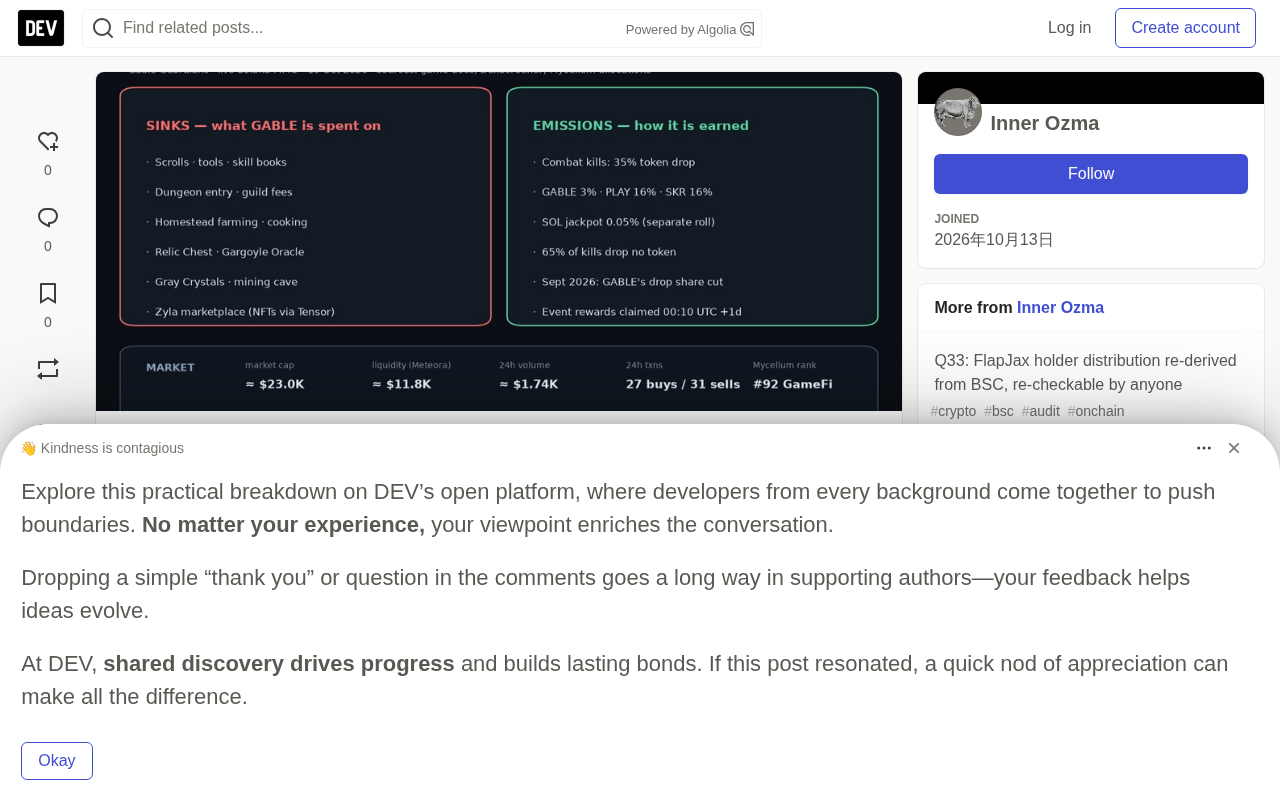
Most GameFi projects start with a token and then go looking for a game to wrap around it. Gable Guardians takes the opposite path: it's a game that already works, and the token is part of the economy rather than the reason the project exists. This browser/mobile MMORPG, built by a single developer with the help of AI tools, genuinely wires Solana's verifiable randomness, Ephemeral Rollups, and compressed NFTs into the gameplay.
One Person + AI Tools Built a Playable MMO
According to the project documentation (last updated October 12, 2026), development began on December 12, 2025. The project is under active development, with a level cap of 100 that's planned to expand to 1,000. The game includes typical MMO content—gargoyles, elemental cities, dungeons, guild wars, and PvP—and runs on Web, Solana Seeker, PlaySolana PSG1, and Android.
Players log in through an external Solana wallet (Phantom, Solflare, Backpack, MetaMask, Ronin) or through Privy, which assigns a standard Solana address. The core gameplay loop is already in place: character leveling, weapon forging and upgrades, skills, quests, a player-to-player trading system, guilds, altar transformations at level 35, and an ongoing seasonal event—Morwen's Samhain Pact (October 1–31), with pact tiers priced in $GABLE at roughly $1/$5/$10 equivalents.
A single developer completing a project of this scope with AI tools is itself a noteworthy product experiment. It shows that with AI assistance, small teams—or even individuals—can now build the skeleton of an MMO and keep it running.
Token Design: Honest Positioning as a "Consumable Currency"
$GABLE (mint address 9uTekAxmx4rqBcR3iGkKmaBwVWMmi7TXEU41frBdBAGS) is the game's consumable currency. All costs are priced in SOL and paid in GABLE at a live price feed, so the SOL value of a purchase stays stable—only the token amount changes. It's used to buy scrolls, tools, dungeon tickets, guilds, Homestead, Relic Chests, Gray Crystals, mines, and market services. In addition, PLAY, SKR, and the gold-backed RWA token GOLD form a secondary currency system.
The output side comes from combat. Each kill has a 35% total token drop chance, distributed across three tokens (GABLE 3%, PLAY 16%, SKR 16%), plus a separate 0.05% SOL jackpot. An September 2026 economic update reduced GABLE's share of drops, which was interpreted as a deliberate move to lower sell pressure from pure grinding—an admission that the previous output rate exceeded demand.
The "SOL pricing, GABLE payment" design stabilizes player costs while exposing game revenue to a token price it can't control.
"SOL pricing, GABLE payment" is a dual-currency pricing mechanism: goods are priced in SOL, and at settlement the price is converted to the corresponding amount of GABLE at the live exchange rate. For players, the real-world fiat-equivalent cost stays stable and doesn't rise just because GABLE crashes; for the project, revenue denominated in SOL means that if GABLE's price falls, the same SOL revenue requires selling more GABLE to cover—effectively shifting token price risk onto the project side. This design is common in projects that want to downplay a token's speculative nature and reinforce its role as "in-game currency," but it also makes token demand more dependent on actual consumption than on willingness to hold.
The Engineering Implementation Is the Real Highlight
The Solana program 5noZYmNbF6Y9btiFijLtacZTdLTNCoZ5yfbPKamHzTqA coordinates game state and VRF. MagicBlock VRF settles combat rolls, enemy drops, and forging and upgrade results—with one VRF seed shared per 50 kills—making loot outcomes verifiable rather than decided by a server. Ephemeral Rollups handle fast PvP and dungeon sessions; items are real NFTs: characters, weapons, armor, and skills use Metaplex Bubblegum compressed NFTs, while high-end altar gargoyles use Metaplex Core. Sales are listed to Tensor through Zyla's in-game marketplace.
The combination of verifiable randomness, Rollups, and compressed NFTs isn't a whitepaper fantasy—it's wired into a game people actually play. For anyone following Solana gaming infrastructure, this is a reference example of real-world implementation.
Ephemeral Rollups are a scaling solution in the Solana ecosystem introduced by MagicBlock. The idea is to temporarily spin up a dedicated execution environment outside the main chain for a specific application: state changes during a session are processed at high speed on the Rollup layer, and the final results are committed back to the Solana mainnet at settlement. For games, the value lies in bypassing main-chain block production and confirmation delays, so scenarios requiring millisecond-level responsiveness—PvP battles, dungeons—aren't slowed down by on-chain congestion, while retaining the main chain's final settlement and verifiability. The cost is additional trust and operational assumptions—the Rollup operator must guarantee availability during the session, and player assets are in a "temporary" state during the session.
Compressed NFTs (cNFTs) are a technology on Solana for reducing NFT issuance costs. Using state compression and Merkle trees, the metadata of large numbers of NFTs is attested in batches as hashes, with only the root hash kept on-chain and the full data stored off-chain with indexers. The per-item cost can drop from about 0.01 SOL for a regular NFT to one ten-thousandth of that, making it suitable for high-frequency, low-unit-price items like the thousands of weapons, armor, and skills in a game. Metaplex Bubblegum is the standard implementation of this approach, while Metaplex Core is the next-generation standard for high-value single assets.
Verifiable Random Function (VRF) is a cryptographic primitive: it generates a random output along with a proof that anyone can independently verify, proving that the output was indeed computed by a specified key pair on a given input and couldn't be manipulated or predicted after the fact. In on-chain games, this solves the trust problem of "the server secretly changing drops"—loot roll results can be publicly audited. Gable Guardians uses one VRF seed per 50 kills, a batched submission approach used to amortize the cost and latency of each on-chain randomness request, at the cost of results within the same batch being finalized once the seed is determined. MagicBlock provides a VRF service for Solana, so developers can integrate it without building their own oracle.
Reasons for Optimism and Real Risks
The upside: A determined developer, a genuinely launched game, and real on-chain primitives—this combination is rarer than any token. GABLE also appears on Mycelium Strategy's live allocation page, listed as a GameFi allocation. That page has a $200,000 market-cap threshold, but the rules state that projects affiliated with Mycelium are displayed regardless of size—this doesn't imply a partnership, but it does mean the project's visibility extends beyond its own community.
The risks: The token market is extremely thin. GABLE's market cap is about $23,000, liquidity in a single Meteora pool is about $11,800, daily trading volume is in the low thousands of dollars, and over the past day sell orders slightly outnumbered buy orders. In such a thin market, even a small amount of mined GABLE is hard to absorb. The open question is straightforward: as the level cap climbs from 100 toward 1,000, what will keep consumption demand ahead of drop output? Until consumption/output data is published, the token remains the most fragile link in this solid piece of work.
This article is based on the game documentation, DexScreener, and the Mycelium allocation page. Not investment advice.
Thin liquidity is a quantifiable risk metric in decentralized trading. Taking the roughly $11,800 single-pool liquidity mentioned in the article as an example, under the constant-product market-making model, a sell order of a few thousand dollars is enough to push the price down by double-digit percentages. This means that if mined GABLE is dumped in a concentrated way, the price will collapse quickly, which then—through the "SOL pricing, GABLE payment" mechanism—backfires on project revenue. The ratio of market cap to daily trading volume is also worth watching: a market cap of $23,000 with daily volume of only low thousands of dollars shows that while turnover is active, the pool is extremely shallow, and any moderate-sized entry or exit will cause severe slippage. This is one of the most direct due-diligence metrics when evaluating early GameFi tokens.
One-line Summary
A Solana MMO built by a solo developer with AI: technically solid, but the token market is extremely thin.
Paragraph Summary
Gable Guardians is a browser/mobile MMORPG built by a single developer with AI tools since December 2025. It's live on Web, Solana Seeker, PlaySolana PSG1, and Android, with a level cap of 100 planned to expand to 1,000. Its differentiation isn't token narrative but wiring real Solana on-chain primitives into gameplay: MagicBlock VRF settles combat rolls and drops, Ephemeral Rollups handle PvP and dungeons, and Metaplex Bubblegum/Core turn character equipment into NFTs. The $GABLE token is explicitly positioned as a consumable currency using SOL pricing and GABLE payment; a September economic update reduced GABLE's drop share to ease sell pressure. The core concern is the extremely thin market: a market cap of about $23,000 and single-pool liquidity of about $11,800, with whether output and consumption can balance still an open question.
Related articles

LLaMA-Factory in Practice: A Complete No-Code Guide to Fine-Tuning Large Models
An introduction to LLaMA-Factory, the open-source fine-tuning tool: its 60.1K-star background, supported models and algorithms, local vs. cloud deployment, and CUDA setup steps.

Zeng Ming's Deep Retrospective: Why OpenAI May Not Be the Ultimate Winner — and Why the Corporate System Will Disappear
Zeng Ming's deep retrospective on the AI endgame: model companies are just infrastructure, OpenAI and Anthropic won't be the final winners; the next battle is the Agent entry point standard; the corporate system will disappear as AI restructures collaboration, and only mission-driven companies can survive the cycle.

OpenHands v1.28.0: OpenCode and PI Added as Built-in Agents, API Keys Requestable In-Conversation
OpenHands ships 5 releases in 21 days: v1.27.0 adds OpenCode and PI as built-in agents, v1.28.0 enables in-chat key requests. ACP integration, credential reuse, model list changes, and upgrade advice.