Space OCR: A Deep Dive into the Self-Verifying Intelligent OCR Tool

Space OCR is a self-verifying OCR tool that extracts structured data from documents with full traceability.
Space OCR is a newly launched intelligent OCR tool whose core differentiator is its self-verification mechanism — it checks its own answers. The product converts receipts, invoices, and forms into queryable structured tables, with every extracted value traceable to its source in the original image. Offering both a desktop app and API with 100 free pages monthly, it targets both individual users and enterprise developers in the growing intelligent document processing market.
When OCR Learns to Check Its Own Work
Optical Character Recognition (OCR) technology has existed for decades, but for any developer who has actually used OCR in production, the pain points remain crystal clear: recognition results cannot be fully trusted. A blurry receipt, a poorly formatted invoice, or a hand-filled form can all cause traditional OCR to output incorrect numbers or fields. And once errors flow into downstream financial or data systems, the cost is often enormous.
OCR technology dates back to the 1920s with photoelectric voting machines and reading devices for the blind, but true commercialization began in the 1970s with Kurzweil's omni-font OCR system. Traditional OCR works through image preprocessing (binarization, noise reduction, skew correction), character segmentation, feature extraction, and pattern matching to convert text in images into machine-readable text. Although LSTM and CNN architectures in the deep learning era have significantly improved recognition accuracy, in real business scenarios, document quality varies widely and layouts are highly diverse, making end-to-end OCR accuracy difficult to reach 100%. In scenarios like expense reimbursement, insurance claims, and supply chain management, even a 1% error rate can lead to incorrect amounts, compliance risks, or data contamination.
Recently launched on Product Hunt, Space OCR attempts to fundamentally solve this trust problem. Its core philosophy is straightforward and powerful — "OCR that checks its own answers." After launch, the product received 86 upvotes, ranking 12th on the daily leaderboard, categorized across productivity tools, APIs, and developer tools.
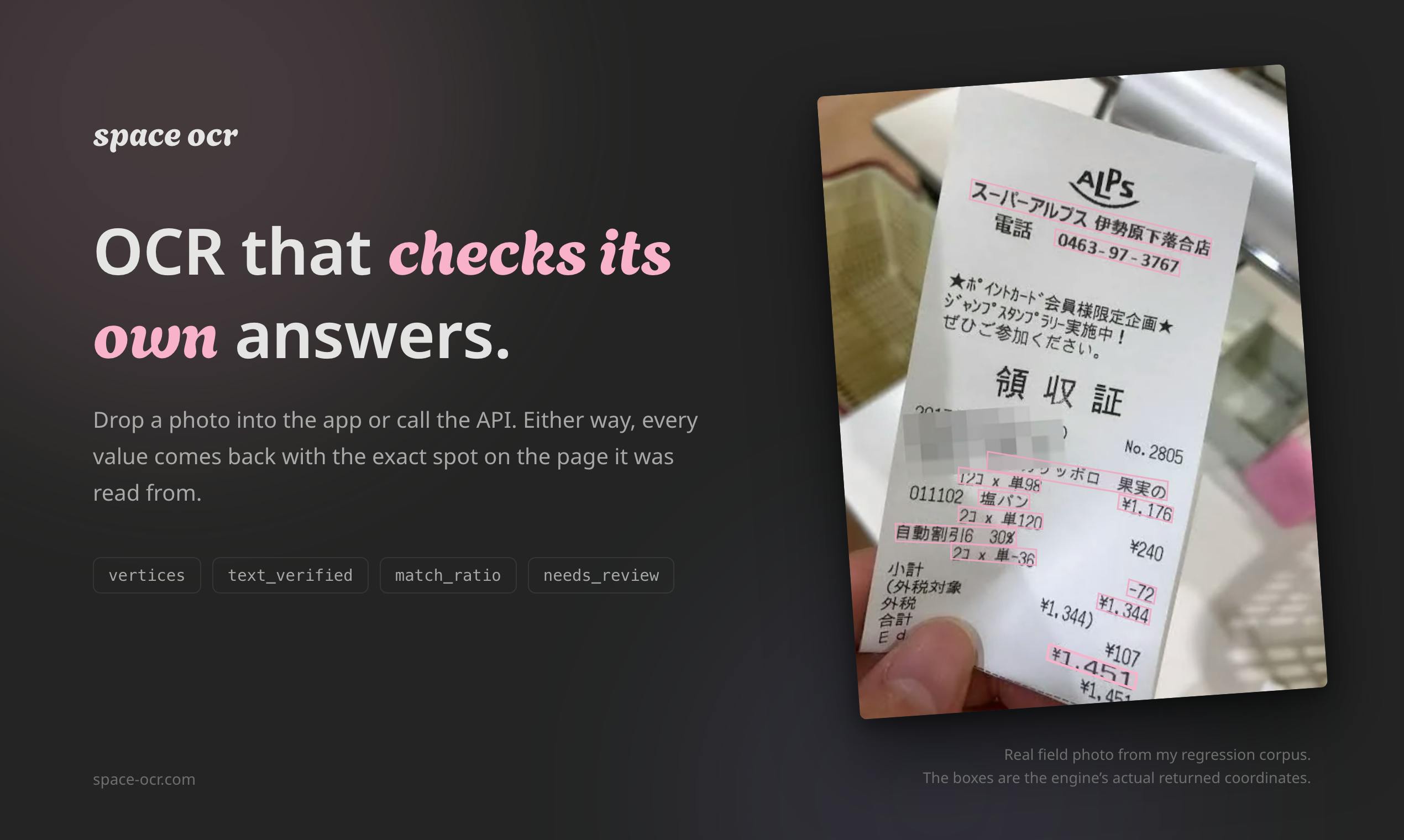
How Space OCR Converts Images into Queryable Structured Data
Space OCR's product logic isn't complicated, but its design philosophy deserves attention. Users can drag photos of receipts, invoices, and forms into folders within the app, or send them in bulk via API. The system then converts each document page into a row in a table, with fields automatically broken down into columns, allowing users to filter and sort the data as they would with a database.
Converting unstructured documents into structured data (Structured Data Extraction) is one of the core challenges in information retrieval and data engineering. Traditional approaches typically rely on predefined templates and regular expressions to match field positions, but this method is extremely sensitive to layout variations. Space OCR's "document as data row" abstraction is essentially a Schema-on-Read design philosophy — rather than presetting fixed templates, it dynamically infers document structure during reading and maps it to relational data. This approach aligns with modern data lake architecture principles, enabling downstream BI analytics, automation rule engines, and data pipelines to directly consume OCR output without additional ETL (Extract-Transform-Load) steps.
This "document as data row" abstraction is particularly friendly for batch document processing scenarios. Imagine a finance team that needs to process hundreds of expense receipts monthly, or an automated system that needs to extract amounts and dates from numerous supplier invoices — Space OCR directly maps originally fragmented image information into queryable, analyzable structured tables.
Data Provenance: Every Extracted Value Can Be Traced to Its Source
What truly distinguishes Space OCR from ordinary OCR services is its traceability capability. The product explicitly states: "Every value shows where it came from."
This means that when the system identifies "Total Amount: ¥1,280," users can directly trace back to the exact location of that number in the original image. The value of this design lies in establishing a chain of trust — it transforms OCR from a "black box" into an auditable tool.
Data Provenance/Lineage is a core concept in data governance, referring to tracking the complete path of every data value from generation through transformation to final use. In financial regulation (such as the SOX Act, Basel Accords) and audit practice, any data entering financial systems needs a verifiable "Audit Trail" — proof of data source authenticity and integrity. Traditional OCR, as a black box tool, lacks traceability in its output, and auditors often need to manually cross-reference original documents, which is virtually impossible at scale. By binding extracted values to specific coordinate regions in the original image, Space OCR essentially constructs a complete evidence chain from pixels to data, which is crucial for meeting compliance requirements and building system trust.
In finance, legal, audit, and other fields with extremely high accuracy requirements, this traceability is often the watershed that determines whether a product gets adopted.
The Technical Logic Behind OCR Self-Verification
Space OCR's most compelling selling point is its self-verification mechanism. While the product page doesn't disclose full technical details, based on its positioning, we can infer that this mechanism likely leverages large language model reasoning capabilities to cross-validate recognized fields — for example, checking whether line item amounts in an invoice sum to the total, whether date formats are reasonable, and whether tax rate calculations are consistent.
The technical foundation of the self-verification mechanism involves multiple layers. First, there's rule-based logical validation, such as numerical sum verification and format consistency checks — these methods have a long history but limited coverage. More noteworthy is semantic-level verification based on Large Language Models (LLMs): LLMs possess the ability to understand document context and can judge whether "a dining receipt amount is reasonable" or "whether a supplier name matches its tax ID" — verification tasks that require commonsense reasoning. This approach essentially uses the LLM as a "Second Reader," similar to the double-blind reading system in medical imaging diagnosis. Additionally, multimodal models (such as GPT-4V, Claude's vision capabilities) can directly cross-reference original images for pixel-level verification, forming a dual-assurance architecture of "OCR engine recognition + multimodal model review." This paradigm shift from single-pass inference to multi-step verification is a concrete manifestation of AI Agent thinking in document processing.
This reflects an important evolutionary direction in the current OCR field: from "recognition" to "understanding and verification." Traditional OCR only converts pixels to text, while the new generation of intelligent document processing tools attempts to understand a document's semantic structure and proactively discover and flag potential errors. This transformation from passive output to active quality inspection is the core competitive advantage of document processing tools in the AI era.
The Product Strategy of Dual Desktop App and API Formats
Space OCR simultaneously offers both a desktop application and an API interface, representing an ambitious product positioning.
For regular users and small teams, the drag-and-drop interface lowers the barrier to entry, requiring no technical background to get started; for developers and enterprises, the API provides the flexibility to embed document processing capabilities into existing workflows. This "consumer-facing + developer-facing" dual-track strategy covers both long-tail individual users and B2B clients with integration needs.
The parallel desktop app and API architecture reflects an important trend in the current developer tools market: PLG (Product-Led Growth) and API-First are not contradictory. The desktop app serves the role of user acquisition and value validation — users can experience core functionality without writing code, quickly forming an understanding of the product's capabilities; while the API is the key channel for scaled monetization, with enterprise clients integrating OCR capabilities into ERP, RPA (Robotic Process Automation), financial systems, and other existing workflows, with usage naturally expanding as business grows.
Additionally, the product offers 100 free pages per month. This free tier threshold is quite pragmatic — enough for individual users and small teams to try the product and form usage habits, while leaving room for paid conversion. This design follows the classic Freemium model logic: sufficient to trigger the "Aha Moment" but insufficient to meet ongoing production needs, naturally driving paid conversion. Successful API companies like Stripe and Twilio have employed similar strategies. For developers, the free tier also lowers the cost of integrating the API during the prototyping phase.
Industry Signals in the Intelligent Document Processing Space
Space OCR's emergence is not an isolated case but rather a microcosm of the heating up of the intelligent document processing track. As multimodal large model capabilities mature, an increasing number of startup products are positioning "accuracy" and "trustworthiness" as core selling points, rather than simply competing on recognition speed or number of supported languages.
Intelligent Document Processing (IDP) has been listed by analysts like Gartner as a high-priority area for enterprise AI applications, with market size expected to exceed $5 billion by 2027. Major players in this space include traditional vendors like ABBYY and Kofax, emerging startups like Hyperscience, Rossum, and Sensible, as well as rapidly iterating cloud vendor solutions like AWS Textract, Google Document AI, and Azure Form Recognizer. The rise of multimodal large models is reshaping the technological foundation of this space: layout variations that previously required extensive labeled data and custom models can now be handled through zero-shot or few-shot prompting. The competitive focus has shifted from "can it recognize" to "are recognition results trustworthy, explainable, and integrable into enterprise workflows." Space OCR's choice of "self-verification" and "data provenance" as differentiation points precisely targets the market's upgrade demand from "functional" to "trustworthy."
From a broader perspective, these tools are redefining the standard for "document digitization": in the past, we were satisfied with "being able to convert images to text," but now the expectation is "the extracted data is accurate, queryable, traceable, and the system proactively tells you where errors might exist." For any enterprise that relies on large volumes of documents and forms flowing through processes, such tools represent tangible efficiency gains and risk reduction.
Of course, as a newly launched product, Space OCR still needs to prove itself in the market regarding recognition precision, complex layout support, and multilingual capabilities. But the "self-verification" philosophy it represents undoubtedly points toward a more promising future for OCR technology.
Key Takeaways
Related articles

Apple HomeView Hands-On Review: Is the $300 Smart Home Hub Worth It?
Apple HomeView hands-on: a $300 smart home hub with facial recognition for quick account switching, but no App Store or voice recognition. Is the wall-mounted version worth it? Should you buy the first generation?

Meta Muse Wonder Launch: What It Means for Meta's Return to the Frontier AI Race
Meta releases Muse Wonder and WonderFull, benchmarks reach the frontier, community feedback is polarized. An in-depth look at Meta's return to the frontier AI race, its personal agent strategy, and Zuckerberg's different path.

Apple Home Smart Home Lineup Leaked: LG and Schneider Team Up, UWB Door Lock on Board
Apple Home ecosystem gains new LG and Schneider devices: UWB smart lock with proximity unlock, 2.5K dual-camera doorbell, privacy indoor camera, and AirPods-like seamless pairing.